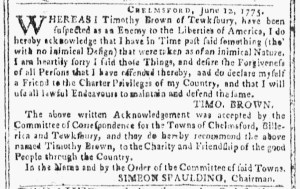
What was advertised in a revolutionary American newspaper 250 years ago today?
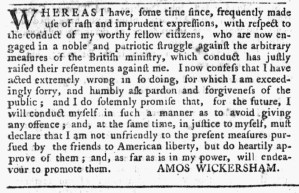
“I am not unfriendly to the present measures pursued by the friends to American liberty, but do heartily approve of them.”
Amos Wickersham had to do something to remedy the error he made. He hoped that placing a newspaper advertisement to apologize and pledging to do better would help return him to the good graces of his community. In a notice in the July 15, 1775, edition of the Pennsylvania Evening Post, he acknowledged that he had “frequently made use of rash and imprudent expressions, with respect to the conduct of my worthy fellow citizens, who are now engaged in a noble and patriotic struggle against the arbitrary measures of the British ministry.” He did so three months after the battles at Lexington and Concord. Since then, supporters of the American cause from Massachusetts and other colonies in New England had laid siege to Boston and Joseph Warren, one of their leaders, had been killed at the Battle of Bunker Hill. The Second Continental Congress had convened in Philadelphia and appointed George Washington of Virginia as commander of the Continental Army. As news of these events spread, provincial congresses met to determine how their colonies should respond to the outbreak of war.
Facing these new developments, Wickersham tried to distance himself from his previous comments, stating that he made them “some time since,” yet also admitted that the conduct “of the British ministry … has justly raised [the] resentments” of his “worthy fellow citizens” against him. He may have had a sincere change of heart … or he may have found his circumstances untenable as emotions became more enflamed. Either way, he wanted the public to know that he had “acted extremely wrong in so doing, for which I am exceedingly sorry, and humbly ask pardon and forgiveness.” That was a good start, but perhaps not sufficient. Wickersham continued, “I do solemnly promise that, for the future, I will conduct myself in such a manner as to avoid giving any offence; and, at the same time, in justice to myself, must declare that I am not unfriendly to the present measures pursued by the friends to American liberty, but do heartily approve of them; and, as far as is in my power, will endeavour to promote them.”
Wickersham’s advertisement resembled some that previously appeared in newspapers published in Massachusetts. For the past year, men who signed an address to Governor Thomas Hutchinson when he departed the colony had been placing advertisements to recant, apologize, and assure others that they were friendly to the American cause. More recently, others resorted to newspaper advertisements to acknowledge other kinds of words or deeds that raised suspicion about their political principles in their efforts to return to good standing in their communities. Wickersham placed one of the first advertisements of this sort outside of New England. Like his counterparts, he paid for space in the public prints to disseminate his confession and support for “the present measures pursued by the friends to American liberty.” Wickersham apparently considered it a good investment if it restored his position and reputation among his neighbors and associates.