What was advertised in a revolutionary American newspaper 250 years ago today?
Pennsylvania Gazette (February 21, 1776).
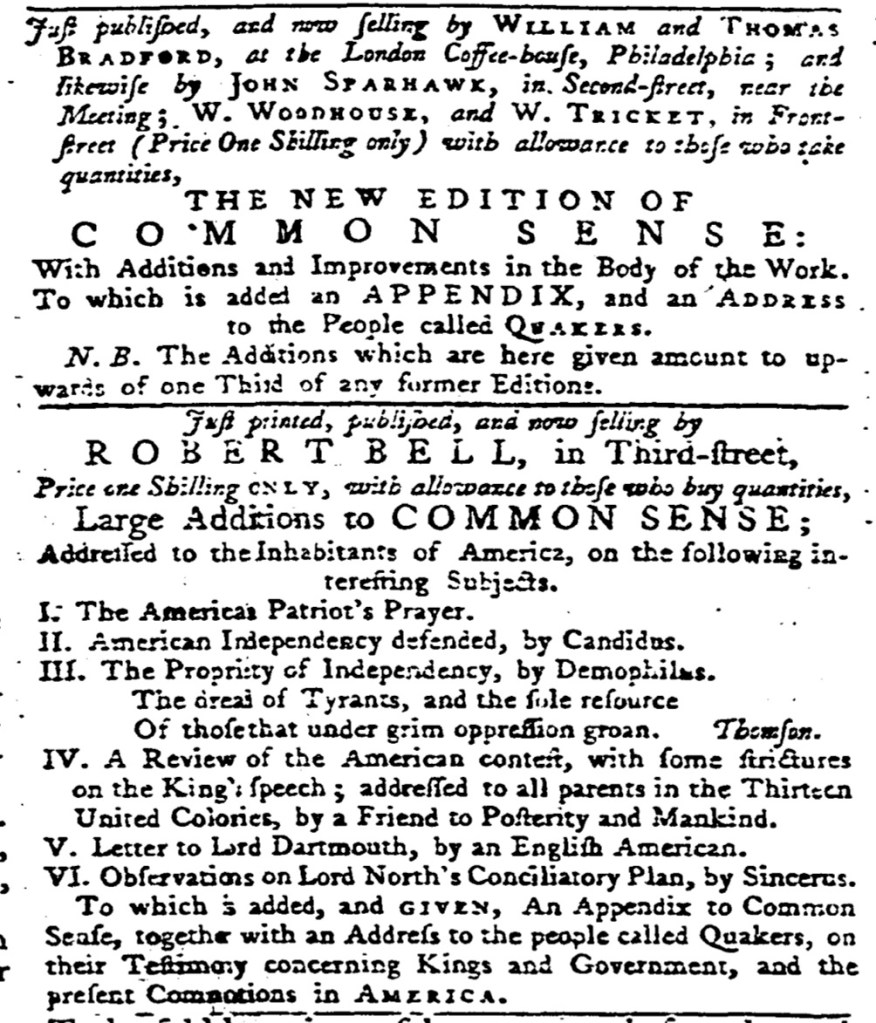
“THE NEW EDITION OF COMMON SENSE.”
“Large Additions to COMMON SENSE.”
Although Benjamin Towne most frequently published advertisements for Thomas Paine’s Common Sense in his Pennsylvania Evening Post, he was not the only printer in Philadelphia to generate revenue from advertisements for competing editions of the pamphlet. Other newspapers also carried advertisements for Common Sense. After Paine and Robert Bell, the publisher of the first edition, had a falling out, Bell went forward with an unauthorized second edition and Paine worked with William Bradford and Thomas Bradford, the printers of the Pennsylvania Journal, on an expanded edition that featured new material. Not to be outdone, Bell advertised, published, and sold other supplementary material that he billed as “Large Additions to COMMON SENSE,” though Paine was not the author of those pieces that Bell instead reprinted from newspapers. Bell and Paine and then Bell and the Bradfords engaged in bitter exchanges in their advertisements in the Pennsylvania Evening Post.
They also placed more subdued notices in other newspapers. In the February 21, 1776, edition of the Pennsylvania Gazette, for instance, their advertisements ran one after the other. In the first, the Bradfords announced that they “Just published … THE NEW EDITION OF COMMON SENSE: With Additions and Improvements in the Body of the Work.” To entice readers to select their pamphlet, they added a nota bene that stated that the “Additions … amount to upwards of one Third of any former Editions.” Customers could acquire this new edition from the Bradfords “at the London Coffee-house” and from associates in the book trades, including John Sparhawk, William Trickett, and William Woodhouse. Immediately below that advertisement, Bell hawked his “Large Additions.” He listed the contents, just as he had done in his first advertisements for the first edition of Common Sense. He also declared that he added Paine’s “Address to the people called Quakers,” pirated from the Bradfords’ new edition. Like Towne, the printers of the Pennsylvania Gazette, William Hall, David Hall, and William Sellers, did not need to sell a single copy of the pamphlet to generate revenue from it. They made their money on Common Sense from the competing advertisements placed by Bell and the Bradfords!
What was advertised in a revolutionary American newspaper 250 years ago today?
Pennsylvania Evening Post (February 20, 1776).
“Pieces taken out of News papers, and not written by the Author of COMMON SENSE.”
The final page of the Pennsylvania Evening Post was once again ground zero for the dispute between Robert Bell, the publisher of the first edition of Thomas Paine’s Common Sense and subsequent unauthorized editions, and William Bradford and Thomas Bradford, the printers of the Pennsylvania Journal entrusted by Paine to publish a “NEW EDITION … With ADDITIONS and IMPROVEMENTS in the BODY of the WORK.” Paine previously participated in the dispute, but he seemingly withdrew in favor of letting the printers duke it out in the public prints.
The Bradfords’ expanded edition had been in the press for a few weeks, but on February 14, 1776, they announced in their own newspaper that “THIS DAY WILL BE PUBLISHED AND SOLD … THE NEW EDITION OF COMMON SENSE.” The following day, they ran a new advertisement in the Pennsylvania Evening Post and then updated it on February 20. To make that edition more appealing than any of the editions published by Bell, the Bradfords proclaimed, “The Additions which are here given, amount to upwards of one Third of any former Edition.” They also acknowledged that Bell had been advertising “ADDITION to COMMON SENSE,” but they alerted readers that Bell was trying to pull a fast one. The “ADDITIONS” that Bell marketed “consist of Pieces taken out of News Papers, and not written by the Author of COMMON SENSE.” Paine had worked exclusively with the Bradfords on the “ADDITIONS and IMPROVEMENTS.” The Bradfords also listed several booksellers who stocked their new edition. Benjamin Towne, the printer of the Pennsylvania Evening Post, was not among them, but he certainly generated revenue from publishing the advertisements that the Bradfords and Bell submitted to his printing office.
Right next to the Bradfords’ advertisement, as had been the case on other occasions, appeared Bell’s advertisement for “Large ADDITIONS to COMMON SENSE.” Those “ADDITIONS” included “the following interesting subjects,” “American Independency defended by Candidus,” and “The Propriety of Independancy, by Demophilus,” and “Observations on Lord North’s Conciliatory Plan, by Sincerus.” This version of the advertisement added “The American Patriot’s Prayer,” left out of Bell’s previous notice, to entice prospective customers. Bell also pirated “AN APPENDIX TO COMMON SENSE, together with an ADDRESS to the people called QUAKERS, on their Testimony concerning Kings and Government.” Like the Bradfords, he charged “one shilling ONLY” and made “allowance to those who buy quantities.” In other words, the printers of Common Sense and related materials offered discounts to retailers who purchased in volume to sell the pamphlet in their own shops and others who bought multiple copies to distribute to friends, relatives, and associates. The contents of Paine’s political pamphlet made it popular, yet the advertisements in the Pennsylvania Evening Post and other newspapers also helped raise awareness of Common Sense.
What was advertised in a revolutionary American newspaper 250 years ago today?
Pennsylvania Evening Post (February 1, 1776).
“A Number of ANXIOUS FRIENDS, and all the MILITARY MEN who wanted MITTENS.”
The screed extended an entire column and overflowed into another in the February 1, 1776, edition of the Pennsylvania Evening Post. It continued the feud between Thomas Paine, the author of Common Sense, and Robert Bell, the publisher of the first edition who embarked on an unauthorized second edition. Two days earlier, advertisements for Bell’s second edition and a forthcoming edition that Paine collaborated with William Bradford and Thomas Bradford in publishing ran side by side in that newspaper. One included an address “To the PUBLIC” by Bell and the other featured a “declaration” by the author. Paine, who still remained anonymous given the radical contents of the pamphlet, concluded by stating, “This is all the notice that will ever be taken of [Bell] in future.”
For his part, Bell was not finished taking notice of Paine. He quickly submitted a response, addressed “TO MR. ANONYMOUS,” for publication among the advertisements that ran in the next issue of the Pennsylvania Evening Post. He mocked Paine because the “Feeble author” “took the field” and engaged in battle that he supposedly could not win against the “Provedore to the Sentimentalists,” as Bell often referred to himself in the subscription proposals he circulated and in his newspaper advertisements for book auctions. The publisher claimed that he had been “wantonly, and maliciously, dragged … into the unwished for field of public altercation,” yet he would defend his actions and his reputation. Bell attacked Paine’s claim that he wished to remain anonymous: “You say you wanted to remain unknown … but, in practice, yourself telling it in every beer-house, gives the direct LIE to the assertor of such falsehood.” Even though Paine’s name had not yet appeared in print, Bell alleged that the author had been bragging about writing Common Sense in taverns around town.
Bell also demeaned “boasted intentional generosity” of the “Would-be-Author” who had declared that he planned to use his share of the profits from the first edition, which he never received, to purchase mittens for the soldiers participating in the American invasion of Canada. Bell insinuated that Paine mentioned drew the “MILITARY MEN who wanted MITTENS” into the dispute as a means of currying favor with the public as he threatened “malevolent LAW SUITS … against one industrious Bookseller, who never asked or received any thing from the public without giving an equivalent.” In contrast to Paine’s manipulations of both his friends who acted as intermediaries and the public, Bell portrayed himself as an honest entrepreneur, “a poor individual who neither attempteth nor wisheth for more FRIENDS than the rectitude of his conduct in business, an in the affairs of society, shall both gain and retain.”
Taking another shot at Paine, Bell instructed him that “your taking the public field was bad, because there was no foundation for it, unless envy be allowed a good one.” Furthermore, his “management of the fight and precipitate flight was worse – and final exit (as you say) worse and worse.” The publisher scorned the way that author backed down, comparing his handling of the situation to a “rascally PUPPY, who, with open mouth, runs snarling at an honest manly DOG, whose notice is attracted by the yelpings of the ill-natured CUR.” Paine, the “PUPPY,” ran away with his tail between his legs once he was on the receiving end of “words of stern contempt.”
Much of the dispute revolved around the revenues generated by Common Sense (or, as “the assignees of the nameless author” discovered, a surprising lack of profits on the first edition). Yet the feud and the publication of multiple editions of Common Sense did produce revenues for Benjamin Towne, the printer of the Pennsylvania Evening Post. The competing advertisements comprised one-quarter of the content in the January 30 edition and Bell’s notice in response to Paine’s “declaration” occupied nearly as much space. With those advertisements, Towne did not need to sell a single copy of the pamphlet to turn a profit on its publication by other printers.
What was advertised in a revolutionary American newspaper 250 years ago today?
Pennsylvania Evening Post (January 30, 1776).
“The said gentlemen have not yet been able to settle with Robert Bell.”
The feud between the Thomas Paine, the author of Common Sense, and Robert Bell, the publisher of the first edition of Common Sense, intensified in the January 30, 1776, edition of the Pennsylvania Evening Post. Advertisements for Bell’s unauthorized “SECOND EDITION” and a “NEW EDITION” currently “In the press, and [to] be published as soon as possible” by William Bradford and Thomas Bradford dominated the final page of that newspaper. Variations of both advertisements appeared in the Pennsylvania Evening Post three days earlier, each of them stirring the pot and inspiring Bell and Paine to submit new material to Benjamin Towne, the printer of that newspaper, to incorporate into their advertisements.
The advertisement for the Bradfords’ edition still included an address “To the PUBLIC,” but it doubled in length with a “declaration” made by the author “for the sake of relieving the anxiety of his friends.” At this point, Paine remained anonymous, at least as far as associating his name with the political pamphlet in the public prints was concerned. He explained that his original plan for Common Sense had been to have it “printed in a series of newspapers,” but others, including Benjamin Rush, convinced him that was impractical and that even printers who supported the American cause would shy away from such radical content. Rush recommended Robert Bell, the noted bookseller as an alternative to the several printers who published newspapers in Philadelphia, acting as an intermediary between Paine and Bell. In this new “declaration,” Paine explained that “he knew nothing of Robert Bell, who was engaged to print it by a gentleman of this city,” referring to Rush but not naming him. Though Rush acted “from a well meaning motive,” his suggestion eventually embroiled Paine in “the unpleasant situation.”
Paine did not hesitate to name Bell, proclaiming that he “hath neither directly, nor indirectly, received, or is to receive, any profit or advantage from the edition printed by Robert Bell.” In the agreement negotiated by Rush, Paine paid for the expense of printing the pamphlet whether it sold or not. In addition, that “noisy man,” Bell, would receive “one half of the profits” if the pamphlet was a success. Paine estimated that amount should have been “upwards of thirty pounds.” Furthermore, the author did not intend to keep his half of the profits. Instead, “when news of our repulse at Quebec arrived in this city,” he committed his share “for the purpose of purchasing mittens for the troops ordered on that cold campaign.” An assault on Quebec City, part of the invasion of Canada undertaken by American forces, had failed on New Year’s Eve. The patriotic Paine wanted to send supplies, especially mittens, to the American soldiers who continued the siege of that city, but Bell did not turn over any money “into the hands of two gentlemen” that Paine designated as his intermediaries. Paine claimed that he had “Bell’s written promise” for that arrangement. Anyone who wished to do so could verify that by consulting with them since their “names are left at the bar of the London Coffee-house” for that purpose.
“The said gentlemen,” Paine continued, “have not yet been able to settle with Robert Bell according to the conditions of his written engagement.” In addition, when they examined his account of the expenses and sales, they did not consider it “equitable” according to that agreement. Paine warned that Bell had a week to make good on their agreement or else “he will be sued for the same.” He concluded by stating, “This is all the notice that will ever be taken of him in future.” Given the ferocity of the advertisements already published, readers may have doubted that.
The advertisement for the Bradfords’ edition featured far more new material than Bell’s advertisement. He added a few lines to the nota bene that ran in the previous edition of the Pennsylvania Evening Post, though he had been so anxious to publish his updated advertisement that he inserted it in the January 29 edition of Dunlap’s Pennsylvania Packetrather than waiting for it to appear in the Pennsylvania Evening Post on January 30. In Dunlap’s Pennsylvania Packet, Bell’s expanded advertisement ran next to the shorter version of the advertisement for the Bradfords’ edition of Common Sense, the one that included an address “TO THE PUBLIC” but not the additional “declaration” by the author.
Bell took the opportunity to demean the “NEW EDITION” the Bradfords were printing. He declared that “the public may be certain” that the “smallness of print and scantiness of paper” meant that it would be an inferior edition “when compared with Bell’s second edition.” Why would readers wait for the Bradfords’ edition “yet in the press” when Bell’s second edition was “out of the press” and available for sale? As a final insult, he trumpeted that comparing the Bradfords’ forthcoming edition to his own second edition was like the difference “in size and value” between a “British shilling” and a “British half-crown.” His second edition, Bell claimed, was the better value in so many ways. Even though Paine pledged that he had nothing more to say about Bell, that made it seem unlikely that the author and the publisher of the first edition would quietly discontinue their attacks in the public prints. In three short weeks since the first advertisement for Common Sense appeared in the Pennsylvania Evening Post, the controversy between Bell and Paine became its own commotion!
What was advertised in a revolutionary American newspaper 250 years ago today?
Pennsylvania Evening Post (January 27, 1776).
“An author, without a name, hath asserted absolute falsehoods.”
The dispute over publishing the second edition of Thomas Paine’s Common Sense continued in an advertisement in the January 27, 1776, edition of the Pennsylvania Evening Post. Robert Bell, the publisher of the first edition, and William Bradford and Thomas Bradford, the printers designated by Paine to publish a new edition with additional materials, ran competing advertisements on January 25. The Bradfords’ advertisement included a note that informed the public that the author had not authorized Bell to publish a second edition, yet the enterprising printer and bookseller moved forward with the project anyway. That advertisement ran once again on January 27.
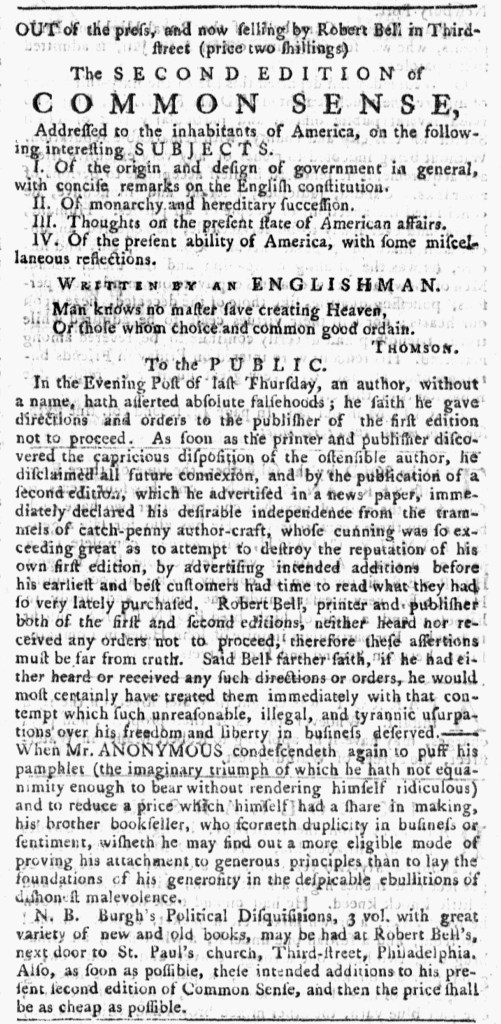
In response, Bell submitted a new advertisement to the printing office. An even more prominent headline proclaimed, “The SECOND EDITION of COMMON SENSE,” followed by a list of the four sections that appeared in the first edition. That overview had been part of most of Bell’s advertisements, as well as an epigraph from “Liberty,” a poem by James Thomson. In response to the address “To the PUBLIC” in the Bradfords’ advertisement, Bell added his own address “To the PUBLIC.” In it, he explained that in the previous edition of the Pennsylvania Evening Post, “an author, without a name, hath asserted absolute falsehoods.” At the time, Paine remained anonymous (and, for the first time, this advertisement described his political pamphlet as “WRITTEN BY AN ENGLISHMAN”). Bell objected to the claims that Paine made that “he gave directions and orders to the publisher of the first edition not to proceed.” For his part, Bell declared that “[a]s soon as the printer and publisher discovered the capricious disposition of the ostensible author, he disclaimed all future connexion,” perfectly content to break ties with Paine. Furthermore, “by the publication of a second edition which he advertised in a news paper, [Bell] immediately declared his desirable independence from the trammels of catch-penny author-craft, whose cunning was so exceeding great as to attempt to destroy the reputation of his own first edition, by advertising intended additions before his earliest and best customers had time to read what they had so very lately purchased.” That certainly was not a flattering portrait of Paine. The contents of Common Sense gave colonizers a lot to discuss. The dispute in the newspaper advertisements gave them even more.
Undaunted, Bell testified that he “neither heard nor received any orders not to proceed, there [the author’s] assertions must be far from truth.” In addition, Bell further dismissed Paine’s expectations for the publication of a second edition, stating that “if he had either heard or received any such directions or orders, he most certainly would have treated them immediately with that contempt which such unreasonable, illegal, and tyrannic usurpations over his freedom and liberty in business deserved.” Bell launched one more tirade: “When Mr. ANONYMOUS condescendeth again to puff his pamphlet … and to reduce a price which himself had a share in making, his brother bookseller, who scorneth duplicity in business or sentiment, wisheth he may find out a more eligible mode of proving his attachment to principles than to lay the foundations of his generosity in the despicable ebullitions of dishonest malevolence.” Bell was annoyed that Paine promoted the Bradfords’ edition as “one half of the price of the former edition,” a suggestion that Bell overcharged when, according to Bell, the author and the publisher set the price in consultation with each other. A lower price for the Bradfords’ edition was not truly “generosity,” especially when inspired by “despicable ebullitions of dishonest malevolence” rather than a desire to make the pamphlet more accessible to the public. Clearly, Paine’s address “To the PUBLIC” did not cause Bell to back down but instead to double down on printing and marketing his second edition of Common Sense.
What was advertised in a revolutionary American newspaper 250 years ago today?
Pennsylvania Evening Post (January 25, 1776).
“A new edition of COMMON SENSE … with large and interesting additions by the author.”
A battle over publishing Thomas Paine’s Common Sense played out in advertisements became apparent to the public when they perused the advertisements in the January 25, 1776, edition of the Pennsylvania Evening Post. Sixteen days earlier, that newspaper had been the first to carry an advertisement for the inflammatory political pamphlet. Robert Bell, the publisher, promoted it, while Paine remained anonymous. It sold so quickly that Bell began advertising “A NEW EDITION of COMMON SENSE” on January 20. Five days later, he ran an updated version of the original advertisement, using type already set. The compositor merely replaced the first line, removing the date (“Philadelphia, January 9, 1776”) and replacing it with a headline that proclaimed, “The second edition,” in a larger font.
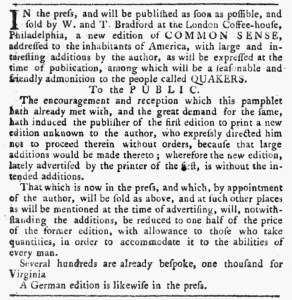
Yet Paine and Bell had had a falling out. Bell’s “second edition” was an unauthorized edition, as a new advertisement on the first page of the Pennsylvania Evening Post made clear. William Bradford and Thomas Bradford, printers of the Pennsylvania Journal, announced that they had a “new edition” of Common Sense “IN the press, and will be published as soon as possible.” Unlike Bell’s second edition advertised elsewhere in that issue, their new edition featured “large and interesting additions by the author, as will be expressed at the time of publication.” As a preview, the Bradfords indicated that the bonus materials included a “seasonable and friendly admonition to the people called QUAKERS.” To entice prospective customers to reserve copies or purchase them as soon as they were available, the Bradfords noted that “Several hundred are already bespoke,” including “one thousand for Virginia.” Advertisements for the pamphlet already appeared in newspapers in New York. The Bradfords made plans to distribute the pamphlet south of Philadelphia. In addition, they reported that a “German edition is likewise in the press” for the benefit of the many German settlers in Pennsylvania and the backcountry extending down to North Carolina.
This advertisement included an address “To the PUBLIC,” perhaps composed by Paine, that outlined the dispute between the author and the original publisher. “The encouragement and reception which this pamphlet hath already met with, and the great demand for the same,” the address declared, “hath induced the publisher of the first edition to print a new edition unknown to the author.” Paine had “expressly directed him not to proceed therein without orders, because that large additions would be made hereto.” He also did not appreciate that Bell had not managed to turn a profit on the first edition, though that did not receive mention in the address in the advertisement. Readers needed to be aware that Bell’s new edition, “lately advertised by the printer of the first [edition], is without the intended additions.” That being the case, readers who exercised a little patience for the Bradfords’ edition “now in the press” and authorized by the author could acquire both the contents of the original pamphlet and the additions in a single volume … and at a bargain price! Even with the new material, the cost “will … be reduced to one half of the price of the former edition.” Bell advertisements consistently listed “two shillings” for the pamphlet. The Bradfords charged one shilling. They also gave “allowance to those who take quantities” or a discount for purchasing in volume, either to retail or distribute to friends, family, and associates. That would “accommodate [the pamphlet] to the abilities of every man.” In other words, the lower price made it possible to disseminate Common Sense even more widely. When it came to airing grievances over the publication of Common Sense in newspaper advertisements, this address “To the PUBLIC” was only the opening salvo. The dispute continued in subsequent editions of the Pennsylvania Evening Post and other newspapers.
What was advertised in a colonial American newspaper 250 years ago this week?
Boston Chronicle (January 12, 1769).
“The sittings of the superior and inferior courts … may be depended on as correct.”
In January 1769, printers and booksellers throughout the colonies advertised almanacs for the new year, attempting to sell excess inventory rather than take a loss on surplus copies. In his efforts to incite demand for a second edition of “BICKERSTAFFs BOSTON ALMANACK,” John Mein emphasized the accuracy of its contents, especially the dates of the “sittings of the superior and inferior courts” in Massachusetts. In so doing, Mein implicitly referenced a dispute between other printers in Boston, William McAlpine on one side and T. and J. Fleet, Edes and Gill, and Richard Draper on the other. After McAlpine issued Nathaniel Ames’s Astronomical Diary, or, Almanack for the Year of our Lord Christ 1769 in the fall of 1768, a cabal of rival printers published a counterfeit edition of the popular almanac. To add insult to injury, they promoted the pirated copy by running advertisements that claimed “a counterfeit Ames’s Almanack has been printed not agreeable to the original copy” and implied that it contained “above Twenty Errors in the Sittings of the Courts.”
Mein did not weigh in on that controversy, but as one of the printers of the Boston Chronicle he almost certainly would have been aware of it. With so many competing titles, he took advantage of an opportunity to distinguish the almanac that he printed and sold at his bookstore on King Street. His advertisement in the January 12 edition of the Boston Chronicle did not comment on any of the contents except to declare the accuracy of the court dates. Mein did not highlight any of the entertaining features. He did not promote other useful information included in the almanac. Instead, he assured prospective customers that “The sittings of the superior and inferior courts of this province, inserted in this Almanack, may be depended on as correct; being obtained from a Gentlemen, one of the Clerks of the court.” Mein had done his due diligence in confirming the dates with a reputable source before taking the almanac to press. Furthermore, “The same care has been taken with the courts of the other provinces.” Prospective customers who might have business in Connecticut, New Hampshire, or Rhode Island could depend the accuracy of the dates in Bickerstaff’s Boston Almanack.
That Mein issued a second edition testified to the popularity of the almanac, yet he presented readers an additional reason for choosing it over others. Amidst the uncertainty of which edition of Ames’s Almanack contained accurate information, consumers could sidestep the confusion by purchasing Bickerstaff’s Boston Almanack instead. Its contents had been carefully compiled after consultation with officials who possessed the most accurate information about when the courts would conduct business in 1769.