September 12

What was advertised in a revolutionary American newspaper 250 years ago today?
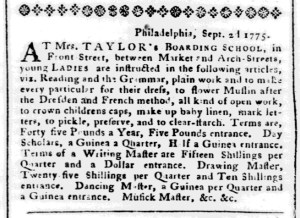
Dunlap’s Maryland Gazette (September 12, 1775).

“Mrs. TAYLOR’s BOARDING SCHOOL … [for] young LADIES.”

The first advertisement in the September 12, 1775, edition of Dunlap’s Maryland Gazette, published in Baltimore, promoted “Mrs. TAYLOR’s BOARDING SCHOOL” for “young LADIES” on Philadelphia, apparently an elite institution based on the tuition.  The headmistress charged forty-five pounds per year along with an initial entrance fee of five pounds.  Taylor advised the parents and guardians of prospective pupils that they would be taught “Reading and the Grammar, plain work and to make every particular for their dress, to flower Muslin after the Dresden and French method, all kind of open work, to crown childrens caps, make up baby linen, mark letters, to pickle, preserve, and to clear-starch.”  The standard curriculum combined practical skills that prepared young women to run a household with some leisure activities that testified to their status.

Yet that was not the extent of the instruction that took place at Taylor’s boarding school.  For additional fees, her charges could opt for additional lessons taught by tutors that Taylor hired.  Students learned to form their letters from a “Writing Master” for fifteen shillings each quarter.  They learned their steps from a “Dancing Master” for a guinea (or twenty-one shillings) each quarter.  Although Taylor did not say so, those students presumably learned to dance with grace rather than focusing exclusively on the mechanics of minuets and other popular dances.  Lessons from a “Drawing Master” cost twenty-five shillings per quarter.  Taylor also listed a “Musick Mater &c. &c.” but did not note their rates.  Repeating the common abbreviation for et cetera twice suggested that other tutors taught painting, French, and other genteel pursuits in addition to singing and playing instruments.  Taylor operated her boarding school in the largest and most cosmopolitan city in the colonies.  For pupils aspiring to gentility, she could arrange for access to all sorts of instructors, allowing her students and their families to choose which kinds of lessons they needed or desired in addition to the standard curriculum.  For the gentry in Baltimore, a port growing in size and importance on the eve of the American Revolution, Taylor’s boarding school for young ladies may have looked very attractive indeed.

August 24

What was advertised in a colonial American newspaper 250 years ago today?

Pennsylvania Journal (August 24, 1774).

“They neatly engrave: Shop Bills; Bills of Exchange; Bills of Lading.”

When John Norman, “ARCHITECT and LANDSCAPE-ENGRAVER, from London,” arrived in Philadelphia in May 1774, he introduced himself to prospective clients via an advertisement in the Pennsylvania Journal.  A few months later, he once again took to the pages of that publication, this time to announce that the partnership of Norman and Ward, “ENGRAVERS and DRAWING-MASTERS,” had opened a shop where they engraved a variety of items and sold “an assortment of Pictures and Frames … much cheaper than imported.”  In addition, they established “an Evening Drawing School” for teaching “that most noble and polite Art in all its various and useful Branches.”  Still a newcomer in the city, Norman devised multiple ways to earn his livelihood.

The various kinds of engraving that Norman and Ward proposed testified to the prevalence of advertising in early America, especially in urban ports.  They indicated that they could produce all sorts of items but could not list them all because they were “too tedious to mention in an Advertisement.”  Yet they named more than a dozen kinds of engraved items, leading their list with “Shop Bills.”  They likely meant both trade cards with an engraved image that filled the entire sheet and billheads that featured an engraved image at the top and blank space for recording purchases.  On occasion, merchants, shopkeepers, and artisans wrote receipts on the reverse side of trade cards.  Norman and Ward next named “Bills of Exchange; Bills of Lading; [and] Bills of Parcels.”  Those could have been simple printed blanks, but that would have defeated the purpose of ordering them from an engraver rather than acquiring those common business forms from printers who produced them in volume.  In this instance, the bills of exchange, bills of lading, and bills of parcels likely included engraved images, not solely text, that served as advertisements for the merchants who ordered them.  Later in the list, Norman and Ward considered “Devices for News-Papers” important enough to include rather than “too tedious to mention.”  Presumably they produced woodcuts in additional to copperplate engravings.  In addition to newspaper printers seeking images to adorn their mastheads and stock images for use elsewhere, the engravers offered their services to advertisers who desired unique images that represented their businesses exclusively.  Trade cards, billheads, and other advertising ephemera have not survived in the numbers that they were likely produced and circulated in early America, yet Norman and Ward’s advertisement suggests that they were part of everyday life as colonizers engaged in commerce and participated in consumer culture.