October 25

What was advertised in a colonial American newspaper 250 years ago today?

South-Carolina Gazette (October 25, 1773).

Let the Beer justify itself.”

As October 1773 came to a close, Edmund Egan promoted his “CAROLINA BEER” in the South-Carolina Gazette and the South-Carolina Gazette and Country Journal.  The prospects of this new product hitting the market excited the compositor for the South-Carolina Gazette enough to enclose the headline within a border of decorative type, distinguishing it from all other news and notices in the October 25 edition.  The headline did not receive the same treatment in the South-Carolina Gazette and Country Journal, though in both publications it had a prime spot at the top of the column in a section for “New Advertisements.”  Readers could hardly miss it.

To incite demand for the beer, Egan told a story about it.  He began by declaring that the “BREWERY … long laboured under many Disadvantages,” but Egan overcame them and the brewery “is now complete, and amply supplied with a Stock of the best MALT and HOPS.”  In so doing, the brewer crafted a narrative that only briefly focused on resilience in the face of adversity before extolling the factors that made his beer such a quality beverage.  Egan cited his own “unwearied Application” in launching the brewery as well as his experience and his “first Connection in London,” perhaps where he learned “the most regular Principles” of his craft.

South-Carolina Gazette and Country Journal (October 26, 1773).

All of that led Egan to assert that he would produce a “constant Supply of BEER and ALE … equal to any imported from any other Country.”  He also suggested that consumers should not take his word for it.  Instead, he proclaimed, “Let the Beer justify itself.”  That declaration appeared in italics in both the South-Carolina Gazette and the South-Carolina Gazette and Country Journal, suggesting that Egan did indeed instruct the compositors in both printing offices to give it some sort of special treatment to make it stand out from the copy in the rest of the notice.  The brewer did not need to say anything else about his “CAROLINA BEER.”  He could not say anything else that would be a better recommendation than consumers drinking his beer and ale and experiencing it for themselves.  “Let the Beer justify itself” simultaneously resonated as an affirmation, an invitation, and a challenge.  Egan was confident that customers would not be disappointed.
November 20

What was advertised in a colonial American newspaper 250 years ago today?

South-Carolina and American General Gazette (November 20, 1770).

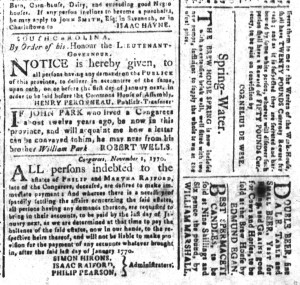
“DOUBLE BEER, fine ALE, TABLE and SMALL BEER.”

Robert Wells, the printer of the South-Carolina and American General Gazette, had too much news and advertising to include all of it in a standard four-page issue on November 20, 1770.  Like other printers who found themselves in that position, he distributed a supplement with the surplus content.  Both news and advertising appeared in the standard issue, but the supplement consisted entirely of advertisements.

Taking into account the number of advertisements that did not make it into the standard issue, Wells used a smaller sheet for the supplement.  That decision led to an unusual format for the supplement.  Each page of the standard issue featured four columns, but each page of the supplement had only three columns.  Two of those ran from top to bottom of the page, as usual, but Wells printed the final column perpendicular to the others.

Why such an awkward format?  It saved time while also maximizing the amount of content Wells could squeeze onto the page.  Most of the advertisements ran in previous issues.  The type had already been set.  Wells wished to use it again rather than investing time in resetting type to fit a page of a different size.  The smaller sheet allowed him to insert two columns of the usual width.  With the remaining space, he rotated the advertisements and formed columns that ran perpendicular to the others.  Wells managed to fit three of these perpendicular columns, but that left a small space at the bottom of the page.

Rather than waste that remaining space by leaving it blank, Wells finally opted to set type for a narrower column.  On one side of the page this permitted him to include two more short advertisements, one for beer and ale and the other for candles.  On the other side he inserted a notice from the Charleston Library Society calling on members to return books.  Engaging with these advertisements required active reading and further manipulation of the page by subscribers.

Wells was simultaneously ingenious and frugal in designing the format for the advertising supplement that accompanied the November 20 edition of the South-Carolina and American General Gazette.  His competitor, Charles Crouch, found himself in a similar position when it came to supplements for the South-Carolina Gazette and Country Journal, choosing to eliminate white space between columns in order to make the content fit the page without having to reset the type.  Publishing advertisements generated important revenues for newspaper printers, but they were not so lucrative to prevent printers from carefully managing the additional expenses of producing advertising supplements.