November 9

What was advertised in a colonial American newspaper 250 years ago today?
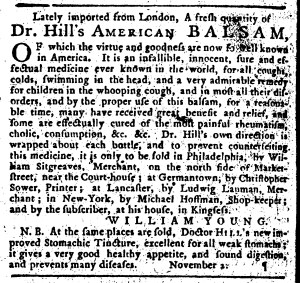
Pennsylvania Journal (November 9, 1774).

“Dr. Hill’s own direction is wrapped about each bottle.”

In the fall of 1774, William Young and his associates offered consumers exclusive access to “Dr. Hill’s AMERICAN BALSAM.”  According to an advertisement in the November 9 edition of the Pennsylvania Journal, this patent medicine “is an infallible, innocent, sure and effectual” cure for “coughs, colds, [and] swimming in the head” as well as a “very admirable remedy for children in the whooping cough, and in most all their disorders.”  Young implied that such recommendations may not have been necessary since the “virtue and goodness” of the medicine “are now so well known in America,” yet figured that trumpeting the efficacy of Dr. Hill’s American Balsam would aid in convincing consumers not yet familiar with this product.

As a means of guarding the reputation of this medicine and “to prevent counterfeiting,” a limited number of local agents stocked and sold this medicine.  Young made it available in Kingsess (or Kingsessing), just outside of Philadelphia.  William Sitgreaves, a merchant in Philadelphia, Christoper Sower, a printer in Germantown, and Ludwig Lauman, a merchant in Lancaster, each sold it as well.  Young also distributed Dr. Hill’s American Balsam to Michael Hoffman, a shopkeeper in New York, to sell there.  He had relied on that method for some time, having placed similar advertisement in May and October 1772.  Unlike some popular patent medicines widely stocked by apothecaries, merchants, shopkeepers, printers, booksellers, and other retailers throughout the colonies, only a select few carried Dr. Hill’s American Balsam.  The medicine came with “Dr. Hill’s own direction … wrapped about each bottle” to instruct patients how to use it to relieve or even cure “the most painful rheumatism, cholic, consumption,” and other maladies.  Such packaging represented another layer of marketing for this product, continuing to promote it to customers after they purchased it and took it home.

Young apparently considered these various strategies effective given that he invested in them on several occasions.  His marketing of Dr. Hill’s American Balsam incorporated the same elements in November 1774 that he deployed two and a half years earlier in May 1772.  That does not demonstrate the impact those methods had on consumers yet does suggest that Young considered them successful enough to repeat when he advertised once again.

September 16

What was advertised in a colonial American newspaper 250 years ago today?

Rivington’s New-York Gazetteer (September 16, 1773).

“EVERY ONE THEIR OWN PHYSICIAN, BY THE USE OF Dr. KEYSER’s PILLS.”

Dr. Keyser’s Pills may have been the most widely advertised patent medicine in colonial American newspapers.  Apothecaries included the remedy among the lists of patent medicines that they stocked, as did merchants and shopkeepers who did not specialize in drugs and medicines.  Printers also frequently advertised a variety of patent medicines, especially Dr. Keyser’s Pills, in their efforts to supplement revenues earned from job printing, newspaper subscriptions, advertising fees, and selling books and stationery.  In the summer of 1772, printers in Charleston, South Carolina, even engaged in a feud over which of them sold genuine Dr. Keyser’s Pills and accusing the other of peddling counterfeit medicines.

James Rivington, printer of Rivington’s New-York Gazetteer, managed to avoid such controversy in the fall of 1773, though he competed with Hugh Gaine, printer of the New-York Gazette and Weekly Mercury, in selling Dr. Keyser’s Pills.  Neither of them placed the kind of extensive notice, complete with descriptions of the symptoms that the medicine alleviated and testimonials to the effectiveness of the pills, that sometimes appeared in colonial newspapers.  Gaine did briefly note that he “has now by him many Proofs of their Utility in curing Inflamations, Rheumatism, [and] White Swellings,” an invitation to readers to examine testimonials on hand in his printing office.  For his part, Rivington deployed a headline that proclaimed “EVERY ONE THEIR OWN PHYSICIAN” when they used Dr. Keyser’s Pills to treat a “DISEASE, not to be mentioned in a News-Paper.”  Consumers knew that patients afflicted with venereal disease commonly turned to Dr. Keyser’s Pills, not just those who suffered from rheumatism (though Rivington did join Gaine in stating the pills “are also wonderfully efficacious” in alleviating those symptoms).  For prospective customers seeking to protect their privacy and avoid embarrassment by acting as “THEIR OWN PHYSICIAN,” Rivington asserted that Dr. Keyser’s Pills “infallibly cure” the unnamed disease “without the Knowledge of the most intimate Friend” (or perhaps even spouses or other partners).  Like other purveyors, Rivington sold the pills in boxes of different quantities so customers could select how many pills they thought they needed to treat themselves.

In the eighteenth century, Dr. Keyser’s Pills were as widely known to consumers as many over-the-counter brands are to customers today.  Accordingly, advertisers did not always need to publish lengthy advertisements to market the pills.  Instead, Rivington and others believed that short notices with bold proclamations, like “EVERY ONE THEIR OWN PHYSICIAN” effectively marketed the popular patent medicine.

October 17

What was advertised in a colonial American newspaper 250 years ago today?

Pennsylvania Chronicle (October 17, 1772).

“It is needless to mention a long list of peoples’ names … [and] what great benefit they have received by the proper use of this Balsam.”

Advertisements for patent medicines frequently appeared in newspapers throughout the colonies.  The Pennsylvania Chronicle carried them, including a notice promoting “Dr. HILL’s American Balsam” on October 17, 1772.  William Young provided a brief and enthusiastic overview of the remedy’s effectiveness, boldly proclaiming that “IT is known, by experiment, that this Balsam is one of the most excellent medicines ever before prepared since the creation of the world, for colds, coughs, consumptions, swimming in the head, rheumatism, pain, gravel, sore throat,” and many other ailments.

Young indicated that he could have produced testimonials, but he considered doing so unnecessary given the reputation of Dr. Hill’s American Balsam.  He reported that “great numbers of people in this and the neighbouring provinces” who had “made trial” of the medicine could confirm its efficacy, yet be believed it “needless to mention a long list of peoples’ names and their residences, who have earnestly desired it might be published for the good of their fellow-creatures.”  Instead, Young underscored “what great benefit they have received by the proper use of this Balsam, when all other medicines have been used in vain.”

That strategy differed from the one deployed by Nicholas Brooks in promoting Maredant’s Drops in the Pennsylvania Gazette earlier in the year.  Brooks published the names of several people “cured by Maredant’s drops” as well as detailed testimonials written by two satisfied customers.  In contrast, Young suggested that there were so many customers whose symptoms had been alleviated by Dr. Hill’s American Balsam that listing their names would have been superfluous.  Whether or not he could have published such a list seemed less important to him than asserting how many people supposedly encouraged him to do so.  That left it prospective customers to imagine for themselves how many patients benefited from the medicine.  In choosing not to publish any specifics, neither names nor testimonials, Young invited readers to envision even grander stories about the effectiveness of Dr. Hill’s American Balsam than he could have compiled in a newspaper advertisement.