November 9

What was advertised in a colonial American newspaper 250 years ago today?
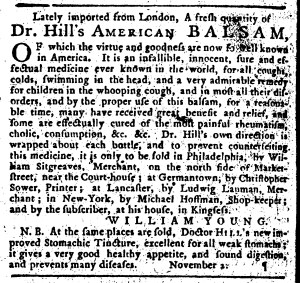
Pennsylvania Journal (November 9, 1774).

“Dr. Hill’s own direction is wrapped about each bottle.”

In the fall of 1774, William Young and his associates offered consumers exclusive access to “Dr. Hill’s AMERICAN BALSAM.”  According to an advertisement in the November 9 edition of the Pennsylvania Journal, this patent medicine “is an infallible, innocent, sure and effectual” cure for “coughs, colds, [and] swimming in the head” as well as a “very admirable remedy for children in the whooping cough, and in most all their disorders.”  Young implied that such recommendations may not have been necessary since the “virtue and goodness” of the medicine “are now so well known in America,” yet figured that trumpeting the efficacy of Dr. Hill’s American Balsam would aid in convincing consumers not yet familiar with this product.

As a means of guarding the reputation of this medicine and “to prevent counterfeiting,” a limited number of local agents stocked and sold this medicine.  Young made it available in Kingsess (or Kingsessing), just outside of Philadelphia.  William Sitgreaves, a merchant in Philadelphia, Christoper Sower, a printer in Germantown, and Ludwig Lauman, a merchant in Lancaster, each sold it as well.  Young also distributed Dr. Hill’s American Balsam to Michael Hoffman, a shopkeeper in New York, to sell there.  He had relied on that method for some time, having placed similar advertisement in May and October 1772.  Unlike some popular patent medicines widely stocked by apothecaries, merchants, shopkeepers, printers, booksellers, and other retailers throughout the colonies, only a select few carried Dr. Hill’s American Balsam.  The medicine came with “Dr. Hill’s own direction … wrapped about each bottle” to instruct patients how to use it to relieve or even cure “the most painful rheumatism, cholic, consumption,” and other maladies.  Such packaging represented another layer of marketing for this product, continuing to promote it to customers after they purchased it and took it home.

Young apparently considered these various strategies effective given that he invested in them on several occasions.  His marketing of Dr. Hill’s American Balsam incorporated the same elements in November 1774 that he deployed two and a half years earlier in May 1772.  That does not demonstrate the impact those methods had on consumers yet does suggest that Young considered them successful enough to repeat when he advertised once again.

October 17

What was advertised in a colonial American newspaper 250 years ago today?

Pennsylvania Chronicle (October 17, 1772).

“It is needless to mention a long list of peoples’ names … [and] what great benefit they have received by the proper use of this Balsam.”

Advertisements for patent medicines frequently appeared in newspapers throughout the colonies.  The Pennsylvania Chronicle carried them, including a notice promoting “Dr. HILL’s American Balsam” on October 17, 1772.  William Young provided a brief and enthusiastic overview of the remedy’s effectiveness, boldly proclaiming that “IT is known, by experiment, that this Balsam is one of the most excellent medicines ever before prepared since the creation of the world, for colds, coughs, consumptions, swimming in the head, rheumatism, pain, gravel, sore throat,” and many other ailments.

Young indicated that he could have produced testimonials, but he considered doing so unnecessary given the reputation of Dr. Hill’s American Balsam.  He reported that “great numbers of people in this and the neighbouring provinces” who had “made trial” of the medicine could confirm its efficacy, yet be believed it “needless to mention a long list of peoples’ names and their residences, who have earnestly desired it might be published for the good of their fellow-creatures.”  Instead, Young underscored “what great benefit they have received by the proper use of this Balsam, when all other medicines have been used in vain.”

That strategy differed from the one deployed by Nicholas Brooks in promoting Maredant’s Drops in the Pennsylvania Gazette earlier in the year.  Brooks published the names of several people “cured by Maredant’s drops” as well as detailed testimonials written by two satisfied customers.  In contrast, Young suggested that there were so many customers whose symptoms had been alleviated by Dr. Hill’s American Balsam that listing their names would have been superfluous.  Whether or not he could have published such a list seemed less important to him than asserting how many people supposedly encouraged him to do so.  That left it prospective customers to imagine for themselves how many patients benefited from the medicine.  In choosing not to publish any specifics, neither names nor testimonials, Young invited readers to envision even grander stories about the effectiveness of Dr. Hill’s American Balsam than he could have compiled in a newspaper advertisement.

May 17

What was advertised in a colonial American newspaper 250 years ago this week?

Pennsylvania Packet (May 14, 1772).

“Enquire only for Dr Hill’s American Balsam.”

Advertisements for patent medicines frequently appeared in early American newspapers.  In the spring of 1772, William Young took to the pages of the Pennsylvania Journal to promote “Dr. HILL’s AMERICAN BALSAM, LATELY imported from London.”  For those unfamiliar with this remedy, Young explained that “Experience has fully testified, that by the proper use of this excellent medicine, great numbers of people in America have been relieved in the consumption, gravel [or kidney stones] and rheumatic pains.”  In addition, it helped with colds, coughs, and “swimmings in the head.”

Many consumers may have been more familiar with popular patent medicines commonly sold by apothecaries, merchants, shopkeepers, and even printers and booksellers.  Newspaper advertisements suggest that colonizers could easily acquire Bateman’s Drops, Godfrey’s Cordial, Hooper’s Pills, Turlington’s Balsam, and a variety of other patent medicines in shops from New England to Georgia.  Hill’s American Balsam, in contrast, was not as readily available.  Instead, a small number of sellers in the colonies exclusively handled the distribution, including merchants in Baltimore, Philadelphia, and Wilmington, North Carolina; shopkeepers in New York and Lancaster, Pennsylvania; a printer in Germantown, Pennsylvania; and a goldsmith in Wilmington, Delaware.  Young proclaimed that consumers would find this patent medicine “no where else.”

Such exclusivity had the potential to lead to confusion or even counterfeits.  In a nota bene, Young warned that “People, in buying this so highly esteemed medicine, should be careful not to get a wrong one and be deceived.”  To prevent that from happening, he gave instructions “to enquire only for Dr. Hill’s American Balsam.”  Consumers could confirm that they obtained the correct product by looking for Hill’s “direction wraped about each bottle.”  Printed materials played an important role in marketing this patent medicine, via the advertisements that appeared in the Pennsylvania Journal and via the ancillary materials that accompanied each bottle of Dr. Hill’s American Balsam.

August 21

What was advertised in a colonial American newspaper 250 years ago this week?

Pennsylvania Chronicle (August 19, 1771).

“He hath to sell also, his Royal Balsam, which is made of American produce.”

Two advertisements for patent medicines appeared among the notices in the August 21, 1771, edition of the Pennsylvania Chronicle.  In an extensive advertisement that filled an entire column and overflowed into another, William Young promoted “Dr. HILL’S AMERICAN BALSAM.”  Further down that second column, George Weed hawked his own “Royal Balsam” as well as several other nostrums that he compounded to cure “the bloody flux,” coughs, and other maladies.  Weed’s advertisement was much shorter, but the apothecary indicated that he had the capacity to publish a notice just as lengthy as the one inserted by Young.  “He hath by him,” Weed proclaimed, “a considerable number of certificates of extraordinary cures by [his medicines], which he designs to publish in a short time.”  In other words, Weed claimed to have testimonials from actual patients to disseminate among the public.

While Weed supplied a variety of powders, syrups, and tinctures, Young devoted his entire advertisement to the American Balsam.  This remedy bore that name because a physician in London produced it from “American plants, sent to England by that ingenious gentleman Mr. William Young, of Pennsylvania, Botanist to their Majesties the King and Queen of Great-Britain.”  That botanist was the son of the advertiser, whom Hill “appointed the only capital vender of [his medicine] in all America” out of gratitude “to the young gentleman.”  Hill did allow that Young could appoint “whom he pleases under him” to sell the American Balsam.  The elder Young had an exclusive franchise, but appointed local agents in Philadelphia, Germantown, Lancaster, and Wilmington.

Weed divided his advertisement into two portions.  In the first half, he proclaimed that the American Balsam, an imported medicine, “is now so well known in Pennsylvania, Maryland, &c. &c. there is no need of any further recommendation” and then described its effective use among patients in great detail anyway.  The second half consisted of a letter from Hill in which the doctor described the afflictions the medicine cured, outlined the history of its creation and refinement, and endorsed Young as his American purveyor.  Weed did not resort to such a preponderance of prose for his Royal Balsam, produced locally, or invest nearly as much in placing his much shorter advertisement, though the “certificates of extraordinary cures” that he suggested he would soon publish likely rivaled Young’s advertisement in length.  Although  they chose different marketing strategies, Weed and Young both apparently considered their methods worth the expense of placing notices in the Pennsylvania Chronicle.