February 17

GUEST CURATOR:  Elizabeth Curley

What was advertised in a colonial newspaper 250 years ago today?

Feb 17 - 2:17:1766 Boston Gazette
Supplement to the Boston-Gazette (February 17, 1766).

“A fresh Assortment of Garden Seeds … warranted to be good.”

As a female millennial who is interested in women’s rights and equality, seeing a woman merchant who posted in a newspaper made me very excited! Lydia Dyar sold “A fresh assortment ” of seeds of all types, from spices and herbs to vegetables. She listed quite a collection of different types of seeds and goes on to say that she has even more. The seeds came from London and had been recently brought in on “the lasts Ships, and Captain Freeman.” Even though the seeds came from London, they had probably been collected from all over England’s other colonies, from the Caribbean to India to trading posts in Africa.
Feb 17 - British Empire 1763
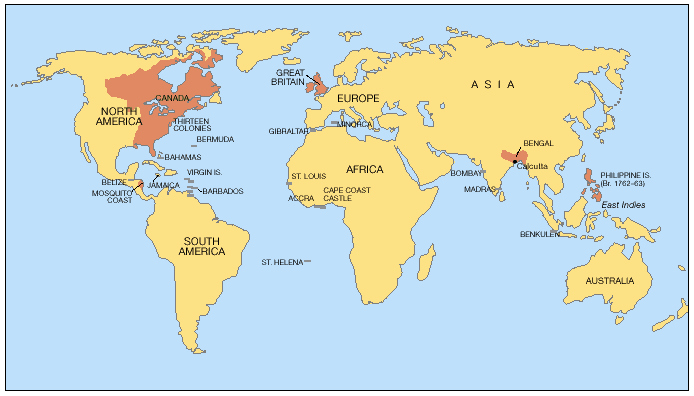
Britain’s global empire in 1763, a result of commercial enterprise and military conquest.

With it being February and winter being somewhat close to over, the early American colonists would be starting to think and prepare for spring. Spring meant that the growing season was going to start and seeds would be a necessity.   Many early American colonists grew much of what they ate rather than always trading or purchasing food. They had no 24-hour CVS or Super Walmart. Lydia Dyar also “warranted to be good” which would be a sort of warrantee that the seeds would yield the appropriate amount of fruit.

**********

ADDITIONAL COMMENTARY:  Carl Robert Keyes

When she first selected this advertisement, Elizabeth asked if it was out of the ordinary for women to participate in the eighteenth-century marketplace as retailers, wholesalers, suppliers, or producers rather than as consumers. I explained that women filled those roles more often than everyday assumptions about early America might suggest. In urban ports like Boston, New York, and Philadelphia as many as one-fifth to one-third of shopkeepers were women.

On the other hand, women did not tend to place advertisements in proportion to their numbers. It would not quite be correct to state that advertisements placed by women were uncommon, but on the whole women tended to be less likely to promote their businesses in the public prints than men.

Given her desire to feature advertisements by women, Elizabeth had three choices in the four-page Boston-Gazette and its two-page Supplement, both issued on February 17, 1766. Lydia Dyar’s advertisement appeared on the second page of the supplement. Shopkeeper Jane Eustis advertised an extensive assortment of textiles on the third page of the regular issue.
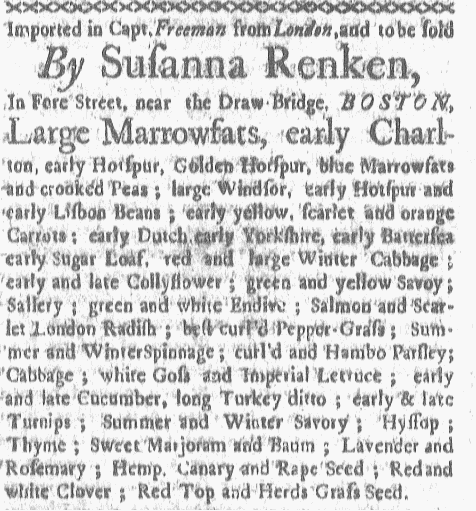
Feb 17 - 2:17:1766 Boston-Gazette - Renkin
Boston-Gazette (February 17, 1766).

And Susanna Renken, a competitor to Lydia Dyar, inserted this advertisement on the final page of the regular issue. Notice that both women sell many of the same seeds. Both indicate that they had been supplied by Captain Freeman. In the absence of an existing personal or commercial relationship with one seed seller or the other, how might a colonial consumer have decided which to visit?

Convenience based on location might have been a deciding factor. However, Dyar made appeals to potential customers that Renken did not: “warranted to be good, and of last Year’s Growth, sold at the lowest Terms.” Renken announced that she had seeds for sale, but Dyar put extra effort into marketing her wares. Perhaps Renken ended up regretting that the Boston-Gazette published a supplement – including Dyar’s advertisement – that week instead of holding her competitor’s advertisement until publishing a new full issue the following week.


February 16

GUEST CURATOR:  Elizabeth Curley

Who was the subject of an advertisement in a colonial newspaper 250 years ago this week?

Feb 16 - 2:14:1766 New-Hampshire Gazette
New-Hampshire Gazette (February 14, 1766).

“TO BE SOLD … A NEGRO LAD, about Seventeen Years of Age.”

As we know from the previous week’s advertisements, even the northern colonies embraced the slave trade. This advertisement has no information about the owner, only that if interested readers should inquire of the printer for more information. We do know that the boy is being sold for lumber or on “short credit.”

At about seventeen the boy had been owned by the advertiser for four years. He could “speak good English.” However, the advertisement goes on that he was not being bought for his “BEAUTY or GOOD QUALITIES.” He would have made a good worker or “labouring Servant.” This means that he would have probably worked outside, perhaps on docks or a farm or assisting with carpentry or masonry. If he had been pretty he could have been placed as a house servant, which might have included duties such as footman, general house staff, and, if the family was wealthy enough, a coach or stable man.

The comment about his looks and beauty go beyond what type of work he would be doing though. Those comments point to the view that his owner and many others had.   They believed that African Americans were inferior and had only bad intentions. However much this makes me upset as a human being, this is an advertisement that needs to be brought up for the discussion that will follow. Many people believe that racism is not as relevant or present today, and, though African Americans thankfully are not property any more, as a nation we have a long way to go until we as a people are united in equality.

**********

ADDITIONAL COMMENTARY:  Carl Robert Keyes

As historians have worked since the era of the modern civil rights movement to better incorporate race, class, and gender into our narratives and interpretations of the American past, some critics (both within and, especially, beyond the academy) have accused us of so-called revisionism. Most historians agree that acknowledging our complicated past tells a richer and fuller story. Furthermore, it is a patriotic endeavor in that it challenges us as a nation to recognize when we have fallen short of the rhetoric of the Revolution so we can strive to do better. But in order to do better, we must be fully aware of both current events and the actions, attitudes, and ideas that have produced and shaped those current events over decades and centuries.

Yet there are other reasons to tell a story of the past that includes as many perspectives as possible. Earlier this semester, Elizabeth and her peers in our Public History course read this passage:

“Students’ lack of historical knowledge about the past results in an inability to see themselves, their families, and their communities as part of the larger process of American history. If students fail to see their own histories as important, they do not believe that they can have an impact on their environments. One of the ways in which people ‘learn to be members of society’ is to feel engaged in it. History is central to identifying, analyzing, and interpreting the values upon which civil society depends. All historians should remember that they are citizens as well as scholars and that they possess some responsibility to the larger civic community.”[1]

Many critics of so-called revisionism yearn for historical narratives they consider patriotic. They envision history as a means of inculcating civics in students. Although I disagree with the shape of the narrative many critics wish to impose, I wholeheartedly agree that civic participation is one of the most important purposes of studying the past. As the passage above argues, we need history with as much breadth and depth as possible in order to empower ALL Americans to engage in thoughtful citizenship and compassionate service to their communities.

The advertisement Elizabeth selected for today is important in its own right for what it tells us about the history of slavery in America and the depictions of Africans and African Americans in colonial New England. There is so much more to say about an advertisement that denigrates a seventeen-year-old boy for a supposed lack of both “BEAUTY or GOOD QUALITIES,” but I appreciate that Elizabeth has challenged us also to think about why it is important that we analyze this kind of advertisement and include it in our historical narrative.

**********

[1] Patricia Mooney-Melvin, “Professional Historians and the Challenge of Redefinition,” in Public History: Essays from the Field, rev. ed., ed. James B. Gardner and Peter S. LaPaglia, (Malabar, FL: Krieger Publishing Company, 2006), 17.

February 15

GUEST CURATOR:  Elizabeth Curley

What was advertised in a colonial newspaper 250 years ago today?

Feb 15 - 2:14:1766 New-London Gazette
New-London Gazette (February 14, 1766).

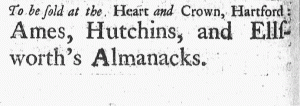
“Ames’s Almanacks for the Present Year, to be Sold by T. Green.”

An almanac is “an annual publication containing a calendar for the coming year, the times of such events and phenomena as anniversaries, sunrises and sunsets, phases of the moon, tides, etc., and other statistical information and related topics.” In today’s society we do not see an almanac in everyone’s back pocket and purse; however back in the 1700s they were a lot more popular.

Here in the New-London Gazette, T. Green is advertising Ames’s Almanack for the “present year” which was 1766. Nathaniel Ames is considered to be the first person to publish an almanac in colonial America. The first annual publishing was done in 1725 and was published in Bridgewater, Massachusetts, until he moved to the South Shore later in his life. Ames’s Almanack was for many yeas considered the greatest with it publishing more then 60,000 copies. That’s quite a large number of copies for a colonial work. He started an industry that would spawn the likes of Poor Richard’s Almanack (Ben Franklin, 1733, Pennsylvania) and Rhode-Island Almanack (James Franklin, 1727, Rhode Island)

Almanacs were a major part of day-to-day life for people during the colonial time. They helped “everyday” people such as farmers, shopkeepers, and black/silversmiths know a little about each day. They would include astrological information, some details of the previous years weather, tide flow charts, copies of poems and stories, and historical essays. They also promoted reading throughout the countryside, and commerce for people such as T. Green. One family could purchase an almanac annually and it would give them access to literary works and a variety of useful information.

**********

ADDITIONAL COMMENTARY:  Carl Robert Keyes

Elizabeth is correct when she notes the ubiquity of almanacs in colonial America. They were cheap print. These small, inexpensive pocket references could be found in households from the grandest to the most humble and were published locally in large numbers from an early date.

Oct 25 - 10:25:1765 New-London Gazette
New-London Gazette (October 25, 1765).

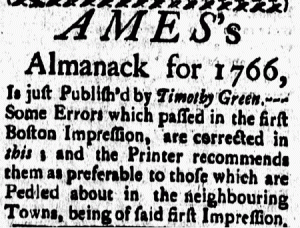
This is not the first time that an advertisement for Ames’s Almanack in the New-London Gazette has been featured by the Adverts 250 Project. In fact, it was the second advertisement I selected when this project was still confined to #Adverts250 on Twitter. This earlier advertisement demonstrates how far in advance almanacs were printed. By the end of October, Timothy Green advertised that his imprint of the almanac did not include “Some Errors which passed in the first Boston Impression” and marketed the version of Ames’s Almanack he printed as “preferable to those which are Pedled about in the neighbouring Towns.”

Not unlike purchasing calendars in the modern era, it is reasonable to expect that colonial consumers bought almanacs before the first of the year or as shortly thereafter as possible. To gain the full value of a calendar or an almanac requires using it throughout the entire period it covers. I previously featured an advertisement for almanacs placed three weeks into the new year. Elizabeth selected an advertisement for almanacs placed nearly seven weeks into the new year!

Jan 21 - 1:20:1766 Connecticut Courant
New-London Gazette (February 14, 1766).

What is happening here? It could be that the advertisement is filler, especially given its brevity, but it is also possible that Green ended up with a surplus and sought to continue to sell as many almanacs as possible to those who had not yet purchased them or desired additional copies. This advertisement could have been both padding that filled the page and the issue and an attempt to recoup his investment in printing Ames’s Almanack. This was the very first advertisement to appear in this issue of the New-London Gazette. Subscribers who read the news would have had to also read this advertisement to register that the advertising section had begun. Even if they did not continue with the other advertisements, at least they would have seen this one. It was the printer’s prerogative to place advertisements for his own goods and services wherever he wished in the issue.

February 14

GUEST CURATOR:  Elizabeth Curley

What was advertised in a colonial newspaper 250 years ago today?

Feb 14 - 2:14:1766 New-Hampshire gazette
New- Hampshire Gazette (February 14, 1766).

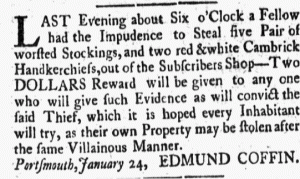
“A Fellow had the Impudence to Steal five Pair of worsted Stockings.”

I could not imagine having my stockings and handkerchiefs stolen from within my own home or shop. Clearly this person from New Hampshire could not either until it happened to him, and he was upset enough to place a whole two dollar reward for information on thief. That would have been a lot of money for five pairs of stockings and two red and white handkerchiefs. This makes me wonder if it was more about revenge on the thief.

This advertisement was placed in Portsmouth, which was one of the biggest cities in New Hampshire, and had different types of people living in the area: robbers and other questionable characters, shopkeepers, merchants, and the genteel class. Edmund Coffin went on to say that “every inhabitant” should watch out and report such behavior or it could happen to them.

This advertisement really grabbed my attention. It was a little different from some of the other advertisements that I had seen, because it was not a service or goods begin sold or bought. Especially in today’s society socks and handkerchiefs are so easily attainable that I would never even think twice if two of my socks disappeared.

**********

ADDITIONAL COMMENTARY:  Carl Robert Keyes

The Adverts 250 Project focuses primarily on marketing consumer goods and services in eighteenth-century America, but then (as now) not all advertisements were placed for that purpose. The guest curators from my Public History class and I have reached an agreement: each may select one advertisement not intended to sell goods or services during his or her week.

Elizabeth is beginning her week as guest curator with her “exception(al)” advertisement, but it is an extremely good choice because it tells us a lot about consumption in eighteenth-century America. Purchasing goods was not the only way to participate in the consumer revolution taking place in the colonies and Britain. Sometimes people came into possession of goods in more nefarious ways via an underground economy that included stolen items. Serena Zabin devotes an entire chapter to this “Informal Economy” in Dangerous Economies: Status and Commerce in Imperial New York. In addition to stolen items, secondhand goods were often exchanged via the informal economy. As Elizabeth notes, people of various backgrounds – from the lower sorts to the elite – resided in colonial cities and towns. Not all of them purchased new goods, but a great many found alternate ways to participate in the marketplace. This advertisement demonstrates one way they did so, much to the chagrin of poor Edmund Coffin who was the victim of an eighteenth-century shoplifter.

Welcome, Guest Curator Elizabeth Curley

Elizabeth Curley is a sophomore at Assumption College. She is an Elementary Education and History double major, with the goal of becoming a 6th grade social studies teacher. When it comes to history her favorite topics are the American Revolution, the Antebellum South, and the Industrial Revolution.   When she’s not being a dedicated student she enjoys learning about different world cultures and cooking. You can follow her public history twitter account: @WomenOfAC .

Welcome, Elizabeth Curley!