October 30

What was advertised in a revolutionary American newspaper 250 years ago today?

Boston-Gazette (October 30, 1775).

“He pays cash for all kinds of homespun cloths.”

Enoch Brown, a shopkeeper, had a history of promoting domestic manufactures (or goods made in the colonies) as alternative to items imported from Britain.  In the spring of 1768, for instance, he ran an advertisement alerting “those Persons who are desirous of Promoting our Own Manufactures … That he takes in all Sorts of Country-made Cloths at his Store on Boston Neck.”  In the wake of learning about duties levied on certain imported goods in the Townshend Revenue Act, many colonizers set about organizing nonimportation agreements.  They simultaneously embraced goods produced locally as a means of supporting the colonial economy and correcting a trade imbalance with Britain.  Several years later, Brown ran another advertisement with similar themes in January 1775.  Bearing the headline “American Manufacture,” that notice emphasized that the variety of textiles Brown stocked “were manufactured in this Province, and are equal in quality to any, and superior to most imported from England, and much cheaper than can be produced from any part of Europe.”

Although Brown had been at the same location for years, he departed Boston for Watertown following the battles at Lexington and Concord.  That presented challenges for both Brown and his customers, so “for greater Conveniency” he once again moved, this time to “Little-Cambridge” in the fall of 1775.  When he opened his shop, he advertised a “Variety of Winter Goods” for the coming season as well as “sagathees, duroys, camblets,” and other textiles “of American manufacture, which he sells extreme cheap.”  Customers could acquire any of those for low prices, despite the disruptions taking place as the siege of Boston continued.  Committed to giving consumers choices that matched their political principles, Brown sought new merchandise made locally.  In a nota bene at the end of his advertisement, he declared that he “pays cash for all kinds of homespun cloths.”  In so doing, he filled the role of intermediary between producers and consumers, giving both the opportunity to support the American cause.  After all, the Continental Association devised by the First Continental Congress did not merely instruct consumers to cease purchasing imported goods but also called on colonizers to “encourage Frugality, Economy, and Industry; and promote Agriculture, Arts, and the Manufactures of this Country.”  As a shopkeeper who bought and sold homespun cloth, Brown did his part.
January 29

What was advertised in a colonial American newspaper 250 years ago this week?

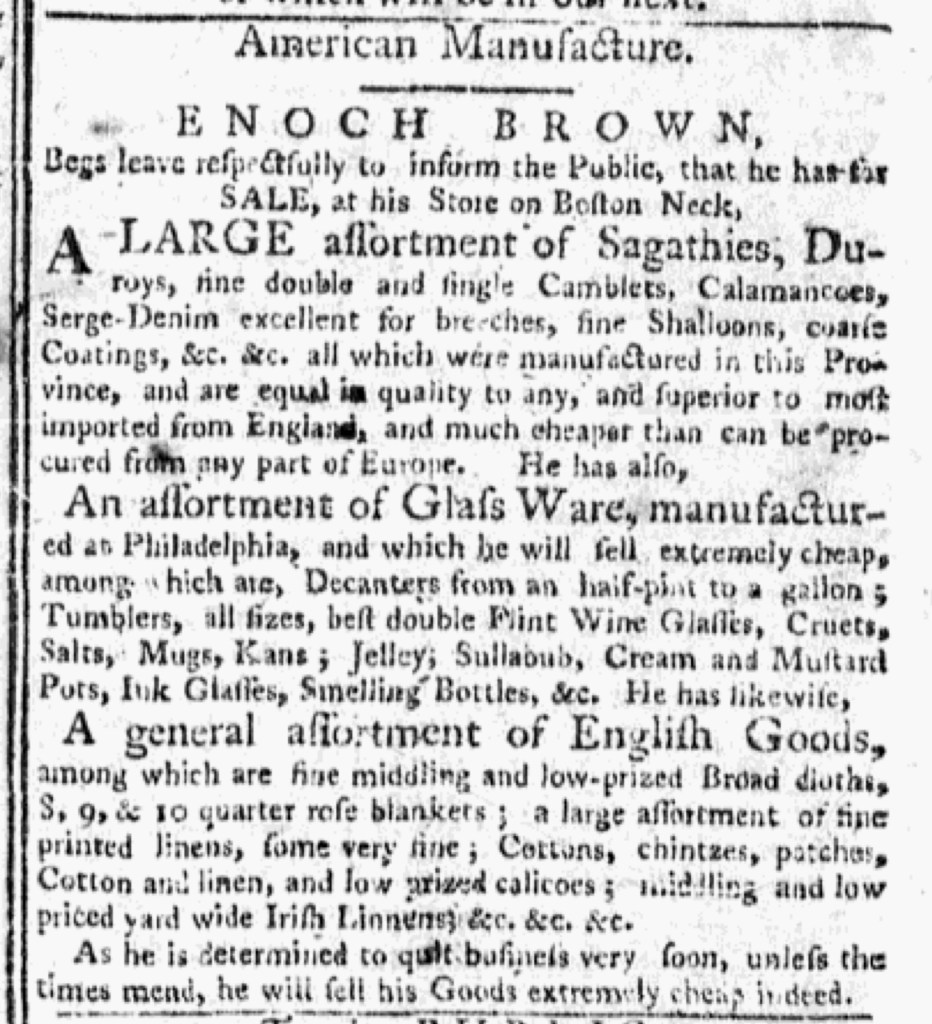
Massachusetts Spy (January 26, 1775).

“American Manufacture.”

An advertisement in the January 26, 1775, edition of the Massachusetts Spy informed readers of “SUNDRY Goods, Wares and Merchandize Imported in the Brigantine Venus … from London” that would be “SOLD agreeable to The American Congress Association.”  That nonimportation agreement included provisions for selling goods imported between December 1, 1774, and February 1, 1775, yet it also called for encouraging “domestic manufactures” as alternatives to items acquired from Britain.

Enoch Brown emphasized such wares in his own advertisement in that same issue of the Massachusetts Spy.  The headline proclaimed, “American Manufacture.”  Brown reported that he stocked several kinds of textiles, a “LARGE assortment of Sagathies, Duroys, … Camblets, Calamancoes, Serge-Denim, [and] Shalloons … all which were manufactured in this Province.”  Like many other retailers who encouraged consumers to “Buy American” during the imperial crisis, Brown emphasized that his customers would not have to make sacrifices when it came to price or quality for the sake of abiding by their political principles.  These textiles, he insisted, “are equal in quality to any, and superior to most imported from England.”  In addition, customers could purchase them “much cheaper than can be procured from any part of Europe.”

Yet that was not the extent of Brown’s wares produced in the colonies.  He also stocked an “assortment of Glass Ware, manufactured at Philadelphia.”  Perhaps he stocked some of the “AMERICAN GLASS” advertised by John Elliott and Company in the Pennsylvania Journal just as the Continental Association went into effect at the beginning of December 1774.  Brown listed a variety of items, including decanters, wine glasses, and mustard pots, underscoring that “he will sell extremely cheap.”

Only after detailing products made in the colonies did Brown also mention a “general assortment of English Goods,” naming several textiles, such as “fine printed linens,” not included among those “manufactured in this Province.”  He likely attempted to liquidate inventory that had been on his shelves before the nonimportation agreement commenced, intending to “quite business very soon, unless the times mend.”  To that end, he vowed to “sell his Goods extremely cheap indeed.”  In the process, he gave priority to “American Manufacture” in his advertisement, directing readers to options that would allow them to be responsible consumers who did their part in support of the Continental Association and the American cause.

September 12

What was advertised in a colonial American newspaper 250 years ago today?

Sep 12 - 9:12:1768 Boston-Gazette
Boston-Gazette (September 12, 1768).

“Those Persons who are desirous of Promoting our Own Manufactures.”

Enoch Brown mixed politics and commerce when he drew attention to his supply chain in an advertisement in the September 12, 1768, edition of the Boston-Gazette. Eighteenth-century advertisers frequently mentioned and even promoted the origins of the goods they sold, but prior to the 1760s they placed a premium on demonstrating that they carried imported goods. In the advertisement printed immediately above Brown’s notice, John Andrews noted that he had imported his inventory “in the last Ships from London and Bristol.” Further down the column, Moses Deshon announced that a “Variety of European” goods would be sold at public auction later in the week. In several other advertisements spread throughout the rest of the issue merchants and shopkeepers introduced their wares as “Imported from London.”

Brown did not make such proclamations. Instead, he tied his merchandise to recent calls to reduce and eliminate dependence on imported goods as a means of resisting Parliament’s ongoing efforts to raise revenues by imposing taxes within the colonies. In addition, colonists were concerned about an imbalance of trade that benefited Britain at the expense of the colonies. Nearly a year earlier the Boston town meeting had voted to encourage “domestic manufactures” as an alternative to importing goods from London and other English cities. Residents of other cities and towns throughout the colonies followed Boston’s lead, either through formal ballots or newspaper editorials that spread the word. By the fall of 1768, the residents of Boston and other urban ports were preparing for non-importation agreements set to go into effect in January 1769.

In his advertisement, Brown encouraged consumers to get an early start. He requested that “those Persons who are desirous of Promoting our Own Manufactures” supply him with “all Sorts of Country-made Cloths.” Brown would then either sell those items on commission or barter for “West-India Goods,” such as sugar, molasses, and rum. This advertisement also informed prospective customers that they could put their political principles into practice by visiting Brown’s store and purchasing textiles produced locally rather than patronizing the shops of his competitors who were attempting to sell goods imported from England before the new agreement went into effect.

Brown was part of the first wave of marketers who deployed “Buy American” appeals, advancing this strategy even before the colonies declared independence. As the imperial crisis intensified, more advertisers adopted this approach. Once the fighting ended, however, many retailers returned to promoting the European origins of their wares. Yet in the 1780s and 1790s those advertisements increasingly appeared alongside “Buy American” advertisements, following a course first plotted by Enoch Brown and other advertisers in the wake of the Stamp Act, Townshend Act, and other attempts to tax the colonies.