May 17

What was advertised in a revolutionary American newspaper 250 years ago today?
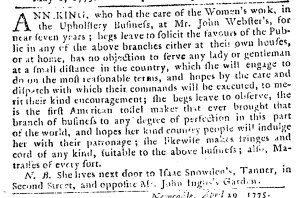
Pennsylvania Journal (May 17, 1775).

“ANN KING … had the care of the Women’s work, in the Upholstery Business, at Mr. John Webster’s.”

Ann King promoted her experience and expertise when she advertised her services in the May 17, 1775, edition of the Pennsylvania Journal, following an example set by artisans, male and female, who placed notices in newspapers during the era of the American Revolution.  She explained that she “had the care of the Women’s work, in the Upholstery Business, at Mr. John Webster’s, for near seven years.”  Although she had worked with Webster for quite some time, he had not acknowledged her contributions to his enterprise in his own advertisements.  Artisans only occasionally mentioned their assistants in their newspaper notices, yet King’s advertisement testified to the invisible labor performed by employees (as well as family members) in many workshops.  In particular, she reveals that women, whether employees or relative, participated on the production side even though editorials usually depicted them exclusively as consumers.

King took pride in her work.  She proclaimed that she “is the first American tostel [tassel] maker that ever brought that branch of business to perfection in this part of the world.”  If readers had ever admired the tassels that adorned any of the furniture upholstered in Webster’s workshop, then they should hire King when they were in the market for that item.  Even if they were not familiar those tassels, King hoped that her long tenure in a workshop operated by an “Upholsterer from London” who had served “several of the nobility and gentry, both in England and Scotland” would recommend her to prospective clients.  She intended for Webster’s reputation to bolster her own.  In addition to tassels, King “likewise makes fringes and cord of any kind,” part of the “Women’s work” she had overseen for Webster, and even “Mattrasses of every sort.”  She did so with “care and dispatch,” hoping to “merit [the] kind encouragement” of her patrons.

Female shopkeepers and milliners occasionally placed newspaper advertisements, far outnumbering the female artisans who did so.  King took to the public prints to advance her business, demonstrating that women did work alongside men in workshops, though their endeavors were sometimes cast as “Women’s work.”  Webster upholstered furniture “in the best and newest taste” for many years, depending on King and other women for assistance with the final product.  King then leveraged that experience in her effort to earn her livelihood by contracting directly with customers.

December 15

What was advertised in a colonial American newspaper 250 years ago today?

Dec 15 - 12:15:1767 South-Carolina Gazette and Country Journal
South-Carolina Gazette and Country Journal (December 15, 1767).

“She continues the Upholstery Business with Mr. COLEMAN.”

Rebecca Weyman’s advertisement announcing that “she continues the Upholstery Business” demonstrated what was possible for women participating in the eighteenth-century marketplace, though not necessarily what was probable. Relatively few women placed newspaper advertisements publicizing the goods and services they provided during the colonial era. Of those who did resort to the advertising to promote their business endeavors, most were shopkeepers, seamstresses, milliners and schoolmistresses. Each pursued occupations widely considered appropriate for women. Seamstresses and, especially, milliners might have been considered artisans, but their work depended on skills traditionally associated with women’s labor within the household. Their presence in the marketplace and the public prints did not disrupt prevailing gender expectations.

On occasion, other female artisans ran advertisements, but they were small in number among both the general population and advertisers. Those who did place newspaper advertisements often did so in collaboration with a male relative, supervisor, or partner, perhaps as a means of tamping down apprehensions that they participated in the market in ways that deviated from what was considered appropriate for women. Note that Rebecca Weyman appended her own advertisement to the conclusion of Thomas Coleman’s much lengthier notice. In it, she specified that she “continues the Upholstery Business with Mr. COLEMAN.” For his part, Coleman indicated that he operated the business “At Mr. Edward Weyman’s.” The female upholsterer had both a business partner and a male relation overseeing her work. This gave her additional security to earn a living as an upholsterer by sanctioning her endeavors and shielding her from criticism. In a marketplace dominated by men, Rebecca Weyman mobilized her affiliation with these particular men as a means of giving her more freedom to operate her business, doing her best to transform constraint into opportunity.

Not all female advertisers, however, opted to establish masculine oversight of their business endeavors in their advertisements. An advertisement for a female shopkeeper appeared in the same column of the South-Carolina Gazette and Country Journal, placed by “FRANCES SWALLOW, SOLE-TRADER.” Among the colonies, South Carolina had a fairly unique legal designation for married women who operated businesses independently of their husbands: sole trader. Swallow established her autonomy in the first line of her advertisement, adopting a very different strategy than Weyman. Perhaps Rebecca Weyman believed that allowing Thomas Coleman to do the bulk of the marketing in their joint advertisement allowed her to attract attention for her services without attracting condemnation for her intrusion into the marketplace.