January 6

What was advertised in a revolutionary American newspaper 250 years ago today?
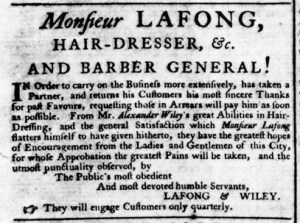
Virginia Gazette [Dixon and Hunter] (January 6, 1776).

Monsieur LAFONG, HAIR-DRESSER, &c. AND BARBER GENERAL!”

George Lafong, a “French HAIR-DRESSER” in Williamsburg, occasionally placed newspaper advertisements in the early 1770s.  When he took to the pages of the first issue of John Dixon and William Hunter’s Virginia Gazette for 1776, he presented himself as “Monsieur LAFONG, HAIR-DRESSER, &c. AND BARBER GENERAL!”  That elaborate and spectacular title served as the headline for his advertisement.  He had not previously dropped his first name in favor of referring to himself as “Monsieur LAFONG,” but apparently decided that circumstances merited this affectation.

That may have been because he jointly placed the advertisement with his new partner, Alexander Wiley, explaining that they went into business together “IN Order to carry on the business more extensively.”  Wiley possessed “great Abilities in Hair-Dressing,” according to the advertisement, yet neither his name nor reputation seemed to suggest any connection to French styles.  Hairdressers frequently benefited from the cachet that their clientele associated with French fashion, something that Lafong understood when he introduced himself as a “French HAIR-DRESSER” and there in a French phrase, “TOUT A LA MODE,” in 1770.  He doubled down on that in his new advertisement, naming himself “Monsieur Lafong” in the body as well as “Monsieur LAFONG” in the headline.

The new partners hoped that the combination of Wiley’s “great Abilities in Hair-Dressing, and the general Satisfaction which Monsieur Lafong flatters himself to have hitherto given” would yield “Encouragement” (or appointments) “from the Ladies and Gentlemen of this City.”  Lafong deserved to lean on his reputation.  According to the entry on wigmakers from the Williamsburg Craft Series, Lafong operated one of the premiere wig shops in the town in the early 1770s.[1]  In his own marketing, he declared that he “makes Head Dresses for Ladies, so natural as not to be distinguished by the most curious Eye.”  If former clients (or their acquaintances who knew who dressed their hair) agreed with that assessment, it did indeed suggest a “general Satisfaction” with Lafong’s work.  Furthermore, Lafong and Wiley promised that “the greatest Pains will be taken” to earn the approval of their clients.

**********

[1] Thomas K. Bullock and Maurice B. Tinkin, Jr., The Wigmaker in Eighteenth-Century Williamsburg: An Account of his Barbering, Hair-Dressing, and Peruke-Making Services, and Some Remarks on Wigs of Various Styles (Colonial Williamsburg: 1959, 1987).

December 23

What was advertised in a colonial American newspaper 250 years ago this week?

Pennsylvania Journal (December 20, 1770).

“D.K’s performance is scandalous and preposterous.”

Lewis Fay’s advertisement in the Pennsylvania Journal caused some controversy.  For several weeks in November 1770, the “Periwig Maker and Hair Dresser” originally from Paris, announced that he now offered his services to the ladies and gentlemen of Philadelphia.  He proudly proclaimed that he could style women’s hair “in fifty different manners” and men’s hair “in thirty fashionable and different manners.”  As Kate Haulman and others have shown, many colonists considered elaborate hairstyles an unnecessary luxury that also signaled a lack of character and predisposition to vices.

D.K. was one such critic.  Upon encountering Fay’s advertisement in the November 8 edition of the Pennsylvania Journal, D.K. was so incensed as to send a letter to the editor of the Pennsylvania Chronicle about it.  That letter ran on December 3.  Even though Fay clearly identified both ladies and gentlemen as prospective clients in his advertisement, D.K. thought “on the first perusal” that it was “probably a satire on the Ladies, who in general are too fond of new fashions.”  Critiques of consumption and fashion often devolved to gendered attacks on women, even when they engaged in the same practices as men.  D.K. went on to describe Fay as “a worthless daring animal” and an instrument of the devil, “the arch-enemy of mankind,” because he sought “to propogate his infernal arts” in Philadelphia.  D.K. then quoted extensively from Fay’s original advertisement, thus supplementing a different advertisement that Fay happened to insert on the previous page of that issue of the Pennsylvania Chronicle.  After quoting Fay’s claims about how many hairstyles he had mastered, D.K. exclaimed, “I think Cerberus himself could not belch forth more horrid and hateful language.”  As far as D.K. was concerned Fay should have labored in the workhouse rather than “dressing hair, in the shameful ridiculous manner he proposes.”  Still, D.K. imagined that Fay might attract a clientele of “poor thoughtless vain Girls, or some giddy wanton Matrons, or brainless fluttering Fops.”  D.K. did not want to see them become victims of “this French Metamorphoser.”  The anonymous critic concluded by stating that he hoped to “prevent so abominable a practice from getting encouragement in any of our provinces” by raising the alarm with his letter.

That editorial garnered a response among the advertisements in the December 20, 1770, edition of the Pennsylvania Journal.  Another anonymous correspondent, who signed as “ADMIRER of ARTS,” defended Fay.  Admirer described D.K.’s “censure upon the Ladies in general, and Mr. Fay in particular” as “scandalous and preposterous.”  Admirer did not wish to further dignify most of the editorial with a response, but did clarify that Fay “has resided at Boston with the greatest applause, for his superior Knowledge of dressing and preserving the hair, exactness and sobriety.”  Fay’s original advertisement ignited a passionate response that was part of a larger discourse about consumption, fashion, luxury, and vice in the era of the American Revolution.  The debate in the public prints took place in various formats, sometimes among letters to the editor and other times in advertisements.  Paid notices did not operate independently of other contents of newspapers.  Instead, colonists read … and responded … back and forth as they imposed political and cultural meaning on consumption.

September 6

What was advertised in a colonial American newspaper 250 years ago today?

Sep 6 - 9:6:1770 Virginia Gazette Rind
Virginia Gazette [Rind] (September 6, 1770).
TOUT A LA MODE.”

George Lafong introduced himself to the ladies and gentlemen of Williamsburg as a “French HAIR-DRESSER” in an advertisement in the September 6, 1770, edition of William Rind’s Virginia Gazette.  Apparently, he was new in town and had not yet established a clientele; he announced that he “intends carrying on the said business.”  He also made two familiar marketing appeals, though he put a twist on the second one when he proclaimed that he styled hair “in the cheapest manner, & TOUT A LA MODE.”  The hairdresser concluded by inviting “Gentlemen who may please to honour him with their commands” to come to him for shaving.

Extending only eight lines, it was a brief advertisement, but Lafong managed to pack a lot of meaning into it.  Throughout the colonies, newcomers often noted their origins in their advertisements, especially when they thought this signaled greater prestige for their wares or services.  Artisans often described themselves as “from London,” suggesting that they possessed greater skill and had better training.  Apothecaries and others who provided medical treatments and services also emphasized their connections to London and other places on the other side of the Atlantic, often listing their credentials.  For hairdressers, being from London hinted at the cosmopolitanism associated with the thriving metropolis at the center of the empire, but being a “French HAIR-DRESSER” may have been even better since even the genteel denizens of London looked to France for fashion cues.  Hiring a French hairdresser in colonial Virginia could have been an expensive luxury reserved for the elite, but Lafong declared that his prices were not exorbitant.  His clients could have their hair elegantly styled and adorned “in the cheapest manner.”  Hiring a French hairdresser at all alluded to exclusivity, but the newcomer did not seek to become so exclusive that he priced himself out of the market.  He also put his own spin on familiar marketing appeals that emphasized fashion.  Shopkeepers, tailors, milliners, and others who provided consumer goods and services frequently incorporated fashion into their advertisements.  Lafong did so as well, trumpeting that he styled hair “TOUT A LA MODE” or “all in fashion.”  This appeal simultaneously underscored his identity as a French hairdresser and enhanced the aura of exclusivity for prospective clients who learned French to appear more genteel to their friends and neighbors.

Upon arriving in Virginia, Lafong placed a savvy advertisement intended to cultivate a clientele among the “Ladies and Gentlemen” of Williamsburg.  Incorporating several familiar marketing appeals, he also introduced an innovative means of underscoring his origins as a “French HAIR-DRESSER” by making his appeal to fashion in French rather than English.