January 2

What was advertised in a revolutionary American newspaper 250 years ago today?

Pennsylvania Evening Post (January 2, 1776).

“PRINTING In ENGLISH, GERMAN, and other Languages.”

In late December 1775 and early January 1776, Melchior Steiner and Charles Cist placed advertisements for “PRINTING In ENGLISH, GERMAN, and other Languages” in several newspapers published in Philadelphia.  Having acquired a “general assortment of new and elegant TYPES, and other Printing Materials,” they opened an office “where they intend carrying on the PRINTING BUSINESS in all its different branches, with care, fidelity, and expedition.”  Both partners had been born in Europe and migrated to Philadelphia, as Isaiah Thomas explained in his History of Printing in America (1810).  Steiner, born in Switzerland, served an apprenticeship with Henry Miller, the printer of the Henrich Millers Pennsylvanischer Staatsbote (formerly Der Wochentliche Philadelphische Staatsbote and Der Wochentliche Pennsylvanische Staatsbote).  Cist, an apothecary born in St. Petersburg, Russia, came to the colonies in 1769, worked for Miller as a translator of English into German, and “by continuing in the employment of Miller several years he acquired a considerable knowledge of printing.”[1]

Steiner and Cist, according to Thomas, “executed book and job work, in both the German and English languages,” the “different branches” of printing that they advertised in their notice.  They competed with other local printers, especially Miller.  Their former associate also took orders for job printing in both languages and annually published an almanac in German.  The masthead of the Pennsylvanischer Staatsbote indicated that “All ADVERTISEMENTS to be inserted in this Paper, or printed single by HENRY MILLER, Publisher hereof, are by him translated gratis.”  Thomas reported, “Not long after the commencement of the revolutionary war, [Steiner and Cist] published a newspaper in the German language; but, for want of sufficient encouragement, it was discontinued in April, 1776.”[2]  The venerable printer appears to have been misinformed on that point.  Clarence S. Brigham does not attribute any newspaper published in 1775 or 1776 to Steiner and Cist, but he does list another newspaper that Thomas credited to the partners, the Philadelpisches Staatsregister, published during the war from 1779 to 1781.[3]  Even if they considered launching a newspaper eventually, the new partners sought to establish a printing office with a reputation for “giv[ing] satisfaction to those who may be pleased to employ them” for job printing.  As they surveyed the local and regional landscape, they may have determined that Henrich Millers Pennsylvanischer Staatsbote and the Germantowner Zeitung already met the needs of colonizers who spoke German and the market would not support another newspaper.  That they operated their printing office in Philadelphia throughout most of the war, leaving temporarily during the British occupation of the city, testifies to the multilingual origins of the new nation.  English was the language spoken (and printed) most prevalently in the thirteen colonies that declared independence, but certainly not exclusively during the era of the American Revolution.

**********

[1] Isaiah Thomas, The History of Printing in America: With a Biography of Printers and an Account of Newspapers (1810; Weathervane Books, 1970), 404.

[2] Thomas, History of Printing, 404.

[3] Clarence S. Brigham, History and Bibliography of American Newspapers, 1690-1820 (American Antiquarian Society, 1947), 1392, 1487.
April 12

GUEST CURATOR:  Sean Sullivan

What was advertised in a colonial American newspaper 250 years ago today?

Apr 12 - 4:12:1768 Wochentliche Philadelphische Staatsbote
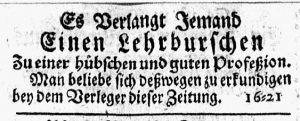
“An apprentice is needed for this well and fin occupation. Those interested should inquire of the publisher of this paper.” Wochenlichte Philadelphische Staatsbote (April 12, 1768).

“Es Verlangt Jemand Einen Lehrburschen.”

In contemporary America where all those of European descent are typically simply labeled under the moniker of ‘white,’ we can forget that the diversity of European cultures present during the colonial period was often a defining aspect of people’s lives. Settlers from different places in Europe brought their own traditions, aesthetics, Christian denominations, and, most importantly, languages to the colonies they considered a new world. In Pennsylvania, Germans left an indelible mark on colonial culture. Such was the scope of German immigration to the British colonies that newspapers such as the Wochentliche Philadelphische Staatsbote sprung up to cater to the large German-speaking population.

The advertisement shown above asked for an apprentice, likely one for the paper itself. The very act of putting out such an advertisement indicates that there was a large enough German-speaking population (of youths in particular, as apprentices would themselves be in their teenage years) that an advertisement in this newspaper would be worth the cost and would likely ensure a response. This advertisement also implies that business was good enough between the newspaper and job printing that the printer needed more assistance, a likely case given the sheer magnitude of the number of Germans in Pennsylvania in this period.

For more information, see “German Settlement in Pennsylvania:  An Overview” from the Historical Society of Pennsylvania with the Balch Institute for Ethnic Studies.

**********

ADDITIONAL COMMENTARY: Carl Robert Keyes

Today Sean introduces the first advertisement from a German-language newspaper featured on the Adverts 250 Project, noting that a substantial population of German migrants to Pennsylvania established their its own newspapers and participated in shaping colonial culture and commerce.  The Wochentliche Philadelphische Staatsbotewas not the only German-language newspaper that served that community in 1768.  The Germantowner Zeitungalso disseminated news and advertising to colonists who spoke German rather than English.

Yet those titles represent only a fraction of the more than two dozen German-language newspapers published in Pennsylvania in the eighteenth century.  See the list below, compiled from Clarence Brigham’s monumental History and Bibliography of American Newspapers, 1690-1820, for a complete census of known German-language newspapers founded prior to 1800.  Nine were founded prior to the American Revolution, another four during the years of the war, and the remaining thirteen after independence had been achieved. The Harrisburger Morgenröthe Zeitung continued publication well into the nineteenth century, demonstrating that German migrants and their descendants continued to maintain their own language and some aspects of their culture even as they participated in creating a distinctive American identity in the era of the early republic.  This series of newspapers testifies to the presence of German migrants in colonial America.  German settlers in Pennsylvania were among the many ethnic groups other than the English that made a home in England’s North American colonies.

  • Philadelphische Zeitung, 1732
  • [Germantown] Hoch-Deutsch Pensylvanische Geschicht-Schreiber, 1739-1746
  • [Germantown] Pensylvanische Berichte, 1746-1762
  • Philadelphier Teutsche Fama, 1749-1751
  • Lancastersche Zeitung, 1752-1753
  • [Philadelphia] Hoch Teutsche und Englische Zeitung, 1751-1752
  • Germantowner Zeitung, 1762-1777
  • [Philadelphia] Wochentliche Philadelphische Staatsbote, 1762-1779
  • [Germantown] Wahre und Wahrscheinliche, 1766
  • [Philadelphia] Pennsylvanische Staats-Courier, 1777-1778
  • [Lancaster] Pennsylvanische Zeitungs-Blat, 1778
  • Philadelphisches Staatsregister, 1779-1781
  • [Philadelphia] Gemeinnützige Philadelphische Correspondenz, 1781-1790
  • Germantauner Zeitung, 1785-1799
  • [Lancaster] Neue Unpartheyische Lancaster Zeitung, 1787-1797
  • [Reading] Neue Unpartheyische Readinger Zeitung, 1789-1802
  • [Philadelphia] General-Postbothe, 1790
  • [Chestnut Hill] Chesnuthiller Wochenschrift, 1790-1796
  • [Philadelphia] Neue Philadelphische Correspondenz, 1790-1812
  • [Easton] Neuer Unpartheyischer Eastoner Bothe, 1793-1805
  • [York] Unpartheyische York Gazette, 1796-1804
  • [Philadelphia] Pensylvaniche Correspondenz, 1797-1800
  • [Lancaster] Deutsche Porcupein, 1798-1799
  • Lancaster Wochenblatt, 1799
  • [York] Volks-Bericher, 1799-1803
  • Harrisburger Morgenröthe Zeitung, 1799-1820+