June 27

What was advertised in a colonial American newspaper 250 years ago today?
Jun 27 - 6:27:1767 Providence Gazette
Providence Gazette (June 27, 1767).

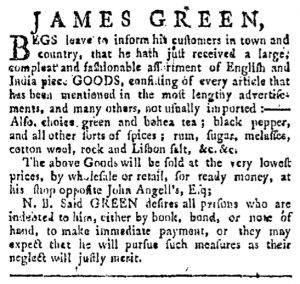
“GOODS, consisting of every article that has been mentioned in the most lengthy advertisements, and many others, not usually imported.”

James Green sold a variety of imported goods at his shop in Providence. For several weeks in the late spring and early summer of 1767 he placed a notice that “he hath just received a large, compleat and fashionable assortment of English and India piece GOODS, consisting of every article that has been mentioned in the most lengthy advertisements, and many others, not usually imported.” This claim caught my attention because it so closely replicated an advertisement placed by Gilbert Deblois in the Boston Evening-Post, the Boston Post-Boy, and the Massachusetts Gazette at about the same time. Deblois carried “A complete fashionable Assortment of English & India Piece GOODS, consisting of every Article that has been mentioned in the most lengthy Advertisements, and many others not usually imported.” Green eliminated the italics that consistently appeared in Deblois’s advertisements in all three Boston newspapers, but he otherwise adopted the same language to make a fairly unique appeal.

Many eighteenth-century advertisements included formulaic phrases, such as “compleat and fashionable assortment,” but appropriation of entire sentences that expressed distinctive marketing efforts was not common. Shopkeepers occasionally stated that they carried too much merchandise to list all of it in an advertisement, but rarely did they claim to carry goods “not usually imported.” Green, whose advertisement first appeared in the Providence Gazette on May 23, apparently lifted copy from Deblois’s notice, probably hoping that it would have the same effect of intriguing potential customers and inciting curiosity about what might be on the shelves in his shop. He may have believed that he could get away with treating this marketing strategy as his own if he was the first and only shopkeeper in Providence to adopt it.

Other scholars have demonstrated that news flowed through networks of printers who liberally borrowed news items from other newspapers, reprinting them word for word, sometimes with attribution and other times without. This advertisement suggests that sometimes advertisers engaged in the same practices, keeping their eyes open for innovative marketing appeals formulated by their counterparts in other cities and adopting them as their own.

May 4

What was advertised in a colonial American newspaper 250 years ago today?

May 4 - 5:4:1767 Boston Evening-Post
Boston Evening-Post (May 4, 1767).

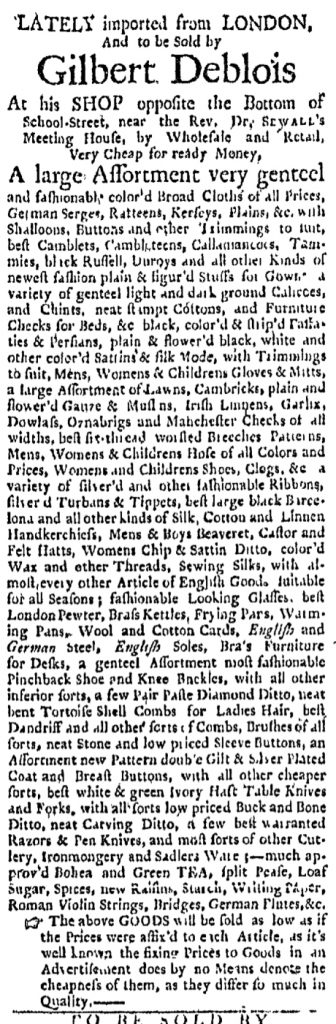
“GOODS, consisting of every Article that has been mentioned in the most lengthy Advertisements.”

Gilbert Deblois frequently advertised in Boston’s newspapers, sometimes at great length. On May 4, 1767, he inserted the same advertisement in both the Boston Evening-Post and the Boston Post-Boy. Several days earlier the same notice appeared in the extraordinary that accompanied the current issue of the Massachusetts Gazette. Compared to some of his other marketing efforts in the public prints, this notice was considerably shorter. Still, extending over almost one-third of a column, it occupied significantly more space – about three times as much – compared to advertisements placed by some of his competitors.

Deblois seemed less concerned about those advertisements than the much lengthier list advertisements placed by other competitors, including John Appleton and John Barrett and Sons (two-thirds of a column), Clement Jackson and John Gore, Jr. (three-quarters of a column), and Frederick William Geyer (an entire column and one-fifth of another). Those advertisements listed scores of items stocked by local shopkeepers.

Deblois devised a way to make those lengthy list advertisements (paid for by his competitors) work to his own advantage. After inserting the standard language about “A complete fashionable Assortment of English & India Piece GOODS,” he proclaimed that he carried “every Article that has been mentioned in the most lengthy Advertisements and many others not usually imported.” (The italics appeared in the advertisements in all three newspapers that carried this advertisement, indicating that Deblois gave specific instructions to the printers rather than leaving it to their discretion to make decisions about that particular aspect of formatting the notice. On the other hand, the three advertisements had other variations in format, but not copy.)

Considering the variety of consumer goods imported and advertised by Boston’s merchants and shopkeepers, readers probably greeted this pronouncement with some skepticism. As a frequent advertiser who sometimes placed lengthy list notices, however, Deblois may have previously amassed some credibility. He did not need to enumerate all of his wares in every advertisement. Invoking his competitors’ advertisements provided a means of listing his merchandise without actually listing it – or paying to do so. This also initiated a challenge to potential customers to visit his shop and assess for themselves the validity of his claim, generating foot traffic that could result in additional sales.

January 12

What was advertised in a colonial American newspaper 250 years ago today?

jan-12-1121766-boston-evening-post
Boston Evening-Post (January 12, 1767).

“The above GOODS will be sold as low as if the Prices were affix’d to each Article.”

Eighteenth-century advertisers rarely indicated specific prices for their merchandise, though they frequently proclaimed that they charged “reasonable rates” or offered discounts for purchasing by volume. Shopkeeper Gilbert Deblois stated that he sold the “large Assortment” of goods he stocked “Very Cheap for ready Money.” He made this promise in what might be considered the header of his advertisement that appeared before an extensive list detailing his inventory. Advertisements placed by retailers commonly featured some sort of header that included the advertiser’s name and location, announced that their wares had been recently imported, and made general appeals to price, quality, and fashion.

Deblois augmented his standard assurance that customers could expect “Very Cheap” prices with a note that explained why he did not specify any particular prices. “The above goods,” he asserted, “will be sold as low as if the Prices were affix’d to each Article.” He further explained, just in case potential customers were not already aware or needed to be reminded, that “it’s well known the fixing Prices to Goods in an Advertisement does by no Means denote the cheapness of them, as they differ so much in Quality.” Consumers would not find it useful, the shopkeeper argued, to review the prices in an advertisement before visiting his shop. They needed to examine the merchandise to assess its quality for themselves in order to determine that any price was indeed “Very Cheap.”

This clarification may help to explain why so few advertisers announced specific low prices as a means of attracting potential customers, a significant difference between eighteenth-century methods and modern marketing practices that often rely on advertising particular prices. In an era before major manufacturers mass produced products that carried brand names associated with well known reputations, both retailers and, especially, consumers may have considered listing specific prices in advertisements meaningless, ineffective, and potentially misleading.