February 8

What was advertised in a colonial American newspaper 250 years ago today?
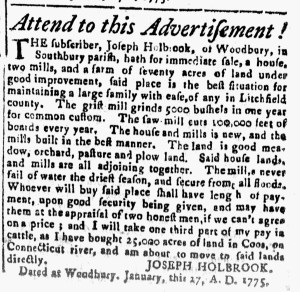
Connecticut Journal (February 8, 1775).

Attend to this Advertisement!

When Joseph Holbrook sought to sell a house, two mills, and a farm in Woodbury in the winter of 1775, he placed an advertisement in the Connecticut Journal and New-Haven Post-Boy.  In it, he assured prospective purchasers that “said place is the best situation for maintaining a large family with ease.”  The house and mills were new.  The gristmill “grinds 5000 bushels in one year for common custom,” while the sawmill “cuts 100,000 feet of boards every year.”  They operated throughout the year because the mills “never fail of water [during] the driest season,” nor did they flood at other times.  The land included “good meadow, orchard, pasture and plow land.”

Holbrook’s notice looked much like other advertisements in colonial newspapers except for a headline that proclaimed, “Attend to this Advertisement!”  That headline almost certainly drew the attention of readers, making them curious about what appeared in the notice.  Such a command distinguished Holbrook’s advertisement from others, not only because it gave instructions but because it had a headline at all.  Several notices in the February 8 edition of the Connecticut Journaldid not have headlines, just the first word in capital letters with a dropped capital for the first letter.  Some had the first line in larger font, such as one that began, “Pursuant to a Request made to,” and another that started, “This is to give notice to all.”  Among those with headlines, the name of the advertiser usually served that purpose.  One headline announced, “Jacob Dagget” in a larger font than anything else on that page.  Another used “JOSEPH HOWELL” as the primary headline with two secondary headlines, “Choice good Train & blubber Oil” and “Dry’d and pickled COD-FISH.”  Holbrook, however, did not resort to the usual wording and format for advertisements.  The headline for his advertisement, in italics and a larger font than its body, suggested that something of consequence followed the edict to “Attend to this Advertisement!”  The advertiser and the compositor deployed both copy and design to encourage readers to peruse what otherwise would have been an ordinary real estate notice.

April 6

What was advertised in a colonial American newspaper 250 years ago today?

Providence Gazette (April 6, 1771).

Consider his Misfortunes, and to favour him with their Custom.”

When Elisha Brown resumed “his former Right and Estate in the GRIST-MILL” that he once operated, he took to the pages of the Providence Gazette to increase his chances of success.  He outlined his plans for running the mill, but also attempted to play on the sympathies of prospective clients in an advertisement that first ran on April 6, 1771.  He acknowledged that he was back in business thanks to “the Favour and Assistance of many of his Creditors, and some of his Friends” and requested “the Favour of his former Customers … to consider his Misfortunes, and to favour him with their Custom.”  Brown did not elaborate on those “Misfortunes,” apparently believing the community was already familiar with them and would respond to his plea that they once again entrust their grain to him for processing.

To serve his customers, Brown planned “to give constant Attendance” at the mill from sunrise until nine o’clock at night.  He would “make their Meal good” as well as replace any bags lost by mistake, but specified that he needed customers’ assistance in bringing him grain that was “clean and dry” in well-marked bags.  Achieving customer satisfaction depended in part on the care that clients took in preparing their grain for the mill, yet the miller also played an important role in the process.  Brown aimed “to please his Customers,” but resumed operations on a trial basis.  He pledged that if he “should be so unfortunate as not to please them” he would “procure some other Person to tend said Mill to their Satisfaction.”  Brown hoped to earn the approbation of his clients on his own, but he recognized that the success of the business might ultimately depend on hiring an associate.

In the process of informing the community that he once again operated his mill, Brown constructed a narrative of redemption to encourage clients to avail themselves of his services.  He already benefited from the “Favour and Assistance” of creditors and friends who overlooked his “Misfortunes” and now called on former customers and prospective new ones to do the same.  He asked them to give him an opportunity to demonstrate his commitment and competence during a trial period, intending to win their trust and return business.