August 4

What was advertised in a revolutionary American newspaper 250 years ago today?

Connecticut Gazette (August 4, 1775).

“Thomas Tileston, HAT-MAKER from BOSTON.”

Thomas Tileston, a hatmaker, ran an advertisement in the Connecticut Gazette for several weeks in the summer and early fall of 1775.  He published it to inform prospective customers that “he has taken a Shop In WINDHAM, … Where he intends the carrying on his Business in all its Branches.”  He currently had in stock the “Best of Beaver, Beaverett, Castor and Felt HATS.”  Tileston promised exemplary customer service, asserting that they “may depend on the best Usage” and promising to undertake all orders “with Fidelity and Dispatch.”

As a newcomer to the area, Tileston introduced himself as a “HAT-MAKER from BOSTON.”  Advertisers often indicated where they previously conducted business or received their training, but this detail had new significance.  Tileston’s arrival in Windham coincided with the outbreak of hostilities at Lexington and Concord and the ensuing siege of Boston. General Thomas Gage, the governor, and the Massachusetts Provincial Congress negotiated an agreement that permitted Loyalists to enter the city and Patriots and others to depart.  After enduring the closure of the harbor a year earlier via to the Boston Port Act and the hardships that resulted, Tileston may have decided to take what might have been his last opportunity to leave the city and establish himself elsewhere before the situation deteriorated even more.  Windham was certainly a small town compared to Boston, yet Tileston did not merely suggest that he brought an elevated sense of fashion with him.  He likely expected that readers might consider him a refugee and hoped that they would believe that he merited support from consumers in his new town.

Given the stakes, Tileston went to additional lengths to draw attention to his advertisement.  A border composed of printing ornaments enclosed his notice, distinguishing it from other advertisements that appeared in the Connecticut Gazette.  Week after week, Tileston’s notice had that distinctive feature, making it easy for readers to spot.  The hatmaker would have had to make special arrangements with the printer for his advertisement to receive such treatment.  Perhaps he even had to pay more for it.  Tileston apparently considered it worth the investment as he sought to establish his business in a new town.
December 1

What was advertised in a colonial American newspaper 250 years ago today?

Pennsylvania Gazette (December 1, 1773).

“He continues the Hat-making Business, and hopes those who have already obliged him with their Custom will continue so to do.”

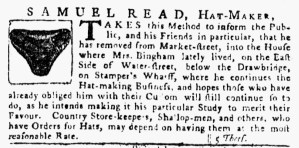
When he moved from Market Street to Water Street in Philadelphia, Samuel Read, “HAT-MAKER,” ran an advertisement in the Pennsylvania Gazette to “inform the Public, and his Friends in particular” of his new location.  He encouraged “those who have already obliged him with their Custom” to visit his new shop, especially since he “intends making it his particular Study to merit their Favour.”  Read also assured “Country Store-keepers, Shallop-men, and others, who have Orders for Hats” that they “may depend on having them at the most reasonable Rate.”

In an effort to draw attention to his advertisement, Read adorned it with a woodcut depicting a tricorne hat, a style so popular at the time that it has become widely associated with late eighteenth-century fashions.  Few advertisements in the December 1, 1773, edition of the Pennsylvania Gazette featured visual images.  The printers supplied woodcuts of vessels at sea for seven advertisements seeking freight and passengers for ships departing for other ports.  Frederick Hubley, a coppersmith in Lancaster, ran the only other advertisement with a woodcut designed for the exclusive use of his business.  Readers of the Pennsylvania Gazette became familiar with his woodcut of a still thanks to repeated insertions over several months.  Even with those advertisements appearing elsewhere in the newspaper, Read’s advertisement was the only one with a woodcut on the first page.

Rivington’s New-York Gazetteer (December 2, 1773).

Read’s woodcut reflected his occupation and distinguished his advertisement from others in the Pennsylvania Gazette, even though it was not as elaborate as a similar image that Nesbitt Deane, a hatmaker in New York, frequently used in his advertisements.  Deane’s woodcut depicted a tricorne hat above a ribbon that stated his name.  Deane also developed marketing appeals beyond those deployed by Read.  For instance, he declared that he devised “a method peculiar to himself, to turn rain, and prevent sweating of the head damaging the crown.”

Read’s advertisement was not as sophisticated as the one that Deane simultaneously ran in Rivington’s New-York Gazetteer, not in terms of the copy nor in terms of the visual image, yet the hatmaker in Philadelphia demonstrated more than a little marketing savvy.  His notice did not merely announce that he moved to a new location.  Read attempted to maintain existing relationships with his customers by promising that their satisfaction remained his primary concern.  He also promised low prices to retailers who would purchase in volume and other customers.  The woodcut, plain as it may seem to modern eyes, also drew attention to his advertisement, distinguishing it from most others in that issue of the Pennsylvania Gazette.

April 29

What was advertised in a colonial American newspaper 250 years ago today?

Rivington’s New-York Gazetteer (April 29, 1773).

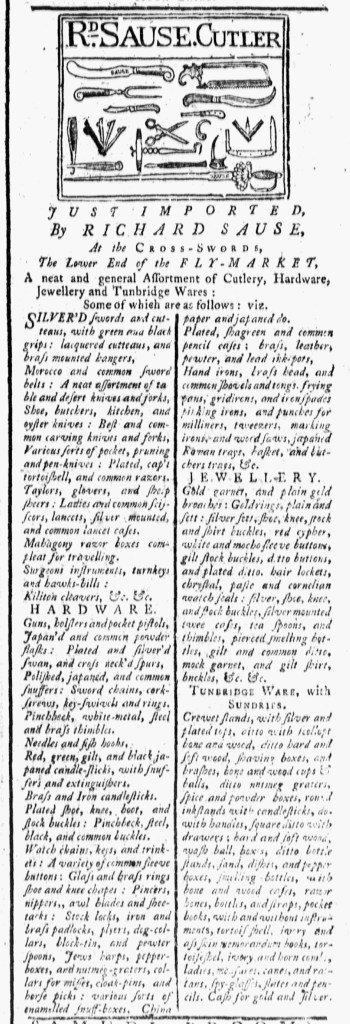
“RD. SAUSE. CUTLER.”

In the second issue of Rivington’s New-York Gazetteer, the printer continued publishing a significant number of advertisements to supplement the revenue earned from subscriptions.  Advertising accounted for six of the twelve columns in the April 29, 1773, edition.  Many of those advertisers also placed notices in other newspapers.

Richard Sause, a cutler, ran an advertisement that filled more than half a column.  He listed a variety of goods from among the “neat and general Assortment of Cutlery, Hardware, Jewellery and Tunbridge Wares” that he recently imported, clustering the various categories of merchandise together with headings to help readers locate items of interest.  A woodcut that depicted more than a dozen forms of cutlery, including knives, scissors, a saw, and a sword, adorned the advertisement.  That image may have replicated the sign that marked the location of Sause’s shop.  It likely looked familiar to readers who regularly perused the New-York Gazette and Weekly Mercury since it had previously accompanied the cutler’s advertisements in that newspaper.

Nesbitt Deane, a hatmaker who frequently advertised in the city’s newspapers, placed a notice that featured a woodcut of a tricorne hat with his name enclosed in a banner beneath it in the first issue of Rivington’s New-York Gazetteer, but it did not appear in the second issue.  Like Sause’s woodcut, that image would have been familiar to readers who regularly read other newspapers since it had been appearing in the New-York Journal for more than a year.  Deane apparently wished to increase the visibility of his business among curious colonizers who examined the first issue of Rivington’s newspaper, but returned to advertising in a publication that he had greater confidence would yield customers.  His advertisement, complete with the woodcut, ran in the New-York Journal rather than Rivington’s New-York Gazetteer on April 29.  Deane either collected the woodcut from one printing office and delivered it to the other or made arrangements for the transfer.

In both instances, the advertisers benefitted from visual images that prominently displayed their names and distinguished their notices from others that consisted solely of text.  To gain those advantages, they made additional investments in commissioning woodcuts and then carefully coordinated when and where they appeared in the public prints.  Like other advertisers who incorporated images into their notices, Deane and Sause each commissioned a single woodcut rather than multiple woodcuts that would have allowed them to enhance their advertisements in more than one newspaper simultaneously.

January 26

What was advertised in a colonial American newspaper 250 years ago today?

Jan 26 - 1:26:1770 New-London Gazette
New-London Gazette (January 27, 1770).

Hopes to be able, if duly encouraged, shortly to supply the Country.”

In an advertisement in the January 26, 1770, edition of the New-London Gazette, Aaron Cleveland made some big claims about the hats that he made at his “FELT MANUFACTORY” in Norwich. He asserted that his hats would “out wear any Three of the same Price that are Imported,” a bold statement about the quality and durability of his goods produced in the colonies compared to more familiar alternatives shipped from the other side of the Atlantic.

Although Cleveland stated that he placed his advertisement “to acquaint the Publick” of his new enterprise, he made particular overtures to “the Merchants in the several adjacent Towns,” apparently hoping to sell in volume to others who would then assume the risk and responsibility for further distributing his felt hats and retailing them to consumers. Nonetheless, he accepted all sorts of customers, selling the hats “Singly or by the Dozen.”

Cleveland testified that he wanted to do his part to serve the colonies in their efforts to leverage commerce for political purposes. In protest of the duties Parliament imposed on imported paper, glass, lead, paint, and tea in the Townshend Acts, colonists adopted nonimportation agreements and pledged to support “domestic manufactures” as a means of reducing their reliance on Britain for goods that they needed or wanted. Cleveland suggested that the quality of his felt hats provided “sufficient Argument for his Encouragement, without mentioning the Inconveniences attending Importation,” yet in even alluding to imported goods he encouraged both retailers and consumers to consider the political implications of their decisions about acquiring inventory and making purchases. Cleveland could do his part for the cause only “if duly encouraged.” The successful production of goods in the colonies, the encouragement of domestic manufactures, required a receptive market comprised of consumers who purchased those wares. Cleveland challenged readers to consider their responsibilities, indeed their duty, as consumers in the political battle waged against Parliament.