January 3

What was advertised in a revolutionary American newspaper 250 years ago today?
Pennsylvania Journal (January 3, 1776).

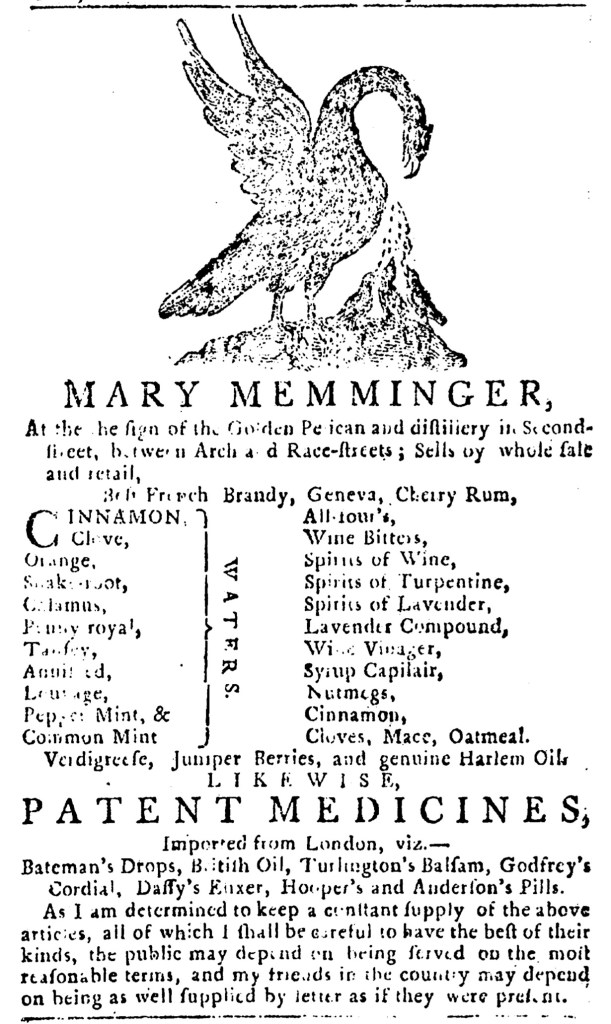
“MARY MEMMINGER, At the sign of the Golden Pelican.”

In the final issue of the Pennsylvania Journal published in 1775 and continuing in January 1776, Mary Memminger advertised the remedies available at her apothecary shop “At the sign of the Golden Pelican” on Second Street in Philadelphia.  Memminger described her shop as a “distillery,” suggesting that she may have produced some of the “WATERS” (including cinnamon, clove, orange, peppermint, and “Common Mint”) and “Spirits of Wine,” “Spirits of Turpentine,” and “Spirits of Lavender.”  She also stocked popular “PATENT MEDICINES, Imported from London,” listing “Bateman’s Drops, British Oil, Turlington’s Balsam, Godfrey’s Cordial, Daffy’s Elixer, [and] Hooper’s and Anderson’s Pills.”  Memminger apparently tended closely to her advertising.  The first time her notice appeared, it featured an error, truncating “Godrey’s Cordial, Daffy’s Elixer” to “Godfrey’s Elixer.”  The compositor fixed the mistake, a rare instance of an updated version of a newspaper advertisement for consumer goods and services after the type had been set.

Memminger did not indicate when she received the patent medicines “Imported from London,” whether they arrived in the colonies before the Continental Association went into effect on December 1, 1774.  Apothecaries and others who sold patent medicines often gave assurances that they were “fresh,” recent arrivals that had not lingered on shelves or in storerooms for months, yet Memminger left it to readers to draw their own conclusions.  She did assert that she was “determined to keep a constant supply of the above articles, all of which I shall be careful to have the best of their kinds,” perhaps indicating a willingness to make exceptions when it came to certain imported items.  Memminger made the health of her clients her priority, promising that “the public may depend on being served on the most reasonable terms, and my friends in the country may depend on being as well supplied by letter as if they were present.”  As a symbol of the care she provided, a woodcut dominated her advertisement (and the entire final page of the January 3, 1776, edition of the Pennsylvania Journal).  As William H. Helfand explains, it depicted “a pelican piercing her breast to nourish her young.”  Perhaps it replicated the “sign of the Golden Pelican” that marked Memminger’s location.  While other apothecaries, like Philip Godfrid Kast and Oliver Smith, deployed images that incorporated mortars and pestles, Memminger declined to include a tool of the trade in favor of emphasizing a symbol of motherly care and sacrifice tending to the welfare of others.
July 30

What was advertised in a revolutionary American newspaper 250 years ago this week?

Rivington’s New-York Gazetteer (July 27, 1775).

“Iron utensils, so much recommended by physicians for their safety.”

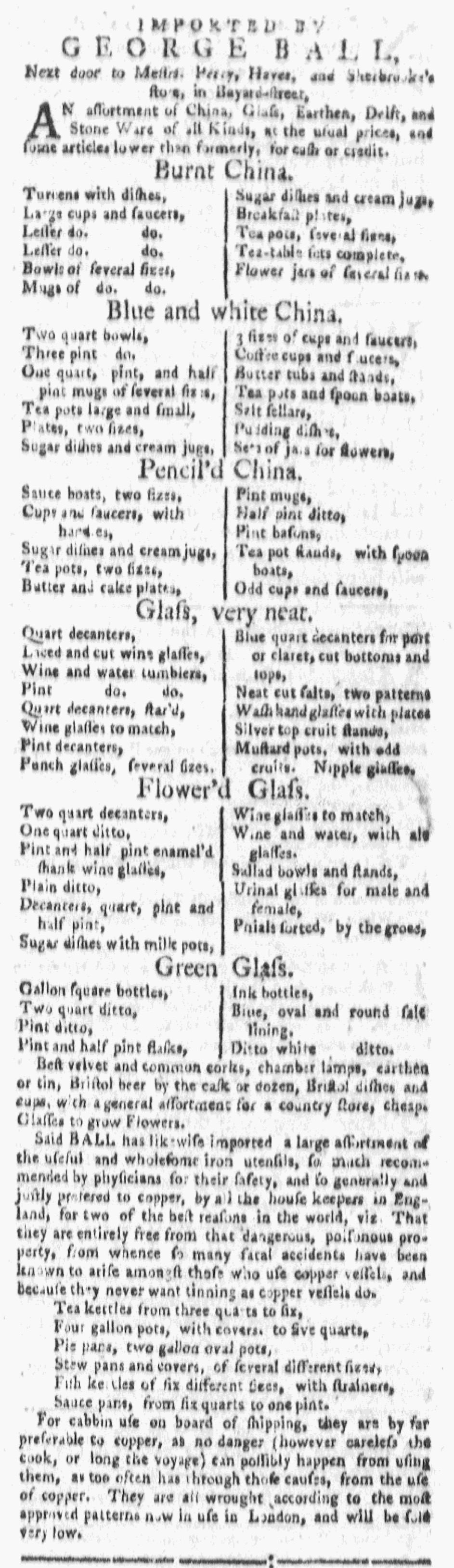
As July 1775 came to a close, George Ball advertised an “assortment of China, Glass, Earthen, Delft, and Stone Ware of all Kinds” in Rivington’s New-York Gazetteer.  He conveniently did not mention when he acquired his merchandise, whether it arrived in the colonies before the Continental Association went into effect, though the headline did proclaim “IMPORTED BY GEORGE BALL” rather than “JUST IMPORTED BY GEORGE BALL.”

Most of Ball’s advertisement consisted of a list of the various items he stocked, divided into categories that included “Burnt China,” “Blue and white China,” “Pencil’d China,” “Glass, very neat,” “Flower’d Glass,” and “Green Glass.”  In the final third of the advertisement, however, Ball highlighted “iron utensils” and made a pitch to convince consumers to demand iron tea kettles, iron pots, iron saucepans, iron pie pans, and iron stew pans with iron covers instead of copper ones.  Those “useful and wholesome iron utensils,” Ball asserted, were “so much recommended by physicians for their safety” and, accordingly, “so generally and justly prefered to copper, by all the house keepers in England.”  Ball made health and safety the centerpiece of his marketing, citing “the best reasons in the world.”  He emphasized that cookware made of iron was “entirely free from that dangerous, poisonous property, from whence so many fatal accidents have been known to arise amongst those who use copper vessels.”  As a bonus, consumers could save money over time since “iron utensils” did not need the same maintenance: “they never want tinning as copper vessels do.”  In addition to the “house keepers” of New York, Ball promoted his wares to readers responsible for outfitting ships.  “For cabbin use on board shipping,” he declared, iron items “are by far preferable to copper, as no danger (however careless the cook, or long the voyage) can possibly happen from using them, as too often has through those causes, from the use of copper.”  Ball concluded by noting that his “iron utensils” were “all wrought according to the most approved patterns now in use in London,” but that nod to fashion and taste merely supplemented his primary marketing strategy.  For consumers concerned about health and safety in the kitchen, he carried the cookware that they needed to use instead of taking chances with copper kettles, pots, and pans.

June 22

What was advertised in a colonial American newspaper 250 years ago today?

Pennsylvania Gazette (June 22, 1774).

“ABINGTON MINERAL WATER, SO useful in Chronic Diseases.”

As the first day of summer arrived in 1774, a headline in the Pennsylvania Gazette promoted “ABINGTON MINERAL WATER, inviting residents of Philadelphia and other towns to visit that “most healthy Part of the Province of Pennsylvania.”  There they could experience the waters “SO useful in Chronic Diseases” and recuperate from a variety of ailments.  William French placed that advertisement, offering “good Accommodations, at a modern Expence.”  Interested in encouraging health tourism in his town, he mentioned that “several other commodious Houses in the Neighbourhood of said Spring” also provided lodging for visitors.

In addition to marketing room and board in proximity to the mineral waters, Rush advised that that he had on hand “Dr. RUSH’S Experiments and Observations on the above Mineral Water, with particular Directions in what Diseases, and in what Manner, it should be used.”  He did not specify whether he sold copies or made them available for consultation by his guests, similar to modern hotels displaying fliers, brochures, and other promotional literature for points of interest in the area.  He also did not invoke the full title of the pamphlet, Experiments and Observations on the Minera Waters of Philadelphia, Abington, and Bristol, in the Province of Pennsylvania.  French conveniently left out other sites that competed for health tourism, though he was not the only advertiser who referred to Rush’s pamphlet, originally a paper delivered to the American Philosophical Society in June 1773, as a means of educating the public about the advantages of taking the waters.  The proprietors of the “BRISTOL BATHS and CHALYBEATE WELLS” did so as well in their own advertisement in the Pennsylvania Gazette a couple of months earlier.  In each instance, those seeking to generate revenue from mineral waters did not simply ask guests to take their word for the supposed benefits to their health; instead, they marshalled evidence from a medical expert as a testimonial on their behalf.  The “commodious Houses” in Abington amounted to pleasant amenities, but it was the healing power of the “MINERAL WATER” that most effectively marketed a stay in that town.

April 27

What was advertised in a colonial American newspaper 250 years ago today?

Pennsylvania Gazette (April 27, 1774).

“These Baths and Waters … have been for some Years deservedly in the highest Repute.”

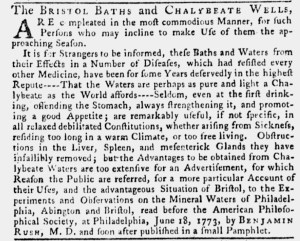
As spring gave way to summer in 1774, the proprietors of the “BRISTOL BATHS and CHALYBEATE WELLS” ran an advertisement in the Pennsylvania Gazette to advise residents of Philadelphia and other towns that they provided services “in the most commodious Manner, for such Persons who may incline to make Use of them [during] the approaching Season.”  For any “Strangers” who were not familiar with “these Baths and Waters,” the proprietors proclaimed that they “have been for some Years deservedly in the highest Repute” for their “Effects in a Number of Diseases, which had resisted every other Medicine.”  The chalybeate (or iron-infused) waters had a restorative effect that made visiting the spa an occasion for recuperation as well as relaxation.  The proprietors provided several examples of maladies that the bathing in and drinking the chalybeate waters alleviated.  They asserted that the waters strengthened the stomach, “promoting a good Appetite,” and rejuvenated “relaxed debilitated Constitutions, whether arising from Sickness, residing too long in a warm Climate, or too free living.”  In addition, the iron-infused waters “have infallibly removed” “Obstructions in the Liver, Spleen, and mesenterick Glands.”

Pennsylvania Gazette (April 27, 1774).

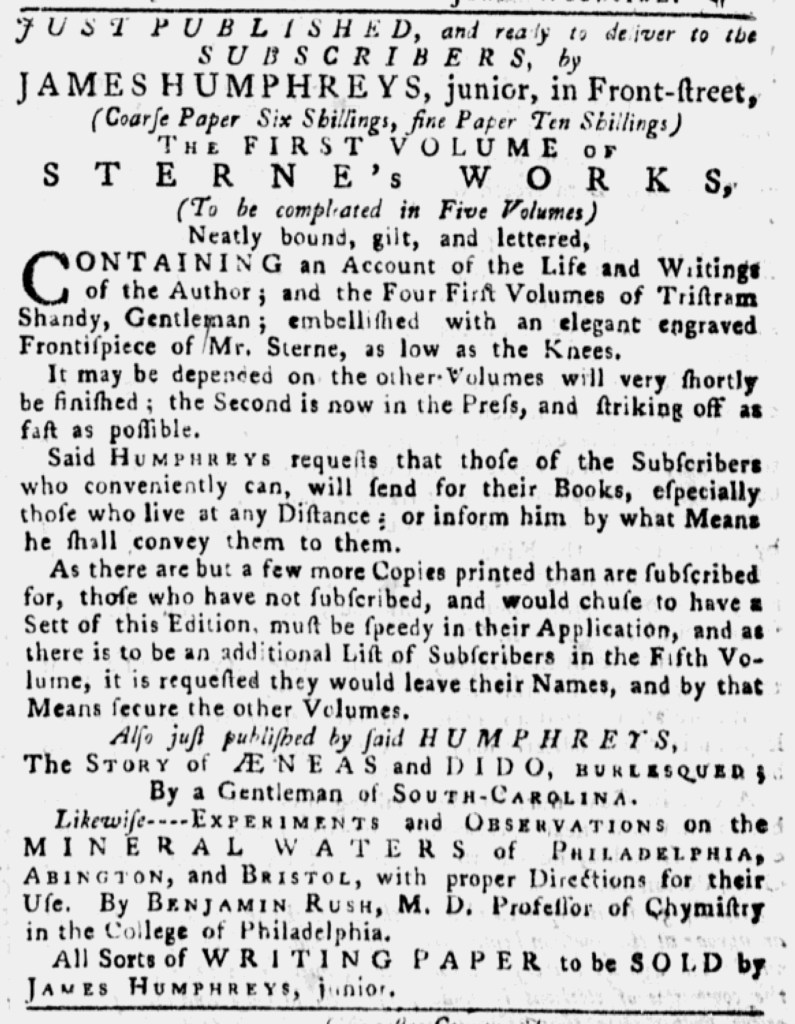
Yet the proprietors did not ask prospective patrons simply to take their word about the effects of the baths and wells in Bristol.  Instead, they declared that the “Advantages to be obtained from Chalybeate Waters are too extensive for an Advertisement, for which Reason the Public are referred” to a pamphlet “by BENJAMIN RUSH, M.D.”  The prominent physician had read a paper, “Experiments and Observations on the Mineral Waters of Philadelphia, Abington, and Bristol,” to the American Philosophical Society on June 18, 1773, and then published it.  The proprietors of the Bristol Baths, Rush gave a more particular Account of their Uses, and the advantageous Situation of Bristol.”  Historian Vaughan Scribner explains that Rush “nurtured colonists’ expanding interest in the science and commercialization of mineral springs.”  The doctor provided a “general location and description of each spring,” described experiments with “mix[ing] more than twenty-one different substances with the mineral waters,” noted several diseases the waters cured (along with only a couple of exceptions), and “contended that the springs could hardly be rivaled for their health and commercial values.”[1]  In the April 27 edition of the Pennsylvania Gazette, printer James Humphreys, Jr., conveniently placed an advertisement on the opposite side of the page as the notice about the Bristol Baths and Chalybeate Wells.  Most of it concerned an update for subscribers to “STERNE’s WORKS,” but the printer appended a note that he sold “EXPERIMENTS and OBSERVATIONS on the MINERAL WATERS … By BENJAMIN RUSH, M.D. Professors of Chymistry in the College of Philadelphia.”  Perhaps that was a happy coincidence for the proprietors of the Bristol Baths and Chalybeate Waters, but maybe they had coordinated with Humphreys to have their advertisements run at the same time.  Either way, they did not direct the public to an obscure pamphlet.  Instead, anyone interested in learning more could easily acquire Rush’s tract.

**********

[1] Vaughn Scribner, “‘The happy effects of these waters’: Colonial American Miner Spas and the British Civilizing Mission,” Early American Studies: An Interdisciplinary Journal 14, no. 3 (Summer 2016): 437, https://doi.org/10.1353/eam.2016.0020.