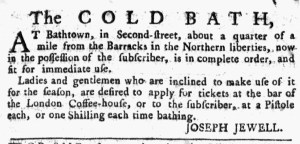
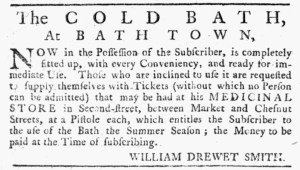
What was advertised in a revolutionary American newspaper 250 years ago today?
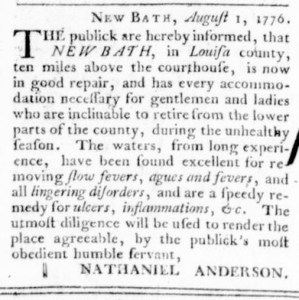
“NEW BATH … has every accommodation necessary for gentlemen and ladies.”
A health tourism industry began developing in America before the American Revolution. As Vaughn Scribner explains, “Americans relied on improvements in transportation, roads, and communication during the second half of the eighteenth century to push spa culture forward. … Such improvements caused colonists increasingly to view mineral springs – as well as the all-important spas that accompanied them – as a prime opportunity for fashionable ‘improvement’ and genteel leisure.”[1] The proprietors of various baths, spas, and mineral springs placed newspaper advertisements inviting guests to visit their establishments. Such notices continued appearing shortly after the Continental Congress declared impendence in July 1776.
Although “regions surrounding northeastern urban centers such as Philadelphia and Boston became especially popular for their well-dev eloped mineral spas,” entrepreneurs in other regions also established and advertised similar facilities. In early August 1776, for example, Nathaniel Anderson placed an advertisement in Alexander Purdie’s Virginia Gazette. “THE publick are hereby informed,” he announced, “that NEW BATH, in Louisa county, ten miles above the courthouse, is now in good repair,, and has every accommodation necessary for gentlemen and ladies who are inclinable to retire from the lower parts of the country, during the unhealthy season.” While some clients might visit New Bath merely for leisure, the proprietor emphasized the health benefits for those afflicted with various maladies. “The waters, from long experience,” Anderson confided, “have been found excellent for removing slow fevers, agues and fevers, and all lingering disorders.” In addition, they provided “a speedy remedy for ulcers, inflammations,” and other afflictions. No matter why clients traveled to New Bath, Anderson would extend exemplary hospitality, promising that the “the utmost diligence will be used to render the place agreeable.” With his advertisement and his facilities at New Bath, Anderson contributed to a process of spas, “along with other ‘improving’ public spaces such as taverns, bowling greens, theaters, and pleasure gardens, … defin[ing] a region’s gentility, sociability, and, ultimately, civility” in the eighteenth century.[2]
**********
[1] Vaughn Scribner, “‘The happy effects of these waters’: Colonial Mineral Spas and the British Civilizing Mission,” Early American Studies: An Interdisciplinary Journal 14, no. 3 (Summer 2016): 440.
[2] Scriber, “happy effects of these waters,” 440.