December 21

What was advertised in a colonial American newspaper 250 years ago today?
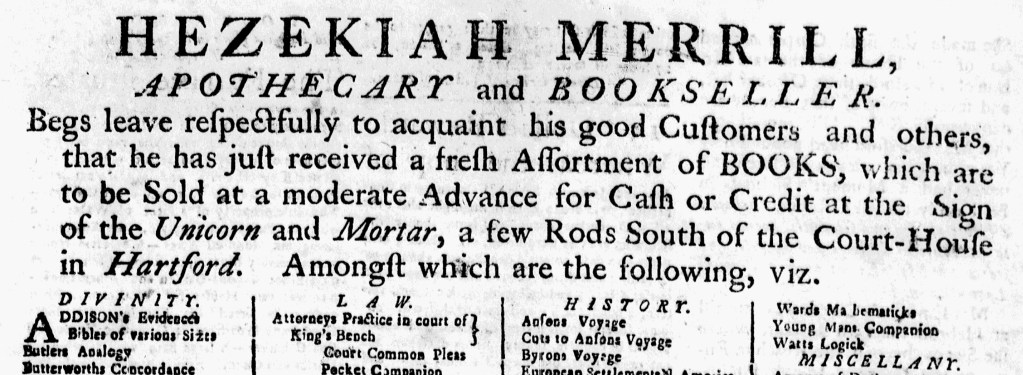
Connecticut Courant (December 21, 1773).

“He has just received a fresh Assortment of BOOKS.”

Hezekiah Merrill, “APOTHECARY and BOOKSELLER … at the Sign of the Unicorn and Mortar” in Hartford, ran a full-page advertisement in the December 21, 1773, edition of the Connecticut Courant.  His name and occupation served as headlines running across the top of the page, followed by an introduction that gave his location and announced that he “just received a fresh Assortment of BOOKS,” which also ran across the entire page.  To aid prospective customers in navigating the advertisement, Merrill divided the books by genre with headings that included “DIVINITY,” “LAW,” “PHYSIC & SURGERY,” “HISTORY,” “SCHOOL BOOKS,” and “MISCELLANY.”  In smaller type, four columns listed individual titles for sale, compared to three columns for news, editorials, advertising, and other contents on the other three pages of the newspaper.  A nota bene in the same size font as the list of titles, ran across the entire page at the bottom.  In it, Merrill promoted stationery, writing supplies, and a variety of items often sold by apothecaries.  In many ways, Merrill’s advertisement dominated that issue of the Connecticut Courant.  It accounted for one-quarter of the total space as well as more space than the other advertisements combined.  When readers perused the issue, Merrill’s advertisement became visible to others gathered nearby.

It was not the first time that the bookseller and apothecary published an oversized advertisement in his local newspaper.  On May 11, 1773, he ran an advertisement that filled two of the three columns on the second page.  He may have made arrangements with Ebenezer Watson, the printer, to produce the advertisement separately as handbills or broadside book catalogs, though no such items have been identified in research libraries, historical societies, or private collections.  Compared to newspapers, often preserved by printers or subscribers in complete or nearly complete runs, handbills and broadside book catalogs were much more ephemeral advertising media.  Still, in the case of Smith and Coit’s broadside book catalog that also ran as a full-page advertisement in the Connecticut Courant in July 1773, Watson had experience producing advertisements in more than one format for his clients.  For Smith and Coit, Watson reset the type, using five columns in the broadside but only four in the newspaper.  He could have done the same for Merrill or, even more easily, printed the newspaper advertisement as a separate handbill or broadside book catalog without making any adjustments to type already set.  Either way, Merrill, Smith and Coit, other booksellers, and other retailers likely distributed more advertisements in the eighteenth century than happen to survive today.

Connecticut Courant (December 21, 1773).

October 5

What was advertised in a colonial American newspaper 250 years ago today?

Connecticut Courant (October 5, 1773).

“At the Sign of the Unicorn & Mortar.”

Hezekiah Merrill ran an apothecary shop in Hartford in the early 1770s.  In October 1773, he placed advertisements in the Connecticut Courant to promote the variety of patent medicines that he sold, including Bateman’s Drops and Cordials, Turlington’s Balsam of Life, and Hooper’s Female Pills.  Each of those remedies would have been as familiar to eighteenth-century readers as popular over-the-counter medications are to modern consumers.  Merrill, like others who sold the same patent medicines, did not believe that they required descriptions when advertising them.  The apothecary also stocked books at his shop.

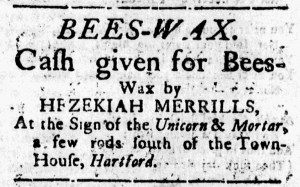
Merrill marked the location of his shop with “the Sign of the Unicorn & Mortar,” an appropriate image for an apothecary, and further advised prospective customers that they could find it “a few rods south of the Town-House.” Residents of Hartford regularly passed the shop and its sign, making it a familiar sight in their daily routines.  For visitors from the countryside, the sign made Merrill’s location unmistakable as they navigated town.  The apothecary encouraged consumers to associate the image of the Unicorn and Mortar with his business, treating it as a logo of sorts.  He inserted two advertisements in the October 5, 1773, edition of the Connecticut Courant, both of them invoking his shop sign.  A longer one on the first page listed the patent medicines and other merchandise, while a shorter one on the third page solicited beeswax in exchange for cash.  Just as residents of Hartford frequently glimpsed the sign, readers of the Connecticut Courant encountered “the Sign of the Unicorn & Mortar” more than once when they perused that issue.

Today, those advertisements testify to some of the sights that colonizers saw as they traversed the streets of colonial Hartford.  According to Thomas Hilldrup’s advertisement in the same issue of the Connecticut Courant, “the sign of the Dial” adorned the shop where he cleaned and repaired watches near the court house.  Other purveyors of goods and services in Hartford almost certainly displayed signs, contributing to the visual landscape of commercial activity in the town.  Few of those signs survive today, except for the descriptions of them in newspaper advertisements.

May 11

What was advertised in a colonial American newspaper 250 years ago today?

Connecticut Courant (May 11, 1773).

BOOKS.”

Hezekiah Merrill’s advertisement for books “JUST IMPORTED, FROM LONDON” filled most of the second page of the May 11, 1773, edition of the Connecticut Courant, filling the space allotted to two columns on other pages.  The compositor, however, did not abide by the usual column width.  Instead, the headline and introduction at the top of the advertisement and a nota bene giving more information at the bottom extended the entire width.  A list of books, one title per line, arranged in three columns accounted for most of the advertisement.  To direct prospective customers to items of interest, Merrill included headers for “DIVINITY,” “LAW,” “PHYSIC & SURGERY,” “HISTORY,” “SCHOOL BOOKS,” and “MISCELLANY.”

Merrill’s advertisement had the appearance of a broadside book catalog that just happened to appear in the pages of a newspaper … and the bookseller may very well have had it printed separately.  Ebenezer Watson, the printer of the Connecticut Courant, made similar arrangements with other advertisers.  In July 1773, for instance, Watson printed a broadside book catalog for Smith and Coit to distribute on their own and inserted it in the Connecticut Courant.  It filled an entire page.  I believe that this previously happened with a full-page advertisement that Smith and Coit placed on August 4, 1772, though no separate broadside book catalog has yet been located.  Similarly, no extant broadside version of Merrill’s advertisement has been identified.

Entrepreneurs created and distributed printed advertisements in a variety of formats in eighteenth-century America, from broadsides and handbills to trade cards and billheads to furniture labels and catalogs.  All of those formats were much more ephemeral than newspaper notices because printers and some subscribers saved their newspapers.  For many newspapers published in the 1700s, we have complete or nearly complete runs, granting access to an array of content that included extensive advertising.  Newspaper notices, in turn, provide evidence of other forms of advertising that have not been preserved by research libraries, historical societies, and private collectors.  Booksellers and auctioneers frequently mentioned catalogs in their newspaper advertisements, but few remain extant.  Merchants, shopkeepers, artisans, tavernkeepers, and others described the signs that marked their locations, sometimes including woodcuts that depicted them, though few of those signs survive today.  Similarly, printers and advertisers likely worked together in producing and distributing far more handbills and broadsides, including broadside book catalogs, than have been saved.  Given its size and unusual format, Merrill’s newspaper advertisement could have circulated separately as part of larger marketing campaign.