June 19

What was advertised in a colonial American newspaper 250 years ago today?
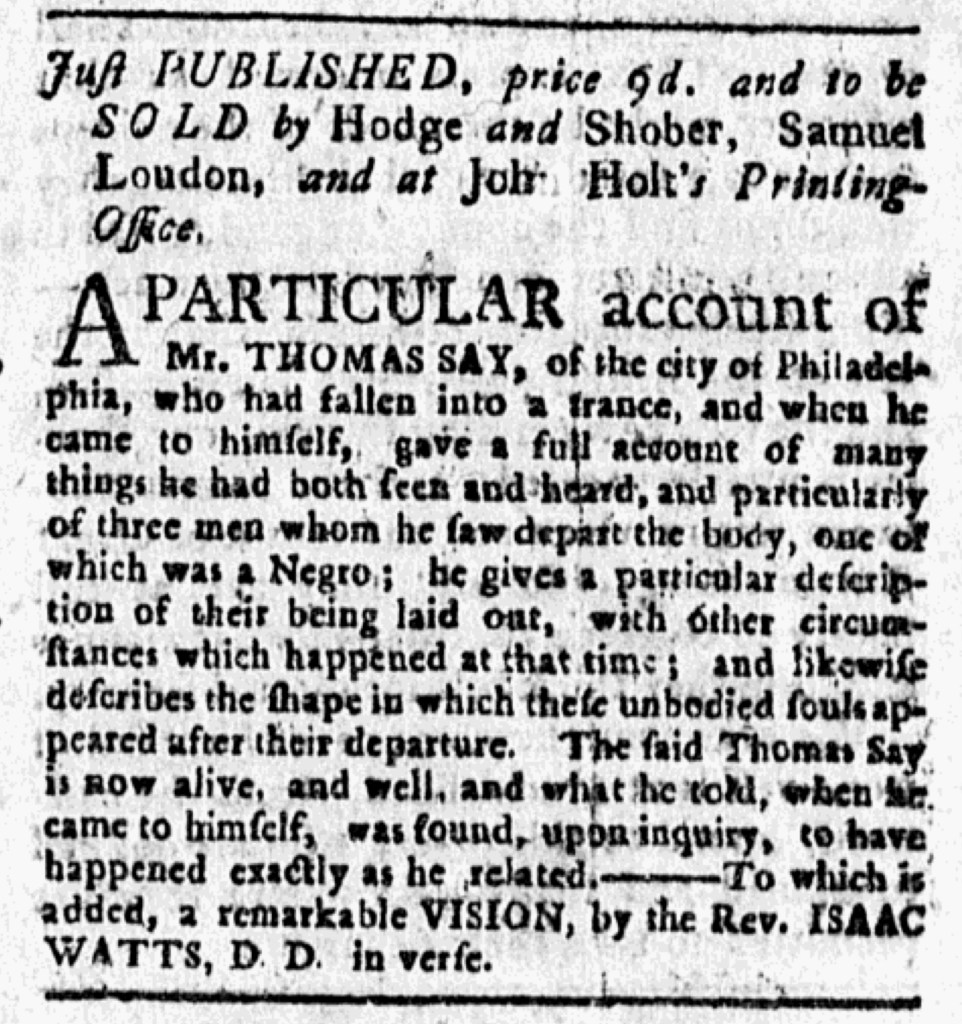
New-York Journal (June 9, 1774).

“A PARTICULAR account of Mr. THOMAS SAY … who had fallen into a trance.”

When William Mentz published The Visions of a Certain Thomas Say, of the City of Philadelphia, Which He Saw in a Trance without permission, Say placed an advertisement in the Pennsylvania Gazette to voice his objection.  He described the text as an “incorrect and imperfect” rendition of what he wished to reveal to the public, further asserting that “publishing any Thing in any Man’s Name without his Knowledge or Consent is, in my Opinion, very unjustifiable.”  He concluded with an appeal to “all Printers … not to aid or assist the said Mentz, or anyone else, in such wrong Proceedings.”

Unfortunately for Say, printers and booksellers in New York either did not see that advertisement or, if they did, chose to disregard it in favor of generating revenue by selling the pamphlet.  An advertisement in the June 16, 1774, edition of the New-York Journal described the contents of the work and noted that readers could purchase copies from printers Robert Hodge and Frederick Shober, bookseller Samuel Loudon, and John Holt, printer of the newspaper that carried the advertisement.  Mentz apparently shipped copies of The Visions of a Certain Thomas Say to New York, perhaps exchanging them for titles printed there.  Local agents felt the pamphlet merited a separate advertisement.  Loudon, for instance, simultaneously ran an advertisement for “BOOKS … TO BE SOLD ON THE LOWEST TERMS” that listed dozens of titles but did not mention The Visions of a Certain Thomas Say.  That advertisement also did not promote any books by providing summaries, unlike the advertisement about the pamphlet that Say wished to withdraw from circulation.

In his own advertisement, Say stated that he “never intended what I have wrote … should be published during my Life.”  More than two decades later, Benjamin Say, his son, published A Short Compilation of the Extraordinary Life and Writings of Thomas Say: In Which Is Faithfully Copied, from the Original Manuscript, the Uncommon Vision, Which He Had When a Young Man.  That work, released following Say’s death in 1796, presumably abided by his wishes for disseminating what he recorded of his vision.  During his lifetime, however, a public notice in the Pennsylvania Gazettehad not been enough to prevent the marketing of an unauthorized account.

July 5

What was advertised in a colonial American newspaper 250 years ago today?

New-York Gazette and Weekly Mercury (July 5, 1773).

“The WITS of WESTMINSTER.”

The headline alone likely the attention of many readers of the July 5, 1773, edition of the New-York Gazette and Weekly Mercury.  It invited them to learn more about a book that Hodge and Shober, printers, and Noel and Hazard, booksellers, offered for sale at their shops, likely an American edition of a book published in London in 1772.  In the advertisement immediately above, Samuel Dellap announced that he stocked copies of The Wits of Westminster “just published.”  Dellap had recently published and advertised an American edition of George Alexander Stevens’s popular Lecture on Heads.  In the second advertisement, the main title of the book served as the headline, while, in both advertisements, the extended secondary title doubled as copy.  When the advertisers described the contents as “A New select Collection of Jests, Bon Mots, humorous Tales, brilliant Repartees, Epigrams, and other Sallies of Wit and Humour, chiefly new and original, being and agreeable and lively Companion for the Parlour, or wherever such a Companion is most necessary and pleasing” they merely copied what appeared on the title page, as many printers, publishers, and booksellers did during the period.

The lengthy secondary title provided additional advertising copy, declaring that The Wits of Westminster contained “more Novelty, than has appeared since the Time of Joe Miller’s Publication.”  According to the British Museum, Joe Miller (1634-1738) was a comic actor whose “reputation as a comedian off-stage was enhanced by the posthumous publication of ‘Joe Miller’s Jests’ in 1739.”  That first edition included 247 numbered jokes.  Subsequent editions included even more.  Miller and, especially, the witticisms collected in the books that bore his name gained so much notoriety that often-repeated jokes became known as “Millerisms.”  A little more than a century after Miller’s death and the publication of Jests, Charles Dickens made reference to the comedian in A Christmas Carol (1843).  Framing The Wits of Westminster as the most entertaining collection of jokes since Jests, published more than thirty years earlier, likely resonated with prospective buyers who would have understood the cultural reference.

In case that was not enough to incite interest, Hodge and Sober and Noel and Hazard added a short poem, a meditation on humor, that distinguished their advertisement from others.  “Haste thee, Nymph, and bring with thee, / Jest and youthful Jollity; / Sport that wrinkled Care derides. / And Laughter, holding both his Sides. / True Wit is like the brilliant Stone, / Dug from the Indian Mine; / Which boasts two various Powers in one, / To cut as well as shine.”  Humor, the poem observed, had the potential both to amuse and to wound, depending on how deployed.  Many of the “Bon Mots,” “brilliant Repartees,” and “Sallies of Wit” in The Wits of Westminster likely did both at once, the humor sometimes depending on belittling the subject of the jest.  While intended primarily for amusement, the book, like the poem in the advertisement, required readers to think about what made something funny.  Even frivolity required contemplation, the advertisers asserted in their efforts to convince prospective buyers to indulge themselves by purchasing The Wits of Westminster.

November 8

What was advertised in a colonial American newspaper 250 years ago this week?

Maryland Gazette (November 5, 1772).

“Intend shortly to exhibit Proposals for publishing a NEWS-PAPER.”

Robert Hodge and Frederick Shober took to the pages of the Maryland Gazette, published in Annapolis, in the fall of 1772 to advise prospective customers that they did “PRINTING In all it’s DIFFERENT BRANCHES … with the greatest neatness, accuracy and dispatch” at their “NEW PRINTING-OFFICE” in Baltimore.  At the time, the Maryland Gazette was the only newspaper published in the colony, so it served Baltimore as well as Annapolis.

Hodge and Shober, however, had plans for establishing their own newspaper in Baltimore.  They declared that they “intend shortly to exhibit Proposals for publishing a NEWS-PAPER, which shall be justly entitled to the Attention and Encouragement of this FLOURISHING TOWN and PROVINCE, both for ENTERTAINMENT and ELEGANCE.”  They were not the only entrepreneurs to decide that Baltimore seemed ready for its first newspaper.  A week earlier, the Maryland Gazette carried an extensive subscription proposal in which William Goddard announced his plans to publish “THE MARYLAND JOURNAL, AND BALTIMORE ADVERTISER … as soon therefore as I shall obtain a sufficient Number of Subscribers barely to defray the Expence of the Work.”  In a market that did not yet have one newspaper, Hodge and Shober competed with Goddard in their efforts to launch two newspapers simultaneously.

Neither met with immediate success.  Goddard, who was already printing the Pennsylvania Chronicle at the time he published his subscription proposal, did not manage to take the Maryland Journal to press until August 20, 1773, ten months after he announced his plans for the newspaper.  Hodge and Shober never published a newspaper.  In his monumental History of Printing in America (1810), Isaiah Thomas notes that the partners purchased “printing materials” in 1772 and “began business in Baltimore, where they intended to have published a newspaper; but, not meeting with the encouragement they expected, before the end of the year they left Baltimore, and settled in New York.”[1]  A variety of factors likely contributed to their decision to relocate.  Competing with Goddard for subscribers to Baltimore’s first newspaper probably did not help their prospects in the city.

After Goddard commenced publication of the Maryland Journal, Baltimore did gain a second newspaper less than two years later.  John Dunlap, printer of the Pennsylvania Packet, established Dunlap’s Maryland Gazette; or the Baltimore General Advertiser on May 2, 1775.  James Hayes, Jr., seems to have operated the publication on Dunlap’s behalf for three years before acquiring it for himself and changing the name to the Maryland Gazette, and Baltimore General Advertiser on September 15, 1778.  Hodge and Shober were just a few years too early in their efforts, though the war almost certainly played a role in inciting interest to establish more than one newspaper in Baltimore.  Under those difficult circumstances, however, Hayes removed to Annapolis just four months later.  Baltimore did not have a second newspaper of any longevity until after the war.[2]

**********

[1] Isaiah Thomas, The History of Printing in America: With a Biography of Printers & an Account of Newspapers (1810; New York: Weathervane Books, 1970), 480.

[2] See entries in Clarence Brigham S. Brigham, History and Bibliography of American Newspapers, 1690-1820 (Worcester, Massachusetts: American Antiquarian Society, 1947) and Edward Connery Lathem, Chronological Tables of American Newspapers, 1690-1820 (Barre, Massachusetts: American Antiquarian Society and Barre Publishers, 1972).