April 24

What was advertised in a colonial American newspaper 250 years ago this week?
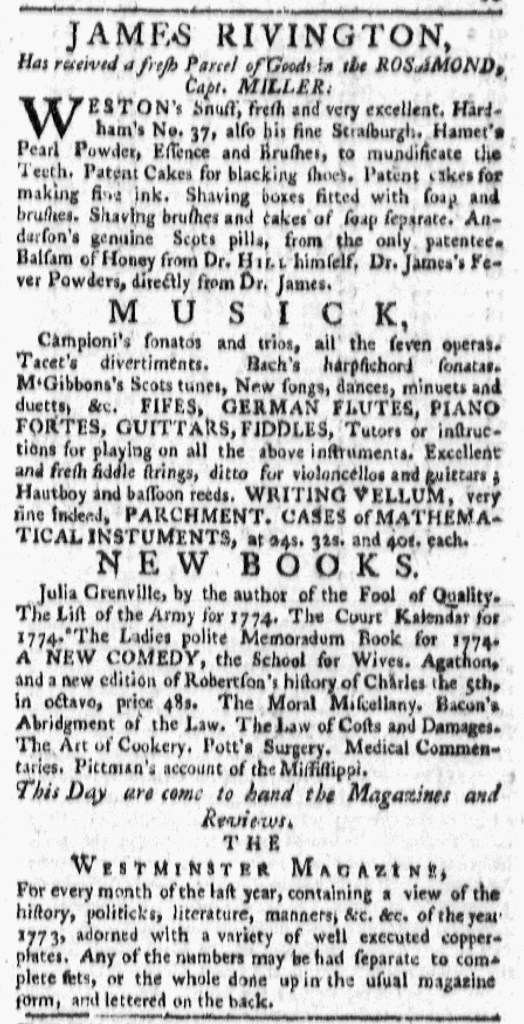
Rivington’s New-York Gazetteer (April 21, 1774).

“Any number may be had separate to complete sets, or the whole done up in the usual magazine form.”

James Rivington, the printer of Rivington’s New-York Gazetteer, cultivated alternate revenue streams at his printing office.  Many printers were also booksellers, peddling books they imported from England.  Such was the case with Rivington.  He devoted a portion of his advertisement in the April 21, 1774, edition of his newspaper to “NEW BOOKS,” listing several that he had on hand.  He also promoted other items from among the “fresh Parcel of Goods” he recently received.  Like many other printers, he sold “cakes for making ink” and popular patent medicines, yet he also stocked a more elaborate inventory of other kinds of goods, including “Shaving boxes fitted with soap and brushes,” “CASES of METHEMATICAL INSTRUMENTS,” and “WESTON’s Snuff, fresh and very excellent.”

The printer and bookseller also advised prospective customers that “This Day are come to hand the Magazines and Reviews.”  In particular, he hawked “THE WESTMINSTER MAGAZINE,” proclaiming that he had copies “For every month of the last year.”  An associate on the other side of the Atlantic had assembled the annual run of the magazine and shipped it to Rivington to peddle to colonizers interested in a review of “the history, politicks, literature, manners,” and other cultural touchstones “of the year 1773.”  To further entice readers, the magazine was “adorned with a variety of well executed copperplates” that buyers could leave intact or remove to frame and display in homes, shops, or offices.  For those who had already purchased some editions but not others, Rivington allowed that “Amy of the numbers may be had separate to complete sets.”  He also offered “the whole done up in the usual magazine form, and lettered on the back.”  In other words, a bookbinder would compile all the issues of the Westminster Magazine from 1773 into a single bound volume and label the spine.  That transformed the separate issues from ephemera into an attractive collection that would enhance any library.

Rivington advertised the Westminster Magazine at the same time that Isaiah Thomas continued marketing the Royal American Magazine, the publication that he launched earlier in the year.  The Royal American Magazine was the only magazine published in the colonies at the time.  Only about a dozen American magazines had been published before that, most of them folding in less than a year and none of them lasting longer than three years.  Instead of American magazines, colonizers usually bought imported magazines from booksellers or received them from correspondents.  Rivington’s method of importing, advertising, and disseminating the Westminster Magazine and other magazines was familiar and standard practice, making the Royal American Magazine the novelty in the American marketplace.

January 29

What was advertised in a colonial American newspaper 250 years ago this week?

New-York Gazette and Weekly Mercury (January 27, 1772).

“The Magazines from January, 1771, to October, inclusive,” Rivington stated, “are likewise come to Hand.”

James Rivington and other American booksellers sold some books printed in the colonies, but imported most of their inventory.  In January 1772, Rivington ran an advertisement in the New-York Gazette and Weekly Mercury to advise prospective that he had recently imported “Lilly’s Modern Entries, a new and correct Edition; Hawkins’s Pleas of the Crown, a new and improved Edition; Wood’s Conveyancer, a new Edition; … [and] a great Variety of other Books in Law, Physick, Divinity, Mathematicks.”  Rivington noted that “the Particulars will be given in a few Days,” signaling to readers that he intended to insert a lengthier advertisement that listed even more titles or perhaps even distribute a book catalog printed separately.

A manicule drew attention to a final note.  “The Magazines from January, 1771, to October, inclusive,” Rivington stated, “are likewise come to Hand.”  American printers published even fewer magazines than books prior to the American Revolution.  They attempted less than fifteen titles before 1775.  Most of those magazines folded in a year or less, though a couple did run for two or three years.  Some printers distributed subscription notices to incite interest, but ultimately had difficulty attracting sufficient subscribers (or advertisers) to make publishing their magazines viable ventures.

When American readers perused magazines prior to declaring independence, they read imported publications printed in London.  Given the time necessary to transport those magazines across the Atlantic, that meant that colonizers read magazines several months after they were published.  That being the case, Rivington’s advertisement for magazines published a year earlier in January 1771 did not offer outdated material.  In fact, the October editions were about as current as any magazines that American consumers purchased.  In addition, Rivington also understood what some customers did with magazines when they acquired them.  Magazines were not just for reading; they were also for display. Some readers collected a “volume” of magazines, usually editions spanning six months or a year, and had them bound together to resemble books.  Advertising magazines “from January, 1771, to October, inclusive,” let customers interested in collecting and displaying a complete run of a magazine that Rivington could supply them with all the issues they needed.  While it may seem strange to modern readers that Rivington advertised magazines published a year earlier, doing so made good sense in 1772 because it resonated with how consumers read and otherwise engaged with those monthly publications.