October 6

Who was the subject of an advertisement in a revolutionary American newspaper 250 years ago today?

“Ran-away … a Negro Man Servant named JACK.”
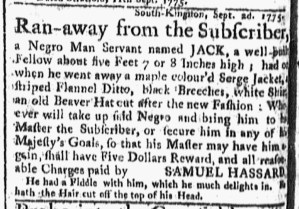
Connecticut Gazette (October 6, 1775).

Even as it carried essays about the imperial crisis and news about one of the first battles of the Revolutionary War, the October 6, 1775, edition of the Connecticut Gazette also ran advertisements described enslaved men and women who liberated themselves by running away from their enslavers.  Each notice encouraged readers to engage in surveillance of Black people they encountered to determine if they matched the description in the newspaper.  Each also offered a reward to those who assisted in capturing fugitives from slavery and returning them to their enslavers.

One of those advertisements, for instance, described a “Negro Man Servant named JACK” who fled from Samuel Hassard of South Kingstown, Rhode Island, at the beginning of September.  He had managed to elude capture for a month.  Hassard described Jack as a “well-built Fellow about five Feet 7 or 8 Inches high,” but did not indicate his approximate age.  At the time he departed, he wore a “maple colour’d Serge Jacket, a striped Flannel [Jacket], black Breeches, white Shirt, [and] an old Beaver Hat cut after the new Fashion.”  Hassard also mentioned that Jack “had a Fiddle with him, which he much delights in” and that he “Hath the Hair cut off the top of his Head.”  Both details made Jack more easily recognizable to readers of the Connecticut Gazette.

In another advertisement, Mortemore Stodder of Groton described a “Negro Girl about 17 or 18 Years old” whose name was once known but did not appear in the notice.  Instead, Stodder informed readers that the “thick set” young woman “speaks good English” and “has a Scar across her Nose and another Scar on the top of one Foot occasioned by a burn.”  In addition to those distinguishing features, she “[h]ad on a tow Shift, a striped woollen Petticoat, and a brown Gown.”  Stodder was so concerned that others might help the young woman remain free that he added a nota bene advising, “All Persons are hereby forbid to harbour, conceal, or carry off the above Servant, on Penalty of the Law.”  There would be consequences beyond Stodder’s frustration and displeasure if he learned that anyone aided this young woman in liberating herself.

As the siege of Boston continued, Timothy Green, the printer of the Connecticut Gazette, published the latest entry in “The Crisis,” a series of essays supporting the American cause, new details about the Battle of Bunker Hill, and an address from George Washington, “Commander in Chief of the Army of the United Colonies of North-America,” to the inhabitants of Canada.  Even as those pieces each promoted liberty in various ways, Green continued a practice adopted by all newspaper printers.  He generated revenue by disseminating advertisements about enslaved people who fled from their enslavers to seize their own freedom.

**********

For all advertisements about enslaved people that ran in American newspapers published 250 years ago today, visit the Slavery Adverts 250 Project‘s daily digest.

June 1

Who was the subject of an advertisement in a revolutionary American newspaper 250 years ago today?

Norwich Packet (June 1, 1775).

“One Dollar Reward [for] a Negro Man, named Jack.”

Among its other contents, the June 1, 1775, edition of the Norwich Packet carried an advertisement that offered a “One Dollar Reward” for the capture and return of “a Negro Man, named Jack” who had liberated himself by running away from his enslaver, Joseph Farnham, Jr. of Canterbury, Connecticut, on the morning of April 8.  Farnham provided a description that included Jack’s age, height, other physical characteristics, and clothing.  He also stated that Jack “speaks broken English,” hoping that would assist readers in identifying the fugitive seeking freedom.  In addition, Jack “has formerly been at Sea.”  He had experience as a sailor, making it even more important to include the standard warning that “All Masters of Vessels and others are forbid to harbour or carry off said Negro, or they may depend on being prosecuted.”  Farnham suspected that Jack was headed to Boston.  He departed before the battles of Lexington and Concord and the siege of Boston.  Those events may have worked to Jack’s advantage, distracting colonizers from taking too much notice of him.

What they certainly did notice was that the imperial crisis had entered a new stage.  “HOSTILITIES are at length commenced in this colony,” Massachusetts, “by the troops under command of General Gage,” Joseph Warren, president pro tem of the Massachusetts Provincial Congress declared in an address to “the INHABITANTS of GREAT-BRITAIN.”  He considered it vital that “an early, true, and authentic account of this inhuman proceeding should be known to you.”  He then outlined the recent battles, especially the “ravages of the troops” in “General Gage’s army.” Farnham’s advertisement about Jack appeared immediately below Warren’s address in the June 1 edition of the Norwich Packet, though most readers likely did not grapple with the contradictions.  On behalf of the Massachusetts Provincial Congress, Warren lamented that “ministerial vengeance against this colony, for refusing, with her sister colonies, a submission to slavery.”  He meant figurative slavery, yet Farnham’s advertisement concerned the literal enslavement of a Black man, prompted by Jack’s quest for his own liberty.  Time and time again, advertisements about enslaved men, women, and children appeared alongside news and editorials about the dangers that Parliament posed to the freedoms of colonizers.  The revenue from Farnham’s advertisement about Jack, for instance, helped in making it possible for the printers to publish an editorial from the president pro tem of the Massachusetts Provincial Congress.

October 1

GUEST CURATOR:  Carl Allard

Who was the subject of an advertisement in a colonial American newspaper 250 years ago today?

South-Carolina Gazette and Country Journal (October 1, 1771).

“RUN-AWAY … a negro man named JACK.”

One part of the mission of the Slavery Adverts 250 Project is to understand the lives of enslaved people through information gathered from “RUN-AWAY” advertisements. In late September 1771, an enslaved man named Jack liberated himself by running away from Meyer Moses, a colonist who bore the name of the biblical figure who liberated the enslaved Israelites yet ironically sought to return Jack to bondage. This advertisement not only details the fascinating biography of Jack, but also remains a testimony to hope. Jack’s escape, a struggle against immense opposition, runs parallel to what we know of his medical history. The ad states Jack was, “much pitted in the face with the small pox, one of his feet frost-bitten.” According to Elizabeth Fenn, medical data from that era suggests the mortality rate of smallpox was quite high; if the hemorrhaging pustules overlapped, one stood a 60 percent chance of dying.  Certainly, Jack’s self-liberation was just the latest in a series of struggles that he had overcome. The advertisement reveals that Jack “speaks good English.” This skill, as David Waldstreicher notes, might have been a powerful tool to secure passage on a ship, as the advertisement stated Jack planned on doing.[1] Waldstreicher also observes that self-liberated people, such as Jack, were often self-fashioning. Clothing choice, such as the “soldier’s coat” Jack wore, was central to the success of enslaved people pursuing freedom, allowing them to try to blend in as free.[2]

**********

ADDITIONAL COMMENTARY:  Carl Robert Keyes

For the next three months, the Adverts 250 Project and the Slavery Adverts 250 Project will feature work undertaken by students who enrolled in my Research Methods: Vast Early America course at Assumption University in Spring 2021.  Required of all History majors in the spring of their junior year to prepare them to pursue their own projects under the direction of a faculty mentor in the capstone seminar in the fall of their senior year, Research Methods focuses on important skills:  accessing and interpreting primary sources and understanding and evaluating secondary sources.  Students complete an historiographical essay for their final project in Research Methods, but throughout the semester they complete smaller projects that help them develop their skills.

To that end, I invite my students to serve as guest curators for the digital humanities projects I have created.  As guest curator, Carl Allard, the author of today’s entry, was responsible for navigating four databases of digitized eighteenth-century American newspapers to create an archive of issues originally published between September 26 and October 2, 1771.  From there, he selected an advertisement to feature on the Adverts 250 Project.  He conducted research to identify secondary sources beyond those we examined in class and then drafted a short entry.  I reviewed that draft and offered suggestions for revisions.  Carl then set about editing and resubmitting his entry.  As he worked on his entry, he also made contributions to the Slavery Adverts 250 Project, composing the tweets to accompany the advertisements that appear on the project this week.  He selected a key quotation from each advertisement and inserted a citation that included the name of the newspaper and publication date.  Throughout the process, he adhered to filename conventions and other methodologies not usually visible to readers and followers but imperative for the behind-the-scenes production of the Adverts 250 Project and the Slavery Adverts 250 Project.  As a result, his classmates, my research assistant, and I could all easily access and consult data Carl contributed to the projects as we each completed our own duties in presenting them to the public.

Each student whose work will be featured in the next three months developed the same skills and made similar contributions.  In that regard they were not merely students but junior colleagues who assumed significant responsibilities in the ongoing production of these digital humanities projects.  They did not simply learn about the past; instead, they spent the semester “doing history” as they prepared to once again “do history” this semester in their capstone seminar.  I very much appreciate the hard work and dedication of each of the guest curators from my Research Methods class.

**********

[1] David Waldstreicher, “Reading the Runaways: Self-Fashioning, Print Culture, and Confidence in Slavery in the Eighteenth-Century Mid-Atlantic,” William and Mary Quarterly, 3rd ser., 56, no. 2 (April 1999): 259-260.

[2] David Waldstreicher, “Reading the Runaways,” 253.