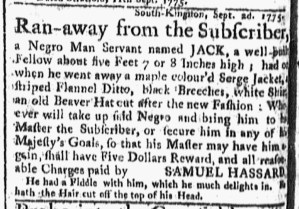
Who was the subject of an advertisement in a revolutionary American newspaper 250 years ago today?
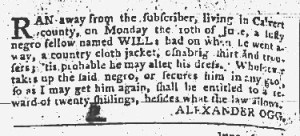
“RUN AWAY … [a] negro fellow named WILL.”
On July 4, 1776, the delegates to the Continental Congress in Philadelphia voted to approve a revised version of a declaration of independence written by Thomas Jefferson, John Adams, Benjamin Franklin, and others appointed for that task. In the 250 years that have passed since that momentous event, the document they approved has become known as the Declaration of Independence and July 4 has been celebrated as the day the colonies, now states, declared their independence from Great Britain. Celebrations and commemorations of that event often overlook other declarations of independence made on July 4, 1776. On that day, American newspapers published more than half a dozen advertisements concerning enslaved people who declared their independence by running away from their enslavers.

The Maryland Gazette, published in Annapolis, carried two such notices. In one, Alexander Ogg of Calvert County offered a reward for the capture and return of Will, a “negro fellow” who liberated himself three weeks earlier on June 10. Ogg described what Will wore when he departed, but he also reported that “‘tis probable he may alter his dress” to avoid detection. In so doing, Ogg acknowledged that Will was clever as well as courageous. In the other advertisement, Anne Gaither of Annapolis sought the return of “a negro fellow named FLANDERS.” She mentioned that he “has been used to go by water,” indicating that he had experience working on boats or ships just like many other enslaved men who lived on or near the Chesapeake Bay. Gaither also reported that Flanders “has no toes,” though she did not elaborate on that detail. Flanders, no doubt, would have told a much more robust story about who he was and what he had experienced if given the opportunity.
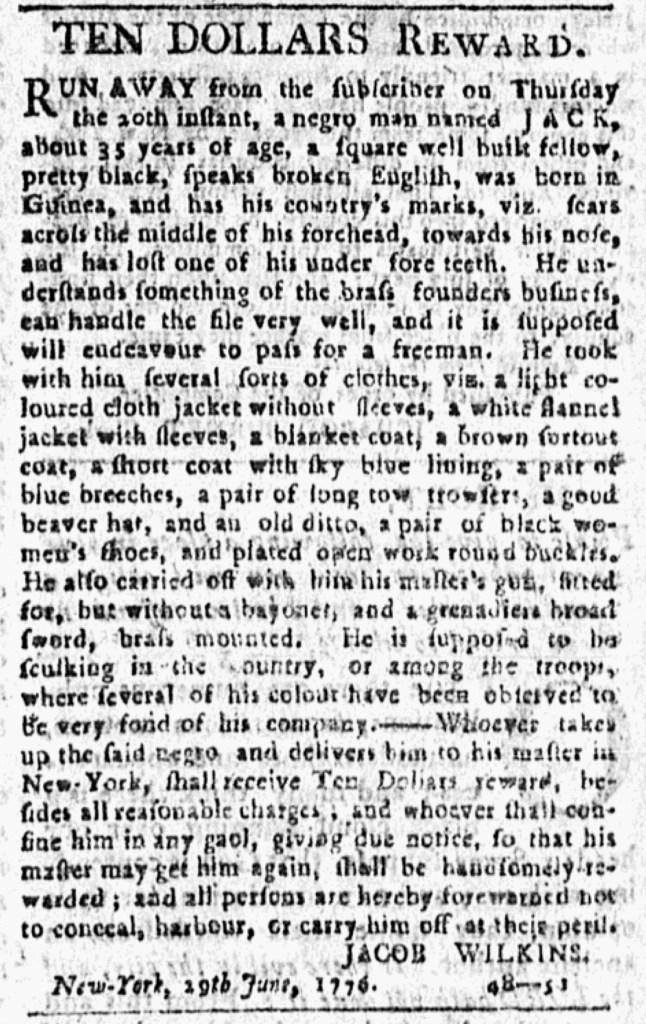
Enslaved people in southern colonies were not the only ones who liberated themselves by running away at the same time that the Continental Congress voted to declare independence. The New-York Journal carried Jacob Wilkins’s advertisement regarding “a negro man named JACK” who liberated himself from his enslaver on June 20. Jack “carried off with him his master’s gun, fitted for, but without a bayonet, and a grenadiers broad sword, brass mounted.” Wilkins suspected that Jack made his way out of the city and was “sculking in the country, or among the troops, where several of his colour have been observed to be very fond of his company.” The many disruptions caused by the war presented opportunities for enslaved people to free themselves by fleeing from their enslavers. To help readers recognize Jack, Wilkins gave his age, “about 35 years,” and mentioned some distinguishing physical characteristics. Having been “born in Guinea,” Jack had “his country’s marks” or ritual scarring “across the middle of his forehead, [and] towards his nose.” At some point, he “lost one of his under fore teeth.” During his enslavement, Jack learned to speak “broken English.” He also developed valuable skills: he “understands something of the brass founders business, [and] can handle the file very well.” Many enslaved people were skilled artisans. Wilkins lamented that Jack “will endeavour to pass for a freeman.” Jack made himself a free man with his decision to escape from Wilkins.

The New York Packet carried another advertisement, this one regarding “a Negro Man, named BEN,” placed by John Taylor of “New Germantown, Hunterdon county, West Jersey.” Ben liberated himself on June 5 and had evaded capture for a month. Taylor focused primarily on describing Ben and his clothing, noting the young man’s height, age (“twenty-two years old”), and a left leg “considerably larger than the other, with a large scar on the small of said leg.” Ben wore a blue coat, red jacket, black breeches, and “calf skin shoes, [with] a pair of carved silver buckles,” though he also took another coat and jacket, “a fine shirt with ruffles at the bosom, a pair of woollen trowsers, [and] a half worn wool hat” in a bag “marked I.T. near the mouth.” Given a chance to write about himself, Ben certainly would have chosen to a tell a different story than the one that Taylor relayed. If readers detected a young black man carrying a bag with his former enslaver’s initials, Taylor offered a reward for securing him in any jail until he could retrieve him.
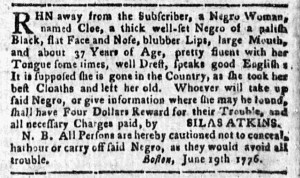
The Continental Journal, published in Boston after the siege of that city ended, carried two advertisements about enslaved people who liberated themselves. Silas Atkins described Cloe, “a Negro Woman” who was “likely gone in the Country, as she took her best Cloaths and left her old.” Atkins gave Cloe’s age (“37 Years’), provided a physical description, and noted that she “speaks good English,” all characteristics that would aid readers in identifying her. Cloe had been gone since the middle of June. Atkins promised that anyone who “will take up said Negro, or give information where she may be found, shall have Four Dollars for their Trouble” as well as any expenses they incurred. In a nota bene, he added a standard warning that appeared in many such advertisements: “All Persons are hereby cautioned not to conceal, harbour or carry off said Negro, as they would avoid all trouble.” The “trouble” would not come from Cloe but rather from legal action undertaken by Atkins.
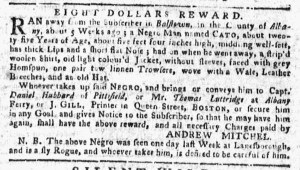
The other advertisement in the Continental Journal concerned “a Negro Man named CATO, about twenty-five Years of Age,” who liberated himself from Andrew Mitchel of “Balstown [Ballston], in the County of Albany, about 5 Weeks ago.” Mitchel described Cato’s features and clothing, but he did not provide other details. He devoted nearly as much space to the network of associates who agreed to aid him by holding Cato until he could retrieve him if a reader managed to capture him. Those seeking the reward could deliver Cato “to Capt. Daniel Hubbard of Pittsfield, [Massachusetts], or Mr. Thomas Luttridge at Albany Ferry, or J. GILL, Printer in Queen Street, BOSTON, or secure him in any Goal [Jail]” and notify Mitchel. In a nota bene, the enslaver reported that Cato “was seen one day last Week at Lanesborough [in western Massachusetts], and is a sly Rogue, and whoever takes him, is desired to be careful of him.” Mitchel meant “sly Rogue” as an insult, not intending to compliment Cato on the ingenuity and perseverance he expected the young Black man to demonstrate in attempting to escape if captured.
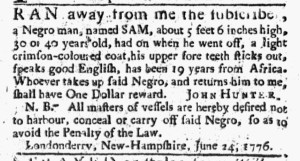
One more advertisement in a newspaper published in Boston, the New-England Chronicle, identified an enslaved man who liberated himself by running away from his enslaver. This one concerned Sam, “a Negro man” who escaped from John Hunter of Londonderry, New Hampshire, in late June. Hunter did not know Sam’s age, estimating that he was “30 or 40 years old,” but he did know that Sam “has been 19 years from Africa” and in that time learned to speak “good English.” Readers might recognize Same from his “upper fore teeth” that stuck out or by the “light crimson-coloured coat” that he wore. Hunter inserted a nota bene with a warning like the one that appeared in Atkins’s advertisement about Cloe: “All masters of vessels are hereby desired not to harbour, conceal or carry off said Negro, so as to avoid the Penalty of the Law.” Hunter included an evocative phrase when he said that Sam “has been 19 years from Africa.” What kind of stories would Sam have told about his own life and his decision to liberate himself after so many years of bondage?
The men who gathered in the Pennsylvania State House (now known as Independence Hall) to declare independence from Great Britain are often called the founders of the nation, yet they were not the only ones who envisioned freedom from oppression. They were members of a founding generation that included soldiers and farmers, women and youth, and many others from diverse backgrounds who contributed to the American cause. Will, Flanders, Jack, Ben, Cloe, Cato, and Sam were all founders as well. They made their own declarations of independence during the era of the American Revolution and their former enslavers published those declarations of independence on July 4, 1776. Will, Flanders, Jack, Ben, Cloe, Cato, and Sam joined countless other enslaved men and women who seized their liberty during the seventeenth, eighteenth, and nineteenth centuries. Those courageous and resilient men and women sought freedom long before the American Revolution and continued seeking freedom long after the American Revolution. Their stories matter and must be told alongside the stories of other founders as we celebrate and commemorate 250 years of independence.
For other stories of enslaved people liberating themselves originally published on July 4 during the era of the American Revolution, see:
- An account of Caesar, a blacksmith (Providence Gazette, July 4, 1767)
- An account of Harry, his wife Peg, a free woman, and their two children (Pennsylvania Chronicle, July 4, 1768)
- An account of Guy and Limehouse, two youths (South-Carolina and American General Gazette, July 4, 1769)
- An account of Jack, a Black man, and Tony, an Indian man, who took a boat when they made their escape (South-Carolina and American General Gazette, July 4, 1770)
- An account of Violet, a woman who eluded capture by her former enslaver for at least nine years (Pennsylvania Journal, July 4, 1771)
- An account of Caesar, who liberated himself at the same time word spread about colonizers burning the Gaspee (Providence Gazette, July 4, 1772)
- A census of enslaved people who liberated themselves advertised in American newspapers in the week leading up to July 4, 1773
- An account of George, who likely changed his coat to avoid recognition (New-York Gazette and Weekly Mercury, July 4, 1774).
- An account of Solomon, a young man from Baltimore who may have headed to the soldiers in New England in the first months of the Revolutionary War (Dunlap’s Maryland Gazette, July 4, 1775).