February 25

What was advertised in a colonial American newspaper 250 years ago today?

Norwich Packet (February 24, 1774).

“CLOCKS and WATCHES, if left with Mr. JOHN CHAMPLIN, in New-London, will be carefully forwarded to the said HARLAND, and returned with all Expedition.”

In February 1774, Thomas Harland, “WATCH & CLOCK MAKER, From LONDON,” ran an advertisement in the Norwich Packet “to acquaint the public, that he has opened a Shop … in Norwich.”  In it, he incorporated some of the appeals commonly advanced by artisans who migrated across the Atlantic.  In particular, Harland emphasized the quality of his work, declaring that he “makes, in the neatest manner, and on the most improved principles, horizontal, repeating, and plain watches.”  Like others in his trade, he also “cleans and repairs watches and clocks with the greatest care and dispatch.”  Harland devoted a nota bene to engraving and finishing clock faces and cutting and finishing parts, such as watch wheels and fusees, as “neat as in LONDON and at the same price.”  Harland suggested that he offered the sort of superior workmanship available in the largest and most cosmopolitan city in the empire.

Connecticut Gazette (February 25, 1774).

Residents of Norwich and surrounding towns were not the only prospective customers that Harland sought to attract.  He simultaneously ran the same advertisement, with a few modifications, in the Connecticut Gazette, published in New London.  His notice appeared on the front page of the February 25, 1774, edition, supplemented with a short paragraph that informed readers, “CLOCKS and WATCHES, if left with Mr. JOHN CHAMPLIN, in New-London, will be carefully forwarded to the said HARLAND, and returned with all Expedition.”  In his own advertisement on the fourth page of that issue, Champlin, a “GOLDSMITH and JEWELLER,” promoted the work he undertook in his shop and “likewise informs his Customers and others that they may have Clocks and Watches repaired at his Shop as usual.”  Harland’s advertisement suggests that those repairs did not take place in Champlin’s shop, that he instead sent them to Norwich.  Champlin had a history of partnering with associates to provide ancillary services to attract customers to his shop.  The previous fall, Champlin and Daniel Jennings jointly advertised in the New-London Gazette.  In April 1772, Champlin placed a notice in which he stated that he “employed a Person well acquainted” with “Clock and Watch making, mending, cleaning and repairing.”  In December 1769, James Watson advertised that he moved from one silversmith’s shop to Champlin’s shop “where he makes, mends and repairs all kinds of clocks and watches.”  Harland and Champlin mutually benefited from their partnership.  Harland, a newcomer, had an established artisan generating business for him, while Champlin continued providing the same array of services to current and prospective customers.

Champlin may have also played a role in Harland’s marketing efforts.  The watch- and clockmaker in Norwich may have sent his advertising copy to Champlin as part of their regular correspondence rather than directly to the printing office in New London.  An advertisement that had a rather plain appearance in the Norwich Packet featured a variety of embellishments in the Connecticut Gazette.  That version had greater variation in fonts as well as a decorative border.  Champlin’s advertisement also had a decorative border, while most paid notices in the Connecticut Gazette did not.  The compositor could have been responsible for sprucing up Harland’s advertisement, but the connection between Champlin and Harland suggests that the changes may have resulted from specific instructions from one of the advertisers.

December 31

What was advertised in a colonial American newspaper 250 years ago today?

Connecticut Gazette (December 31, 1773).

“Clocks and Watches repaired … as well and cheap as in New-York or Boston.”

John Champlin, a goldsmith and jeweler, ran a shop in New London in the early 1770s.  He occasionally placed advertisements in the Connecticut Gazette to promote the goods and services that he provided.  For instance, as 1773 came to a close, he advised the public that he stocked a “good Assortment of cypher’d and brilliant Ear-ring & Button Stones, Locket Stones, Ring Stones of all Kinds,” “Wires of all Kinds, a neat Assortment of Files,” “Materials for repairing Clocks and Watches,” “best plated Shoe and Knee Buckles,” and “many other Articles.”  Like others advertisers, he intended that a list demonstrating the many choices he offered would entice consumers to visit his shop.

Champlin deployed other marketing strategies as well.  He made an appeal to price, asserting that he sold “All Sorts of Gold-smith, Silver-smith, and Jeweller’s Work as cheap” as anywhere else in the colony.  In so doing, he acknowledged that he operated within a regional rather than a local marketplace.  Prospective customers in New London and nearby towns had the option to send away to smiths and jewelers in New Haven, Hartford, and other towns if they thought they might get better deals, but Champlin assured them that was not necessary.  The market also extended beyond the colony.  Champlin declared that his customers “may have Clocks and Watches repaired at his Shop … as well and cheap as in New-York or Boston.”  In recent months, Thomas Hilldrup, a watchmaker in Hartford, advertised widely in newspapers in Hartford, New Haven, and New London, encouraging colonizers to send their watches to him via post riders.  Champlin may have deliberately avoided alluding to Hartford, not wishing to amplify Hillrup’s marketing efforts, and instead focused on low prices often associated with major ports.  All the same, the message was clear that customers should bring or send their clocks and watches to him rather than sending them for repairs in any other city or town.

The goldsmith and jeweler advanced and adapted some of the most common marketing appeals that appeared in eighteenth-century newspaper advertisements.  He emphasized consumer choice, low prices, and quality.  In so doing, he sought to make himself competitive not only in the town where he kept his shop but anywhere in the colony and throughout New England where readers perused the Connecticut Gazette.

October 15

What was advertised in a colonial American newspaper 250 years ago today?

New-London Gazette (October 15, 1773).

“Begs the Favour of those who are acquainted with his Abilities and Veracity in Business, to recommend him to Others.”

John Champlin, a goldsmith and jeweler, ran a shop near the courthouse in New London in the early 1770s.  In the fall of 1773, he advertised his services and merchandise in an advertisement that ran for several weeks in the New-London Gazette.  To entice prospective customers, he declared that he “makes and sells all Kinds of Gold-Smith, Silver-Smith, and Jeweller’s Work as cheap as is sold in this Colony.”

Champlin shared his shop with Daniel Jennings, an artisan who pursued an adjacent trade.  Jennings advised readers that he “repairs and hath to sell, all Kinds of Utensils for repairing Clocks and Watches.”  Recognizing that he operated within a regional marketplace, he asserted that he set prices “as cheap as can be had in New-York or Boston.”  Prospective customers, he suggested, did not need to send their clocks and watches to artisans in either of those urban ports.

Jennings did not mention, perhaps intentionally, the prices for similar goods and services in Hartford, though Thomas Hilldrup, a competitor in that town, had advertised extensively in the New-London Gazette and the Connecticut Journal and New-Haven Post-Boy as well as in the Connecticut Courant, the newspaper published in Hartford.  Perhaps Jennings did not mention Hartford because he did not wish to call any more attention to Hilldrup, a relative newcomer whose aggressive advertising campaign targeted prospective customers well beyond the town where he settled.

To secure his share of the market, Jennings issued a plea for “those who are acquainted with his Abilities and Veracity in his Business, to recommend him to Others.”  He considered such recommendations as effective or even more effective than the lengthy advertisements that Hilldrup ran in several newspapers.  After all, even though Hilldrup was industrious with his advertising he had only begun to establish his reputation in Connecticut.  Enlisting satisfied customers could work to Jennings’s advantage if prospective customers trusted word-of-mouth endorsements over flashy newspaper notices.  Whether or not Jennings had Hilldrup in mind when he composed his advertisement, he understood that the power of testimonials from colonizers who had engaged his services in the past.

April 24

GUEST CURATOR: Turner Pomeroy

What was advertised in a colonial American newspaper 250 years ago today?

New-London Gazette (April 24, 1772).

“All Kinds of Goldsmith, Silversmith, and Jewelry Work.”

John Champlin, a goldsmith, advertised in the New-London Gazette on April 24, 1772.  He advertised “all Kinds of Goldsmith, Silversmith, and Jewelry Work.”  He considered being skilled in all three areas very useful, but working with silver was the most prestigious. According to Frances Gruber Saddord, silversmiths worked in “towns up and down the eastern seaboard” in the eighteenth century, but “the three leading cities of Boston, New York, and Philadelphia remained the major centers of silver production throughout the colonial period, for the trade flourished primarily in a thriving urban environment.”  In addition, “colonial craftsmen relied for their success on a network of family and business ties” since “there were no guilds” in the colonies.  As a result, “[i]ntermarriage within the craft was common and many apprentices were related to their masters.”[1]  Working as a goldsmith or silversmith could be very profitable.  Sometimes families involved in the trade rose in the social ranks.

**********

ADDITIONAL COMMENTARY: Carl Robert Keyes

The advertisement that Turner selected provides evidence of the network of business ties that provided support to artisans in early America.  Although Champlin promoted “all Kinds of Goldsmith, Silversmith, and Jewelry Work” that he produced in his shop, that was not his primary purpose in placing an advertisement in the New-London Gazette.  Instead, he wanted readers and prospective customers to know that an employee in his shop did “Clock and Watch making, mending, cleaning and repairing in the very neatest Manner.”  Champlin offered assurances to “Any Gentlemen favouring him with their Custom” that they “may firmly rely on its being done with Alacrity and Dispatch.”  The goldsmith, silversmith, and jeweler likely believed that diversifying the services available in his shop by adding clock- and watchmaking “in its several Branches” helped in cultivating a larger clientele and generating additional revenue.

Champlin pursued that strategy over the course of several years.  In December 1769, James Watson, a clock- and watchmaker “late from London,” placed an advertisement in the New-London Gazette to inform prospective customers that he “removed from Mr. Robert Douglass, silver smith’s shop, to Mr. John Champlin, silver smith’s shop.”  Watson acknowledged that he was “a stranger” to the community, one who relied on Champlin to vouch for him.  The silversmith did so, “strongly recommend[ing] him to all his customers.”  Champlin also stated that he “will warrant [Watson’s] ability and fidelity in any thing he shall undertake in said business” of watch- and clockmaking.  A couple of years later, Champlin once again formed a partnership with a fellow artisan, leveraging his resources – his reputation and his shop – for the benefit of both.  Former customers who had previously employed Watson could decide for themselves how much stock they put in Champlin’s endorsement of a new clock- and watchmaker.  For his part, the smith seemed confident that he had established a good record in that regard.

**********

[1] Frances Gruber Safford, “Colonial Silver in the American Wing,” Metropolitan Museum of Art Bulletin 41, no. 1 (Summer 1983): 8.

December 22

What was advertised in a colonial American newspaper 250 years ago today?

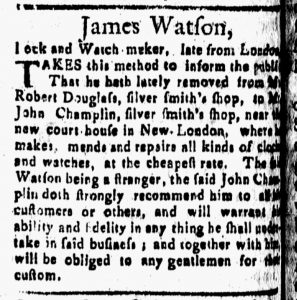
Dec 22 - 12:22:1769 New-London Gazette
New-London Gazette (December 22, 1769).

“The said Watson being a stranger, the said John Champlin doth strongly recommend him.”

James Watson, a clock- and watchmaker “Late from London,” inserted am advertisement in the December 22, 1769, edition of the New-London Gazette to inform prospective clients that he “hath lately removed from Mr. Robert Douglass, silver smith’s shop, to Mr. John Champlin, silver smith’s shop, near the new court house in New-London.” This was not the first time that Watson and his services appeared in the public prints. Just four months earlier Douglass ran another notice, also in the New-London Gazette, announcing that he “employs Mr. James Watson, Clock and Watch Maker, just from London.” Apparently Douglass and Watson quickly discovered some reason to go their separate ways. In the process, Watson pursued the same strategy for integrating into the local marketplace. Rather than open his own shop, he established an affiliation with another artisan already known to local consumers.

In the earlier advertisement, Douglass communicated a guarantee on behalf of the watchmaker, declaring that “Watson will Warrant his Work for Two Years.” Champlin made an even stronger statement of support for the newcomer: “The said Watson being a stranger, the said John Champlin doth strongly recommend him to all his customers or others.” Furthermore, Champlin endorsed Watson’s skill and character, asserting that he “will warrant his ability and fidelity in any thing he shall undertake in said business.” In so doing, Champlin staked his own reputation on the work that he expected Watson to undertake in his shop and the interactions he anticipated Watson would have with the clientele he had already established.

Champlin still considered Watson a newcomer or “stranger” after four months in New London. Prospective clients likely did as well, making it all the more important that Champlin vouched for Watson. Over time the watchmaker could demonstrate his skill to local consumers, but at the start he depended in part on forging relationships with local artisans who practiced affiliated trades, hoping that their clients would also become his clients.