November 15

What was advertised in a colonial American newspaper 250 years ago today?

South-Carolina Gazette and Country Journal (November 15, 1774).

“PUBLIC NOTICE in the three Gazettes of this Province.”

The section for “NEW ADVERTISEMENTS” in the November 15, 1774, edition of the South-Carolina Gazette and Country Journal included a notice from David Deas and John Deas.  “OUR Co-partnership being now expired,” they declared, “we are desirous of brining all our Concerns in Trade to a speedy and final Settlement.”  Like many other merchants, shopkeepers, and other entrepreneurs, the Deases used a newspaper advertisement to call on associates to settle accounts.  Their notice replicated so many others that ran in newspapers throughout the colonies, including a threat of legal action against those who did not respond.  Any “Bonds, Notes, and Book Debts, due to us, which shall not be discharged or settled to our Satisfaction, on or before the 10th Day of March next,” they warned, “will then be put in Suit without Distinction.”  The Deases did not plan to make any exceptions for any reasons, so those with outstanding accounts needed to tend to them by the specified date.

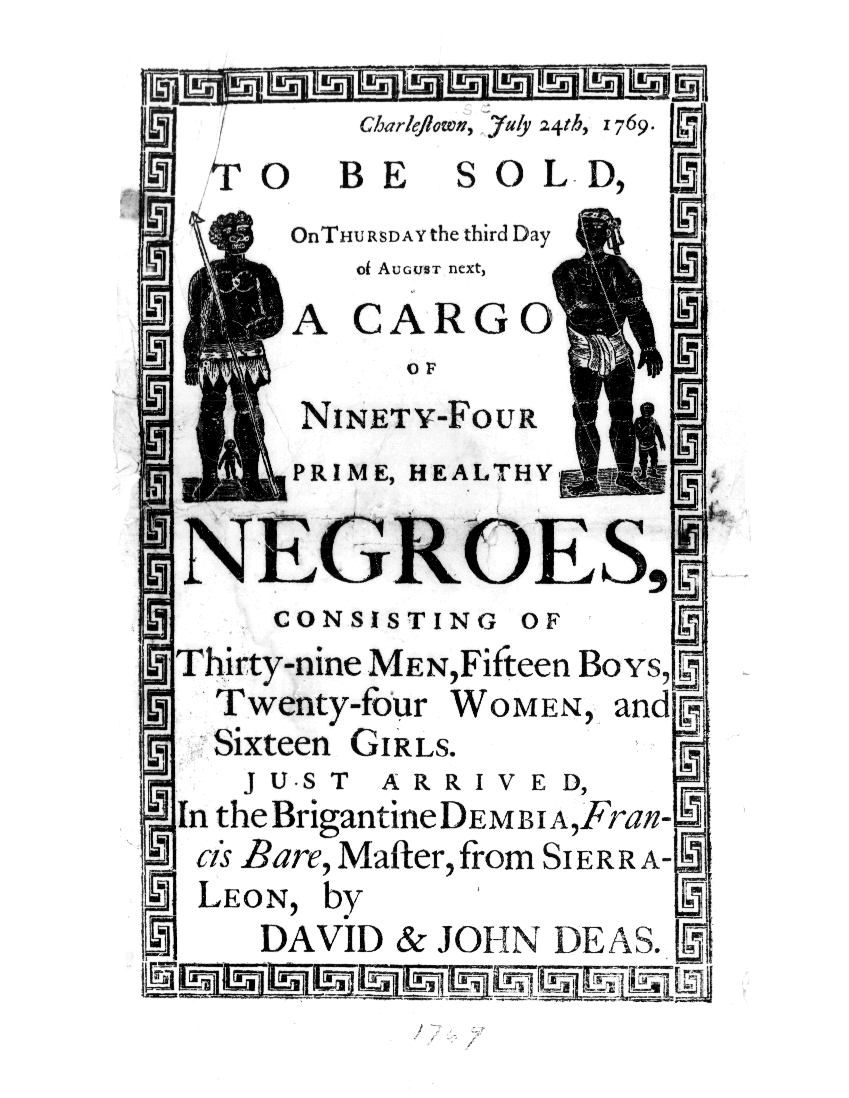
Today, the Deases are best known among historians for their broadside advertising the sale of “A CARGO OF NINETY-FOUR PRIME, HEALTHY NEGROES, CONSISTING OF Thirty-nine MEN, Fifteen BOYS, Twenty-four WOMEN, and Sixteen GIRLS …from SIERRA-LEON” held in Charleston on July 24, 1769.  Yet that was not the only time that they leveraged the power of the press in advancing their business interests.  In this instance, they published their “PUBLIC NOTICE in the three Gazettes of this Province,” submitting it to the South-Carolina and American General Gazette and the South Carolina Gazette as well as the South-Carolina Gazette and Country Journal.  While inserting it in just one of those newspapers would have been sufficient to argue that they gave fair notice, running it in all three increased the likelihood that associates who owed them debts would see their announcement and take heed.  At the same time, placing the advertisement in all three newspapers increased their investment in the endeavor, apparently money the Deases considered well spent if it either had the desired results or gave them a stronger case when they had to resort to going to court.
September 8

What was advertised in a colonial American newspaper 250 years ago today?

Sep 8 - 9:8:1766 South Carolina Gazette
South Carolina Gazette (September 8, 1766).

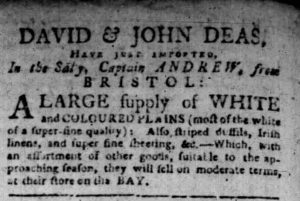
“DAVID & JOHN DEAS, HAVE JUST IMPORTED … an assortment of other goods.”

Contrary to what this short advertisement, rather plain and unremarkable in its appearance, may suggest, David and John Deas made their mark on the history of advertising thanks to the infamous broadsides (what we would call posters today) that they distributed in Charleston, South Carolina, in the decade before the American Revolution.

Not much distinguishes this advertisement for textiles, including “A LARGE supply of WHITE and COLOURED PLAINS,” from other commercial notices about imported goods that appeared in the same issue of the South Carolina Gazette. David and John Deas are much better remembered (and not just by scholars who specialize in economic history or advertising) for this broadside that circulated in Charleston and beyond nearly three years later.

Sep 8 - Deas Broadside
David and John Deas’s broadside for a slave auction (Charleston, 1769). American Antiquarian Society.

This broadside measures 32 x 20 cm (12 ½ x 8 in), which would have made it a good size to post around town or pass out as a handbill. The woodcuts depicting “PRIME, HEALTHY NEGROES” and the graphic design are both crude, but exceptionally memorable, at least to modern viewers. The haunting images of Africans treated as commodities elicit emotional responses today, but that would not necessarily have been the case in the 1760s. While it would have been impossible not to notice the images on the broadside, colonial consumers would not have been shocked by advertisements treating people as commodities. Accustomed to trade cards and billheads with images more skillfully and effectively rendered, colonists likely would not taken particularly favorable notice of the artistic or aesthetic qualities of the broadside.

David and John Deas’s newspaper advertisement for textiles did not indicate any direct involvement with the slave trade, though the merchandise they stocked made them part of transatlantic networks of commerce and consumption that depended on human cargoes and the staple crops produced through the labor of enslaved men, women, and children. Still, the juxtaposition of their newspaper advertisement and their broadside offers an important reminder that advertisements often provide evidence concerning only a portion of a shopkeeper’s, merchant’s, or firm’s business enterprises. How many other advertisers who promoted general merchandise via their advertisements at one time or another imported and auctioned slaves?