January 24

What was advertised in a colonial American newspaper 250 years ago today?

Pennsylvania Evening Post (January 24, 1775).

“THE first Number of the PENNSYLVANIA EVENING POST is now laid before the respectable Public.”

On January 24, 1775, Benjamin Towne launched a new newspaper, the Pennsylvania Evening Post.  The printer distinguished this publication with a publication schedule that differed from all other newspapers in Philadelphia and throughout the colonies, distributing three issues a week on Tuesday, Thursday, and Saturday evenings rather than a single weekly issue.  In an address to “the respectable Public” that opened the inaugural edition, Towne asserted that this publication schedule “will … give particular Satisfaction to all Persons anxious for early Intelligence at this important Crisis.”  To that end, he explained that he timed his issues according to the arrival of the “Eastern Post” that carried newspapers and letters from New York and New England.

The first issue of the Pennsylvania Evening Post did not feature any advertisements, unlike other newspapers founded in the early 1770s, yet Towne sought to attract advertisers to defray the expenses of printing the newspaper.  Although he could not yet promote widespread circulation to entice advertisers, he did note that because “no Paper is published between Wednesday and Saturday, that on Thursday will be very convenient for Advertisements, which shall be punctually and conspicuously inserted.”  Readers in Philadelphia were accustomed to new editions of the Pennsylvania Gazette and the Pennsylvania Journal on Mondays and Dunlap’s Pennsylvania Packet on Wednesdays.  Towne anticipated publication of the Pennsylvania Ledger on Saturdays, realizing that James Humphreys, Jr., would soon print yet another newspaper in Philadelphia.  Humphreys distributed the first issue on January 28.  Still, Towne attempted to seize an advantage, advising advertisers that they could disseminate notices in the Pennsylvania Evening Post during a portion of the week without other publications in Philadelphia.

Towne charged the “usual Rates” for advertisements, though “All Advertisements of useful and ingenious Inventions in Manufactures and Agriculture shall be inserted gratis.”  Savvy readers knew that meant that Towne did his part to support the eighth article of the Continental Association.  It called on all colonizers, “in our several Stations, [to] encourage Frugality, Economy, and Industry; and promote Agriculture, Arts, and the Manufactures of this Country.”  In his “Station” as a printer, Towne could play an important role in delivering information about the “Manufactures of this Country” to the public, provided that advertisers supported his newspaper by supplying him with that information.

Pennsylvania Evening Post (January 24, 1775).

Not long after Towne published the first issue of the Pennsylvania Evening Post, he distributed a broadside that declared, “The first ATTEMPT in AMERICA.  On TUESDAY, the 24th of JANUARY, 1775, was published … An UNINFLUENCED and IMPARTIAL NEWSPAPER, ENTITLED THE Pennsylvania Evening Post, Which will be regularly PUBLISHED every TUESDAY, THURSDAY, and SATURDAY EVENINGS.”  The printer certainly sought to capitalize on the frequency of publication in promoting his newspaper.  Yet he was not entirely correct that his tri-weekly was the “first ATTEMPT” by an American printer.  The American Antiquarian Society’s copy of this broadside, previously bound in a volume with issues of the newspaper from 1775, includes a manuscript notation by Isaiah Thomas: “This is a mistake: a small newspaper, The Spy, was published 3 times weekly, in Boston in 1770.”  Towne may have been unaware that the Massachusetts Spy had been published three times a week in August, September, and October 1770 adjusting its schedule to twice a week in November 1770 and once a week in March 1771.  The Massachusetts Spy had been a tri-weekly just briefly, but Thomas remembered because he and Zechariah Fowle had been partners in the endeavor.  Although Towne was mistaken about the Pennsylvania Evening Post being the “first ATTEMPT” at a tri-weekly, he offered access to the news on a schedule not previously available to subscribers in Philadelphia.

Broadside: Benjamin Towne, “The First Attempt in America” (Philadelphia, 1775). Courtesy American Antiquarian Society.

July 30

What was advertised in a colonial American newspaper 250 years ago today?

New-Hampshire Gazette (July 30, 1773).

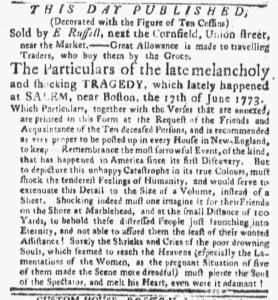
“Just Published, The PARTICULARS of the late Melancholy and Shocking TRAGEDY, which happened at Salem.”

The account of the “most distressing and melancholy Affair” of the drowning of three men and seven women, five of them reportedly pregnant, when their boat sank near Salem during a sudden storm on June 17, 1773, first appeared in the Essex Gazette on June 22 and then in the Boston Evening-Post on June 28 and the Massachusetts Gazette and Boston Weekly News-Letter on July 1.  News also spread beyond the colony where the tragedy occurred.  On June 25, Daniel Fowle reprinted the account from the Essex Gazette in the New-Hampshire Gazette, though some readers likely already heard some of the details via word of mouth.

As was the case in Boston, commemoration and commodification of the drownings, entwined so tightly as to render them inseparable, soon appeared in the public prints.  Ezekiel Russell first advertised a broadside “Decorated with the Figures of Ten Coffins” that related “The Particulars of the late melancholy and shocking TRAGEDY, which lately happened at SALEM” in the July 12 edition of the Boston Evening-Post.  Just three days later, Russell inserted the same advertisement in the Massachusetts Spy, adding a brief note about a second broadside, “An ELEGY on the affecting Tragedy at Salem.”  Fowle apparently acquired copies of the first broadside, which Russell sold “by the Groce,” to sell at his printing office.  A brief advertisement in the July 30 edition of the New-Hampshire Gazette announced, “Just Published, The PARTICULARS of the late Melancholy and Shocking TRAGEDY, which happened at Salem, near Boston, on Thursday, the 17th Day of June, 1773.”

Fowle did not include any of those “PARTICULARS” in the advertisement, nor did he publish any of the extensive memorial that previously appeared in the advertisements in the other newspapers.  Between the account in the New-Hampshire Gazette and conversations about the drownings, he may have thought that the broadside did not need additional explanation.  He also did not have the same financial stake in marketing the broadside that Russell did, likely accepting only as many as he anticipated he could sell.  Russell played on the proximity of the tragedy to Boston in marketing the broadside to readers of newspaper published in that city, though he did proclaim that it “is recommended as very proper to be posted up in every House in New-England, to keep in Remembrance the most sorrowful Event.”  Fowle, on the other hand, did not assert such urgency to readers of his newspaper.  He presented the broadside for prospective customers who might be interested, but did not make the same hard sell in Portsmouth as Russell did in Boston.

July 22

What was advertised in a colonial American newspaper 250 years ago today?

Massachusetts Spy (July 22, 1773).

“An ELEGY on the affecting Tragedy at Salem.”

Three days after Ezekiel Russell first advertised a broadside “Decorated with the Figure of Ten Coffins” that gave the “Particulars of the late melancholy and shocking TRAGEDY,” the drowning of three men and seven women, “which lately happened at SALEM, near Boston, the 17th of June 1773,” in the Boston Evening-Post, he ran a similar advertisement in the Massachusetts Spy.  That new advertisement, repeated in the next issue, included all of the copy from the Boston Evening-Post with the addition of a note about a related item, “An ELEGY on the affecting Tragedy at Salem … By a friend to the deceased.”  These broadsides memorialized the deaths of ten colonizers, including five pregnant women, but they also commodified the tragedy in the form of a keepsake that Russell recommended as “very proper to be posted up in every house in New-England.”  To that end, he offered a similar deal for both broadsides to peddlers who purchased copies to sell near and far.  For the first broadside, the Particulars, Russell noted that “Great allowance is made to travelling Traders, who buy them by the Groce.”  For the other, the Elegy, he offered “an allowance to travelling traders.”

The broadsides each featured an image of ten coffins, each with the initials of one of the drowning victims, and thick mourning borders, but otherwise their contents differed.  In advertising them together, Russell suggested that customers might wish to acquire both as a means of memorializing “the most sorrowful event of the kind, that has happened in America since its first discovery.”  In addition, the broadsides expanded on the coverage that already appeared in newspapers published in Salem and Boston.  The Particulars included the report that first appeared in the Essex Gazette on June 22 as well as an introduction that reiterated the description in the advertisement first published in the Boston Evening-Post on July 12.  The “Names of the Deceased” appeared in the center, surrounded by mourning borders.  A short poem, “The Salem TRAGEDY.  Being a Relation of the drowning of Ten Persons, who were taking their Pleasure on the Water,” appeared below the newspaper account.  It consisted of five stanzas of four line each.  In addition to the ten coffins, an image depicted a strong gust of wind, so strong that it was visible, and a boat foundering in the water.  Mourning borders also surrounded that image.

The Elegy included a shorter introduction that gave the names of the victims and indicated their relationships to each other above a poem, fifteen stanzas in two columns with a double mourning border between them, and a remembrance attributed to “A FRIEND TO THE DECEASED.”  That anonymous friend stated, “Surely no one can fully express the horror and anguish of mind these People’s friends at MARBLEHEAD must suffer … resulting from this amazing catastrophe, and which must form such a shocking scene, that it can better be imagined than expressed.”  Yet neither that “FRIEND” nor Russell left the “Tragedy at Salem” to the imagination of consumers.  The “FRIEND” encouraged others to “make a right improvement” in the wake of “such an awful warning as this from GOD.”  Russell may have shared that perspective.  Whatever his views in that regard, he certainly leveraged current events in marketing a relic to consumers, playing on their emotions and curiosity about the extraordinary tragedy.

Detail from “The Particulars of the Late Melancholly and Shocking Tragedy” (Boston: 1773). Courtesy Library of Congress.

July 12

What was advertised in a colonial American newspaper 250 years ago today?

Boston Evening-Post (July 12, 1773).

“The Particulars of the late melancholy and shocking TRAGEDY.”

Ripped from the headlines!  Just a few weeks after the “melancholy and shocking TRAGEDY, which lately happened at SALEM, near Boston, the 17th of June 1773,” Ezekiel Russell advertised a broadside commemorating the deaths of ten drowning victims, three men and seven women.  Compounding the tragedy, five of the women were pregnant, “two or three of them far advanced.”[1]  Several boats had departed from Salem’s harbor “on Parties of Pleasure,” including one boat that took its passengers to Baker’s Island, “where they went ashore, staid and dined.”  When the passengers boarded again, the boat sailed to another part of the island “for the Purpose of Fishing” and later anchored between Baker’s Island and Misery Island, “where they drank Tea.”

When the weather began to look threatening, they determined to try for Marblehead Harbour.”  As the wind intensified, the men recommended to William Ward, “the Commander of the Boat,” that he lower the sails, but Ward insisted that “the Boat would stand it.”  The passengers, “trusting his Judgment, thought proper to submit.”  The women huddled in the cabin, out of the wind and out of the way of the men attempting to get the boat to shore.  When a “sudden, smart Gust of Wind canted the Boat over on one Side,” one of the men, John Becket, had time to open the cabin door and warn the women that “they were all going to the Bottom.”  The Boat “instantly sunk.”  Becket and a “Lad about 15 Years old” were the only survivors.  Becket reported that heard the women shrieking in their last moments.  Observers on shore in Marblehead, about a mile distant, saw what happened and, “by their timely and vigorous Efforts,” launched a small schooner to retrieve Becket and the youth from the water, but it was too late to aid Ward and the women.

Russell presented an even more dramatic scene when he marketed the broadside, suggesting that the boat had been closer to shore than the newspaper accounts indicated.  “Shocking indeed must one imagine it for their Friends on the Shore at Marblehead, and at the small Distance of 100 Yards,” he proclaimed, “to behold these distressed People just launching into Eternity, and not able to afford them the least of their wonted Assistance!”  Ramping up his efforts to play on the emotions of prospective customers, Russell became even more melodramatic: “Surely the Shrieks and Cries of the poor drowning Souls, which seemed to reach the Heavens (especially the Lamentations of the Women, as the pregnant Situation of five of them made the Scene more dreadful) must pierce the Soul of the Spectator, and melt his Heart, even were it adamant!”  It was not Russell who was ghoulish in marketing this broadside, but rather readers who could learn of this “melancholy and shocking TRAGEDY” without it affecting them.  They could demonstrate that the events had indeed moved them by purchasing and displaying the broadside “Decorated with the Figure of Ten Coffins.”

The following day, colonizers from Salem and Marblehead located and raised the sunken boat.  They recovered the bodies of six of women, but did not find the bodies of Mrs. Diggadon and the three men.  They returned the bodies of the women to “the same Wharf from which so much Cheerfulness and Gaiety they departed the Day before.”  At the funerals, the “Solemnity of the several Processions drew together a vast Number of People” of “all Ranks” to mourn the victims of such a tragedy.

That account of the tragedy first appeared in the June 22 edition of the Essex Gazette, published in Salem.  Within the next ten days, the Boston Evening-Post reprinted the news on June 28 and the Massachusetts Gazette and Boston Weekly News-Letter did so on July 1.  Even if colonizers in Salem, Boston, and other towns did not read about the tragedy, they almost certainly heard about it given the way that local news, especially something as “melancholy and shocking” as these drownings, usually spread by word-of-mouth much more quickly than printers could set type.

Russell provided an opportunity for consumers to acquire a keepsake of the tragedy.  He anticipated that they would be eager to do so, offering “Great Allowance … to travelling Traders, who buy [the broadside] by the Groce [or Gross].”  In other words, peddlers who would disseminate the broadside throughout the countryside received a significant discount for purchasing by volume.  Russell claimed that he did not consider it macabre to advertise and sell the broadside, asserting that it was “printed in this Form at the Request of the Friends and Acquaintance of the Ten deceased Persons.”  To incite sales, whether at his shop or from itinerant peddlers, he suggested that it was “very proper to be posted up in every House in New-England, to keep in Remembrance the most sorrowful Event, of the kind, that has happened in America since its first Discovery.”  Even as Russell focused on the emotional response to such a harrowing story, he participated in the commodification of recent events, just as printers, booksellers, and others did following the Boston Massacre and the death of George Whitefield.

The Library of Congress makes an image of the broadside available to the public.

**********

[1] This narrative draws from the account in the Essex Gazette.  That account also appeared in the Boston Evening-Post and the Massachusetts Gazette and Boston Weekly News-Letter and on the broadside.

October 18

What was advertised in a colonial American newspaper 250 years ago today?

“FOR SALE, THE FOLLOWING VALUABLE TRACTS OF LAND.”

South-Carolina Gazette (October 18, 1770).

This advertisement for “VALUABLE TRACTS OF LAND” offered for sale in South Carolina raises questions about its production and distribution.  Accessible Archives includes it as the fifth page of the October 18, 1770, edition of the South-Carolina Gazette.  Like most colonial newspapers, the South-Carolina Gazette consisted of four pages created by printing two pages on each side of a broadsheet and then folding it in half.  Peter Timothy, the printer, distributed one new issue each week, occasionally printing a supplement to accompany the standard four-page issue when he had sufficient content to justify doing so.

This advertisement deviates from several common elements of newspaper publication familiar to historians of eighteenth-century print culture.  Even though printers sometimes circulated supplements, they rarely distributed one-page supplements.  Instead, they created two-page or four-page supplements by printing on both sides of a sheet.  On rare instances did they print one-page supplements, an expensive venture given that paper was such a valuable commodity.  Blank space that could have been filled with news or, even better, advertising that generated revenues was wasteful.  Timothy included a short note on the final page of the October 18 edition that “ADVERTISEMENTS omitted this Week, will be in our next.”  It seems that he had additional content that could have been printed on the other side of the sheet promoting tracts of land for sale.

This suggests that Timothy did not consider the advertisement on the additional sheet part of the issue he published and distributed that week.  Like most newspaper printers, he did job printing as an additional revenue stream.  Orders included broadside advertisements, today known as posters, that could be handed out or hung up around town.  This advertisement was most likely a broadside printed separately.  How did it get associated with the October 18 edition of the South-Carolina Gazette?  It is possible that the advertisers made a deal with Timothy to distribute the broadside with the standard issue, though that was not a common practice.  More likely, at some point someone who acquired the newspaper and the broadside put them together.  Whether that person was a reader, collector, or librarian, their association of the two items took hold.  Accessible Archives replicated it when producing the digitized database of extant issues of the South-Carolina Gazette.

That is the most likely scenario, but certainly not a definitive answer.  The broadside’s inclusion with the October 18, 1770, edition of the South-Carolina Gazette in the digital archive suggests that it could have been part of that issue from the very start.  If so, that raises questions about innovation on the part of both the printer and the advertisers who deviated from standard practices.  It also raises questions about negotiations between the printer and the advertisers, especially in terms of cost and format.  That the broadside is now treated as the fifth page of the newspapers may be the result of an error introduced sometime after the two were printed.  Alternately, this may be evidence of creativity and innovation in the production and distribution of advertising in eighteenth-century America.

November 4

What was advertised in a colonial American newspaper 250 years ago today?

Nov 4 - 11:4:1769 Providence Gazette
Providence Gazette (November 4, 1769).

“To be Sold … by the several Merchants and Shopkeepers of Providence and Newport.”

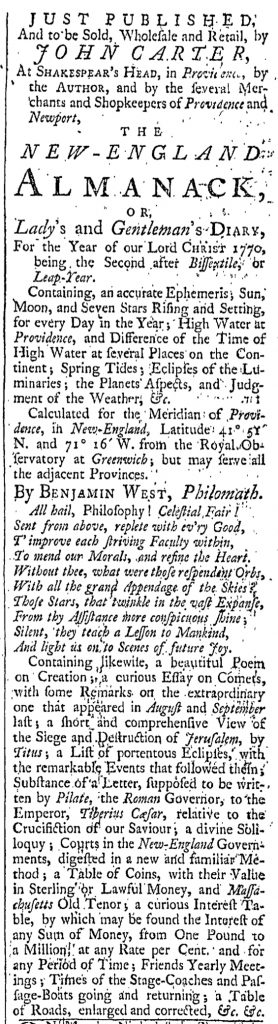
John Carter continued to advertise the New-England Almanack for 1770 in the November 4, 1769, edition of the Providence Gazette. A week earlier he launched his advertising campaign with a full-page advertisement, but he did not continue to give over as much space in subsequent issues of his newspaper. Instead, he condensed the advertisement, filling approximately three-quarters of a column. This made room for other content, especially paid notices that accounted for an important source of revenue for any newspaper printer.

Although the new version of the advertisement filled less space in the Providence Gazette, Carter still managed to insert almost everything than ran in the original. The new version left out only a note to retailers that had appeared at the end: “A considerable Allowance will be made to those who take a Quantity.” It also featured a slight revision to the list of sellers, which originally stated that the almanac was sold “At SHAKESPEAR’S HEAD, in PROVIDENCE, and by the AUTHOR.” The new advertisement made a nod to the popularity of the almanac and the distribution network that Carter devised. Prospective customers could purchase it at the printing office, from the author, of from any of “several Merchants and Shopkeepers of Providence and Newport.” Otherwise, the text of the advertisement did not change from one version to the next.

The addition of merchants and shopkeepers in Newport reveals two important aspects of early American print culture. First, it speaks to the distribution of the Providence Gazette beyond the city where it was printed. Carter expected that colonists who resided in Newport as well as those who lived closer to Newport than Providence would see the advertisement in the Providence Gazette and then obtain copies of the almanac from retailers in Newport.

Second, this strengthens the case that the original full-page advertisement also doubled as a broadside (or poster) that Carter displayed in his shop and posted around town. Business ledgers from eighteenth-century printing offices include records of apprentices hanging posters. (See, for instance, Robert Aitken’s ledger at the Historical Society of Pennsylvania.) Carter could have had boys from his shop post broadsides around Providence without incurring additional expenses or having to give complicated instructions. Making arrangements to have posters hung in Newport, on the other hand, would have been much more complicated and expensive. Thus the Newport merchants and shopkeepers were absent from the full-page advertisement that probably doubled as a broadside but did appear in a subsequent iteration that occupied less space in the newspaper and did not circulate separately. Carter altered the advertisement slightly, likely out of consideration that the two formats had different methods of distribution to prospective customers.

October 28

What was advertised in a colonial American newspaper 250 years ago today?

Oct 28 - 10:28:1769 Providence Gazette
Providence Gazette (October 28, 1769).

“THE NEW-ENGLAND ALMANACK.”

John Carter wanted prospective customers to know that he had “JUST PUBLISHED” the “NEW-ENGLAND ALMANACK, OR, LADY’S and GENTLEMAN’S DIARY, FOR THE Year of our Lord CHRIST 1770” and that it was ready for sale “At SHAKESPEARS’S HEAD, in PROVIDENCE.” To make certain that readers of the Providence Gazette were aware of this publication, Carter exercised his privilege as printer of the newspaper to devote the entire final page of the October 28, 1769, edition to promoting the New-England Almanack. Full-page advertisements were not unknown in eighteenth-century American newspapers, but they were quite rare. In the late 1760s, the printers of the Providence Gazette played with this format more than any of their counterparts in other cities and towns. Still, they did not resort to it often.

Appreciating the magnitude of such an advertisement requires considering it in the context of the entire issue. Like most other newspapers of the era, the Providence Gazette consisted of four pages printed and distributed once a week. Each issue usually consisted of only four pages created by printing two pages on each side of a single broadsheet and then folding it in half. That being the case, Carter gave over a significant portion of the October 28 edition to marketing the New-England Almanack, devoting one-quarter of the contents to the endeavor. By placing it on the final page, the printer also made the advertisement visible to anyone who happened to observe someone reading that issue of the Providence Gazette. Readers who kept the issue closed while perusing the front page put the back page on display. Those who kept the issue open while reading the second and third pages also exhibited the full-page advertisement to anyone who saw them reading the newspaper. Given the size of the advertisement and its placement, prospective customers did not have to read the Providence Gazette to be exposed to Carter’s marketing for the New-England Almanack.

Carter also eliminated the colophon that usually ran at the bottom of the final page. In addition to providing the usual publication information (the name of the printer and the city), the colophon doubled as an advertisement for services provided at Carter’s printing office. Why eliminate it rather than adjust the size of the advertisement for the New-England Almanack? Carter very well likely could have printed the full-page advertisement separately on half sheets that he then distributed and displayed as posters, augmenting his newspaper advertisements with another popular medium for advertising. Broadsides (or posters) were even more ephemeral than newspapers; far fewer have survived. Yet the format of Carter’s full-page advertisement suggests that he had an additional purpose in mind.

March 16

What was advertised in a colonial American newspaper 250 years ago today?

Mar 16 - 3:16:1768 Georgia Gazette
Georgia Gazette (March 16, 1768).

“WHEREAS the following advertisement was stuck up at divers places …”

John Joachim Zubly placed an advertisement concerning a dispute over real estate in the March 16, 1768, edition of the Georgia Gazette. In it, Zubly responded to a separate advertisement that George Galphin and Lachlan McGillivray “stuck up at divers places at Augusta and New-Windsor the beginning of this month.” Zubly opened his own advertisement with an extensive quotation from Galphin and McGillivray’s advertisement, providing readers with the context they needed to understand his rebuttal.

Although the Adverts 250 Project usually features advertisements for consumer goods and services rather than real estate, this notice merits inclusion because it provides a glimpse of another medium used for advertising in eighteenth-century America. Newspaper notices comprised the vast majority of advertising of the period, but advertisers also distributed broadsides, handbills, trade cards, billheads, magazine wrappers, catalogs, and a variety of other printed media for the purposes of disseminating information or attempting to incite demand for goods and services. Although Galphin and McGillivray’s advertisement concerned real estate, others “stuck up” advertisements that promoted the goods they sold in their shops. On occasion, the charges recorded in printers’ ledgers indicate that advertisers paid an additional fee for a boy from the shop to paste their advertisements around town, saving them the time and effort of distributing the advertisements themselves.

Based on Zubly’s description, the advertisement “stuck up at diverse places at Augusta and New-Windsor” was most likely a broadside, a sheet printed on only one side, the eighteenth-century equivalent of a poster (though the size of this particular item may have been closer to a handbill or flier). Zubly responded in print, intending that his advertisement in the Georgia Gazette would reach as many colonists as possible, but he may have also commissioned his own broadside to post in the same places that Galphin and McGillivray distributed theirs.

Even more ephemeral than newspapers, most eighteenth-century broadsides have likely been lost over time. Zubly’s advertisement, however, testifies to the rich landscape of advertising that colonists encountered in their daily lives beyond the pages of the newspapers.

July 6

What was advertised in a colonial American newspaper 250 years ago today?

Jul 6 - 7:6:1767 Boston-Gazette
Boston-Gazette (July 6, 1767).

“At the London BOOK-STORE.”

Bookseller John Mein regularly advertised in Boston’s newspapers in the 1760s, often inserting lengthy advertisements that extended over multiple columns or even filled an entire page. Yet newspaper notices were not the only marketing media utilized by Mein and other eighteenth-century booksellers. They also used broadsides and catalogs to inform potential customers of the titles they sold.

To promote the “Grand Assortment of the most MODERN BOOKS, In every Branch of Polite LITERATURE, ARTS, and SCIENCES” at his “LONDON BOOK-STORE,” Mein distributed a small broadside in 1766. Measuring 20 x 13 cm (8 x 5 in), it could have been posted around town or passed out as a handbill. Unlike his newspapers advertisements, the broadside did not include titles of many books. Instead, Mein listed more than two dozen genres that might interest readers, from Divinity and Philosophy to Travels and Voyages to Anatomy and Midwifery. Potential customers need to visit his shop to discover which titles he stocked.

Jul 6 - Mein Broadside
John Mein’s broadside advertisement (Boston: 1766). Courtesy American Antiquarian Society.

Mein adopted the opposite strategy in the fifty-two-page “CATALOGUE OF CURIOUS and VALUABLE BOOKS” he distributed the same year, listing (and numbering) 1741 different titles. For some, particularly bibles and prayer books, he also described the material aspects of the books, such as “Baskerville’s large Octavo Prayer-Book, bound in red Morocco, gilded” (#1734) and “Tate and Brady’s Psalms, fine Paper, bound in Morocco and Calf, gilded” (#1739). Mein used two different methods in categorizing his books. The first 367 were organized by size: octavo or folio. The remainder, however, fell under subject headings similar to those listed on the broadside. Under certain headings, some books were further demarcated by size. The bookseller aimed to help readers find books that corresponded to their interests, their budgets, their preferences for storing them, and their tastes for displaying them.

Mein’s newspaper advertisement melded aspects of his broadside and catalog, listing multiple titles under several categories. He also added a blurb to promote one book, Oliver Goldsmith’s The Vicar of Wakefield. Lest potential customers not see any books that interested them, Mein concluded by stating that he “has for Sale a grand Assortment of the best AUTHORS in evry Art and Science, and in every Branch of polite Literature.” Like other eighteenth-century booksellers, he experimented with media and organization in his efforts to market his wares. His advertising may have helped to fuel a reading revolution as colonists’ habits veered from intensive reading of devotional literature to extensive reading of many genres, including novels.

The First Full-Page Advertisement in an American Newspaper

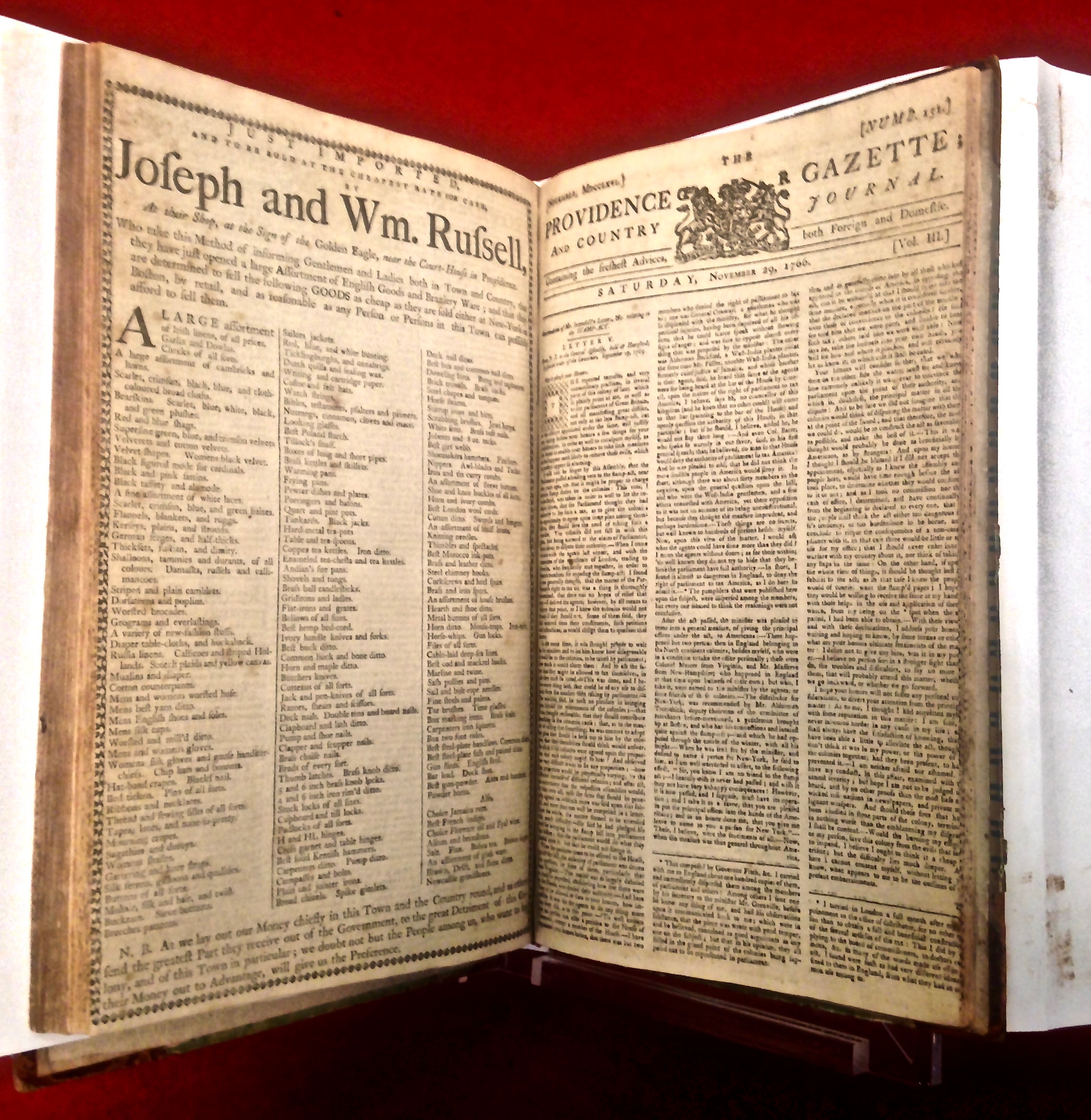
I usually refrain from selecting an additional advertisement to examine on days that my students are serving as guest curators, but I am making an exception in this case because Joseph and William Russell’s advertisement on the final page of the November 22, 1766, issue of the Providence Gazette was just too significant to allow it to pass without acknowledgment. I believe that this is the first full-page advertisement that appeared in an American newspaper!

nov-22-11221766-full-page-providence-gazette
Providence Gazette (November 22, 1766, left; November 29, 1766, right). Courtesy American Antiquarian Society.

For months I have been tracking the innovative layouts designed by Mary Goddard and Company when they began publishing the revived Providence Gazette in the summer of 1766. Between August and November, a trio of advertisers – Thompson and Arnold, Benjamin and Edward Thurber, and Samuel Nightingale, Jr. – placed advertisements that featured decorative borders to set them apart from everything else on the page. Each spanned two columns, dominating the pages on which they appeared. They deviated so significantly from standard eighteenth-century advertisements that they certainly would have attracted the attention of readers. No matter the goods they listed or the appeals the shopkeepers made, these advertisements already caused a visual sensation even before colonists read any of the copy.

Each of these advertisements looked like it could have been printed separately as a trade card that the shopkeepers would have distributed on their own, perhaps recording purchases on the reverse. For the issues of the Providence Gazette in which they appeared, it looked like the oversized advertisements had been positioned in one corner of a page and then the remaining columns built around them.

Given that Mary Goddard and Company were experimenting with size, format, and other graphic design elements on the advertising pages of the Providence Gazette, it probably should not have come as any surprise to find a full-page advertisement occupying the final page of the November 22, 1766, issue. Still, I could not believe my eyes when I saw the digitized image in Readex’s America’s Historical Newspapers database. I needed confirmation, so I visited the American Antiquarian Society and examined the original issue.

nov-22-11221766-full-page-providence-gazette
Providence Gazette (November 22, 1766).

If trade cards had inspired the design of the earlier advertisements, then broadsides must have inspired Joseph and William Russell’s full-page advertisement. Mary Goddard and Company had already played around with mixing genres by placing a trade card within the pages of a newspaper. Making a broadside the entire final page of the newspaper was the logical next step, one that was even more likely to attract notice. Imagine a reader holding up this issue of the Providence Gazette while perusing the pages in the middle. Instead of columns of smaller advertisements typical of other newspapers, observers would have been confronted by a single advertisement larger than any they had preciously encountered in an American newspaper.

I frequently argue that many of the advertising innovations of the twentieth century had precursors in the eighteenth century. Here we see yet another example of eighteenth-century printers and advertisers creating sophisticated marketing materials that have been largely forgotten or overlooked.