August 12

What was advertised in a colonial American newspaper 250 years ago this week?

Aug 12 - 8:11:1766 Newport Mercury
Newport Mercury (August 11, 1766).

“DIRECTIONS for making calcined or PEARL ASHES.”

Advertisements associated with the potash industry appeared quite regularly in colonial newspapers. Some advertisers wanted to buy it, offering a good price in exchange for potash. Others supplied some of the equipment, such as oversized kettles, necessary for producing potash. Although not necessarily directly involved in potash production, printers also published advertisements that indicated they stood to profit from it all the same. Some sold “Justices Blank Certificates” used in the packing and regulation of potash, while others peddled instruction manuals to those who wanted to participate in the industry or improve on their previous efforts.

Such was the case with a short pamphlet (less than twenty pages) devoted to “DIRECTIONS for making calcined or PEARL ASHES, As practised in Hungary, &c.” Samuel Hall, the printer of the Newport Mercury, sold the pamphlet at his shop “on the North Side of the Parade,” but the imprint on the pamphlet itself indicated that it was “Printed for and sold by JOHN MEIN, at the London Book-store” in Boston. Both printers (and quite likely others throughout New England that exchanged stock with Mein) looked to make a profit from indirect involvement in the potash trade through the sale of ancillary products.
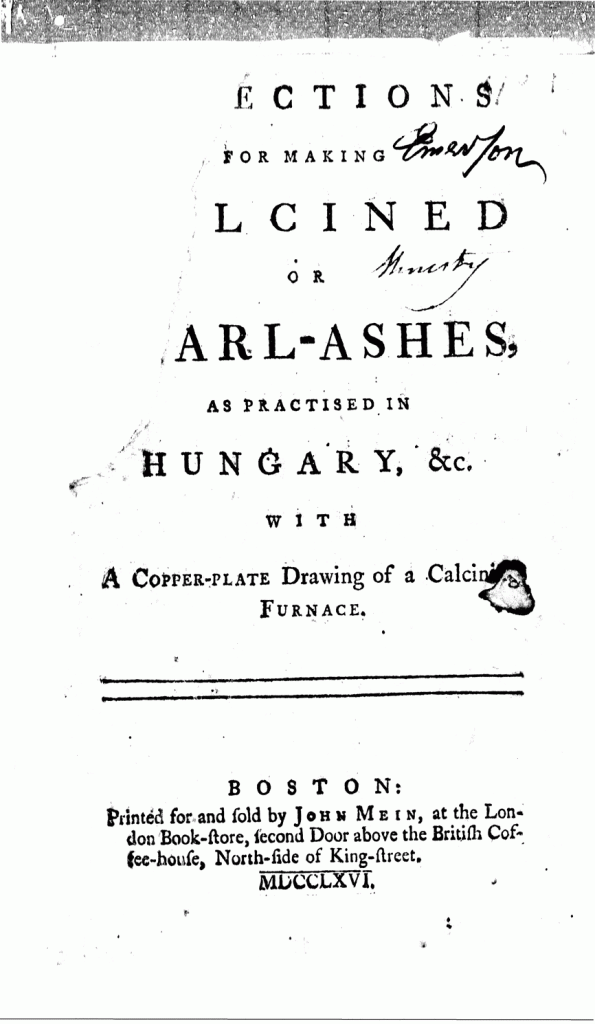
Aug 12 - Potash Pamphlet
Directions for Making Calcined or Pearl Ashes, as Practised in Hungary, &c. with a Copper-plate Drawing of a Calcining Furnace (Boston:  John Mein, 1766).  Boston Public Library.

Both the advertisement and the title page of the pamphlet underscored that it included “a Copper-Plate Drawing of a calcined Furnace.” This would have certainly increased the expense of producing the pamphlet and, ultimately, the cost to the customer, but such an investment could be readily justified. The accompanying image likely offered valuable insight into the text, making it more comprehensible. Art historian Nancy Siegel has argued that engraved images that accompanied eighteenth-century cookbooks were imperative in demonstrating the meaning of the text to readers. The same would have been true for an instruction manual detailing equipment and processes for producing potash, especially for readers not already well versed in the subject. After all, the directions in the pamphlet were “founded on the most extensive Knowledge of Pearl Ashes—a Knowledge acquired by long Practice, Experience and Success. The advertisement warned readers that this was “the only Means to establish Matters of Fact.” It concluded by jeering that “plausible Theories” were “little better than ingenious Amusements.”

In other words, both the text and the engraved copperplate drawing merited attention from anybody serious about potash production. Both were worth the expense.

May 20

What was advertised in a colonial newspaper 250 years ago this week?

May 20 - 5:19:1766 Boston Evening-Post
Boston Evening-Post (May 19, 1766).

“CATALOGUES to be had gratis at the London Book-Store.”

Bookseller John Mein published an advertisement that offered to deliver and distribute another advertising medium to potential customers: his book catalogue. Residents of Boston could pick up a free catalogue “at the London Book-Store, a few Days before the Sale.” While they were there, they could also examine the books, stoking their anticipation of the auction scheduled to take place at the end of the month. Mein also offered to send catalogues to potential customers who lived in the city’s hinterland. (Mein addressed them as “GENTLEMEN in the COUNTRY,” though women read books too.)

May 20 - Catalog Cover
John Mein, A Catalogue of Curious and Valuable Books, To Be Sold at the London Book-Store (Boston:  William McAlpine(?), 1766).  American Antiquarian Society.

Some early American bookseller’s catalogues have been lost over the years, but Robert B. Winans has compiled A Descriptive Checklist of Books Catalogues, Separately Printed in America, 1693-1800 that includes 278 catalogues still extant.[1] In addition, Winans identified eight others not extant but for which good evidence can be found that they were printed, 138 other unlocated catalogues, and 265 references to additional unlocated catalogues from another bibliographer’s American Book Auction Catalogues. Though less than half have survived, book catalogues were a common marketing medium in eighteenth-century America.

May 20 - Catalog Interior
John Mein, A Catalogue of Curious and Valuable Books, To Be Sold at the London Book-Store (Boston:  William McAlpine(?), 1766).  American Antiquarian Society.
May 20 - Catalog Final Page
John Mein, A Catalogue of Curious and Valuable Books, To Be Sold at the London Book-Store (Boston:  William McAlpine(?), 1766).  American Antiquarian Society.

Here’s the main body of Winan’s entry for the catalogue mentioned in today’s advertisement:

Bookseller’s catalogue: total of 1741 consecutively numbered short author entries, 367 in the first catalogue , arranged by format, and 1375 (numbers 368-1741) in the second, arrangement not consistent, partly by format and partly by subject. Subject headings: [miscellaneous]; classics; law; physic and surgery; books of entertainment (the largest group); divinity; tragedies; comedies and operas; pretty little books for children; magazines; political pamphlets, poems, &c.; maps; Bibles, prayerbooks, &c. Date: Mein advertised the catalogue in the Boston Evening-Post, May 19, 1766.

**********

[1] Robert B. Winans, A Descriptive Checklist of Book Catalogues Separately Printed in America, 1693-1800 (Worcester: American Antiquarian Society, 1981).