
What was advertised in a revolutionary American newspaper 250 years ago today?
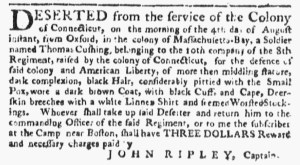
“DESERTED from the service of the Colony of Connecticut … a Soldier named Thomas Cushing.”
Early American newspapers carried various kinds of “runaway” advertisements. By far, the largest number of those notices concerned indentured servants who left before their contracts expired or enslaved people who liberated themselves by escaping from their enslavers. A smaller number of such advertisements featured apprentices and convict servants who, like indentured servants, ran away while they still had time to serve. On occasion, ship captains advertised sailors who did not wish to return to sea, at least not on the same vessel, and seized opportunities to get away while in port. In addition, advertisements about wives who “eloped” from their husbands warned against extending credit to those misbehaving women. In each instance, the advertisements told only part of a story as framed by the master, enslaver, captain, or husband who wrote it.
Shortly after the Revolutionary War began, another sort of runaway advertisement began appearing in newspapers, notices about soldier who deserted. The August 9, 1775, edition of the Massachusetts Spy carried one such advertisement. It reported on “a Soldier named Thomas Cushing” who had “DESERTED from the service of the Colony of Connecticut” on the morning of August 4 while the “10th company of the 8th Regiment” was encamped at Oxford, just a little to the west of Worcester, Massachusetts. The regiment had been “raised by the colony of Connecticut, for the defence of said colony and American Liberty.” The deserter had not fulfilled the commitment he made to the cause, though Captain John Ripley did not indicate Cushing’s reasons for leaving without authorization. Perhaps family obligations trumped political principles, especially once the man experienced life as a soldier, though even those reasons explained but did not excuse deserting. Ripley offered a reward to “Whoever shall take up said Deserter and return him to the commanding Officer of the said Regiment.” The first page of that issue of the Massachusetts Spy featured “RULES and ARTICLES, for the betterGOVERNMENT of the TROOPS raised, or to be raised … by … the TWELVE UNITED ENGLISH COLONIES of NORTH AMERICA.” Those included “ART. 17. No officer or soldier shall lie out of his quarters, or camp, without leave from the commanding officer of the regiment, upon penalty of being punished according to the nature of his offence, by order of a regimental court martial.” Cushing certainly faced consequences if captured and returned to his regiment.
At about the same time that some colonizers resorted to advertisements in the public prints to assure the public of their fidelity to the American cause, other advertisements about soldiers who deserted from the American army began appearing. Newspapers notices provided a means for asserting and assessing loyalty during a time of war.