November 6

What was advertised in a revolutionary American newspaper 250 years ago today?
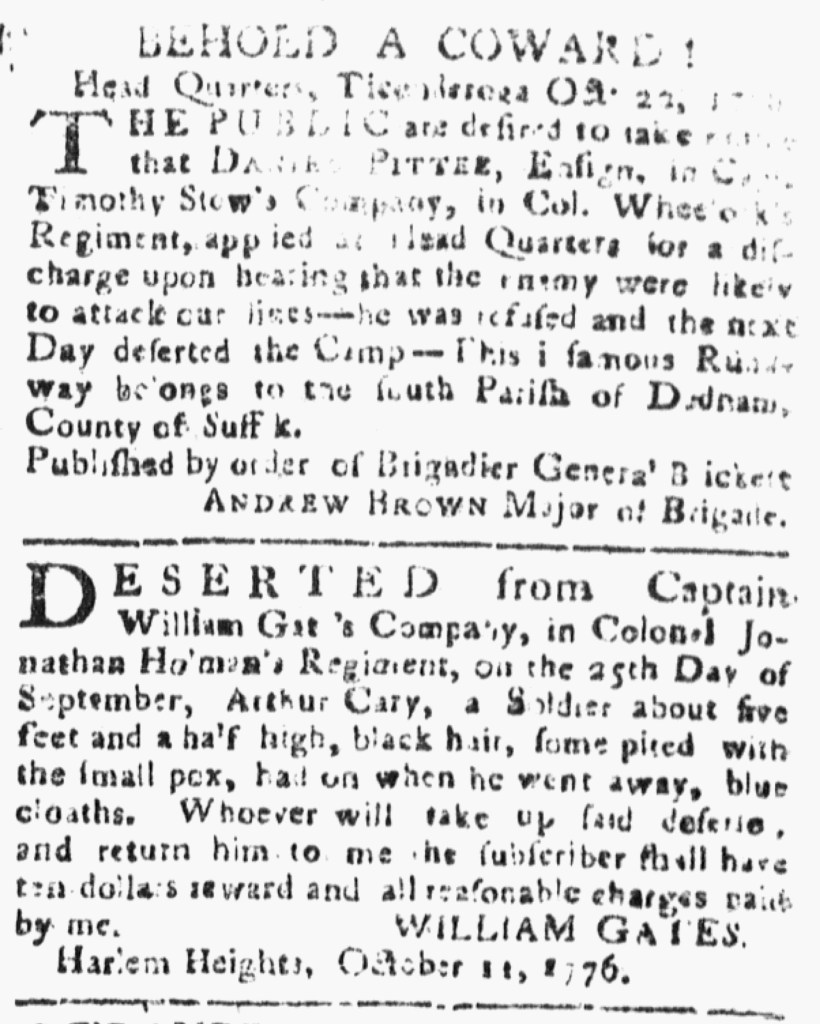
Massachusetts Spy (November 6, 1776).

“BEHOLD A COWARD!”

The harsh tone exceeded what appeared in other advertisements placed for the same purpose.  Before the Revolutionary War, advertisements for runaways abounded in American newspapers.  Aggrieved masters ran advertisements for runaway indentured servants, runaway apprentices, and runaway convict servants.  The notices described the runaways and offered rewards for their capture and return.  Disgruntled enslavers ran similar advertisements about enslaved men and women who liberated themselves by running away.  After the war began, desertion notices started appearing.  In many instances, the number of desertion notices eclipsed advertisements about indentured servants, apprentices, convict servants, and enslaved people combined.

Like those familiar advertisements, desertion notices usually followed a familiar format.  Consider one that appeared in the November 6, 1776, edition of the Massachusetts Spy: “DESERTED from Captain William Gate’s Company, in Colonel Jonathan Holman’s Regiment, … Arthur Cary, a Soldier.”  The advertisement described Cary’s featured and clothing.  “Whoever will take up said deserter,” the notice continued, “and return him to me … shall have ten dollars reward and all reasonable charges paid.”  Many similar advertisements appeared in other newspapers in the fall of 1776.

The advertisement that ran immediately above that one in the Massachusetts Spy took a different approach.  It started with a headline that forcefully condemned the deserter: “BEHOLD A COWARD!”  It then told a story about the circumstances under which “DANIEL PITTEE, Ensign, in Capt. Timothy Stow’s Company, in Col. Wheelock’s Regiment,” deserted from “Head Quarters, [at] Ticonderoga” in October.  “THE PUBLIC are desired to take notice,” the advertisement proclaimed, that Pittee “applied … for a discharge upon hearing that the enemy were likely to attack our lines – he was refused and the next Day deserted the Camp.”  The notice, “Published by order of Brigadier General [James] Brickett,” ran in the Massachusetts Spy and newspapers published in Boston because the “infamous Runaway belongs to the south Parish of Dedham, County of Suffolk,” and his officers apparently suspected he was headed that way.  Unlike other advertisements about deserters, this one did not offer a reward for returning him to his regiment.  Instead, it aimed to humiliate and demean the deserter.  Pittee’s request for a discharge when an attack was likely may have been the deciding factor.  Such cowardice differed from the motivations of other soldiers who deserted in hopes of returning home to protect and aid their families.  The headline certainly attracted attention.  From the very first line, this desertion notice differed from others that so often appeared in newspapers during the Revolutionary War.
August 9

What was advertised in a revolutionary American newspaper 250 years ago today?

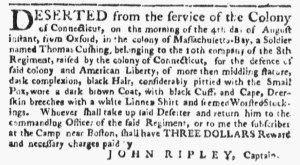
Massachusetts Spy (August 9, 1775).

“DESERTED from the service of the Colony of Connecticut … a Soldier named Thomas Cushing.”

Early American newspapers carried various kinds of “runaway” advertisements.  By far, the largest number of those notices concerned indentured servants who left before their contracts expired or enslaved people who liberated themselves by escaping from their enslavers.  A smaller number of such advertisements featured apprentices and convict servants who, like indentured servants, ran away while they still had time to serve.  On occasion, ship captains advertised sailors who did not wish to return to sea, at least not on the same vessel, and seized opportunities to get away while in port.  In addition, advertisements about wives who “eloped” from their husbands warned against extending credit to those misbehaving women.  In each instance, the advertisements told only part of a story as framed by the master, enslaver, captain, or husband who wrote it.

Shortly after the Revolutionary War began, another sort of runaway advertisement began appearing in newspapers, notices about soldier who deserted.  The August 9, 1775, edition of the Massachusetts Spy carried one such advertisement.  It reported on “a Soldier named Thomas Cushing” who had “DESERTED from the service of the Colony of Connecticut” on the morning of August 4 while the “10th company of the 8th Regiment” was encamped at Oxford, just a little to the west of Worcester, Massachusetts.  The regiment had been “raised by the colony of Connecticut, for the defence of said colony and American Liberty.”  The deserter had not fulfilled the commitment he made to the cause, though Captain John Ripley did not indicate Cushing’s reasons for leaving without authorization.  Perhaps family obligations trumped political principles, especially once the man experienced life as a soldier, though even those reasons explained but did not excuse deserting.  Ripley offered a reward to “Whoever shall take up said Deserter and return him to the commanding Officer of the said Regiment.”  The first page of that issue of the Massachusetts Spy featured “RULES and ARTICLES, for the betterGOVERNMENT of the TROOPS raised, or to be raised … by … the TWELVE UNITED ENGLISH COLONIES of NORTH AMERICA.”  Those included “ART. 17. No officer or soldier shall lie out of his quarters, or camp, without leave from the commanding officer of the regiment, upon penalty of being punished according to the nature of his offence, by order of a regimental court martial.”  Cushing certainly faced consequences if captured and returned to his regiment.

At about the same time that some colonizers resorted to advertisements in the public prints to assure the public of their fidelity to the American cause, other advertisements about soldiers who deserted from the American army began appearing.  Newspapers notices provided a means for asserting and assessing loyalty during a time of war.