May 17

What was advertised in a revolutionary American newspaper 250 years ago today?
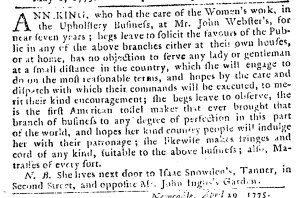
Pennsylvania Journal (May 17, 1775).

“ANN KING … had the care of the Women’s work, in the Upholstery Business, at Mr. John Webster’s.”

Ann King promoted her experience and expertise when she advertised her services in the May 17, 1775, edition of the Pennsylvania Journal, following an example set by artisans, male and female, who placed notices in newspapers during the era of the American Revolution.  She explained that she “had the care of the Women’s work, in the Upholstery Business, at Mr. John Webster’s, for near seven years.”  Although she had worked with Webster for quite some time, he had not acknowledged her contributions to his enterprise in his own advertisements.  Artisans only occasionally mentioned their assistants in their newspaper notices, yet King’s advertisement testified to the invisible labor performed by employees (as well as family members) in many workshops.  In particular, she reveals that women, whether employees or relative, participated on the production side even though editorials usually depicted them exclusively as consumers.

King took pride in her work.  She proclaimed that she “is the first American tostel [tassel] maker that ever brought that branch of business to perfection in this part of the world.”  If readers had ever admired the tassels that adorned any of the furniture upholstered in Webster’s workshop, then they should hire King when they were in the market for that item.  Even if they were not familiar those tassels, King hoped that her long tenure in a workshop operated by an “Upholsterer from London” who had served “several of the nobility and gentry, both in England and Scotland” would recommend her to prospective clients.  She intended for Webster’s reputation to bolster her own.  In addition to tassels, King “likewise makes fringes and cord of any kind,” part of the “Women’s work” she had overseen for Webster, and even “Mattrasses of every sort.”  She did so with “care and dispatch,” hoping to “merit [the] kind encouragement” of her patrons.

Female shopkeepers and milliners occasionally placed newspaper advertisements, far outnumbering the female artisans who did so.  King took to the public prints to advance her business, demonstrating that women did work alongside men in workshops, though their endeavors were sometimes cast as “Women’s work.”  Webster upholstered furniture “in the best and newest taste” for many years, depending on King and other women for assistance with the final product.  King then leveraged that experience in her effort to earn her livelihood by contracting directly with customers.
December 14

What was advertised in a colonial American newspaper 250 years ago today?

Dec 14 - 12:14:1767 Pennsylvania Chronicle
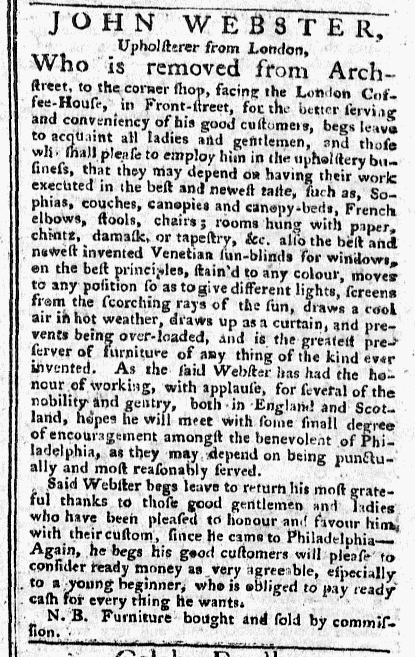
Pennsylvania Chronicle (December 14, 1767).

“Webster has had the honour of working, with applause, for several of the nobility and gentry.”

John Webster, an “Upholsterer from London,” knew that establishing his reputation in Philadelphia would help build the clientele for his endeavors in his new location. To that end, he reported in an advertisement in the December 14, 1767, edition of the Pennsylvania Chronicle that he previously “had the honour of working, with applause, for several of the nobility and gentry, both in England and Scotland.” While providing credentials always helped artisans to promote their businesses, Webster probably did not need to reside in Philadelphia very long to realize that even in the largest city in the colonies the residents experienced anxiety about being perceived as backwater provincials by the better sorts in London, the cosmopolitan center of the empire. He depended on potential customers responding to his pledge of “having their work executed in the best and newest taste,” but indicating that he previously served prominent clients testified to his ability to deliver on that promise.

Yet Webster did not want to give the impression that he had experience only on the other side of the Atlantic. In addition, potential customers may have been skeptical about how extensively he had worked with “several of the nobility and gentry” before arriving in the colony. To alleviate such concerns, Webster extended “his most grateful thanks to those good gentlemen and ladies who have been pleased to honour and favour him with their custom, since he came to Philadelphia.” While this could have also been a ploy, the upholsterer implied that he had already attracted local clients satisfied with his work. Webster created the impression that genteel “ladies and gentlemen” sought after his services. Potential customers who had not yet hire him risked being excluded if they did not contact him before he took on too many other projects.

Webster attempted to attract clients to his upholstery business by creating a buzz among the residents of Philadelphia. Even the location of his new shop, “facing the London Coffee-House,” increased his visibility in the city. His report that he previously served “several of the nobility and gentry” in England and Scotland before working for the “good gentlemen and ladies of Philadelphia” suggested his popularity to colonists concerned with demonstrating their taste and status through the goods they acquired. Implicitly playing on those anxieties, he encouraged them to contract his services in order to keep up with their friends and neighbors.