December 10

What was advertised in a colonial American newspaper 250 years ago today?
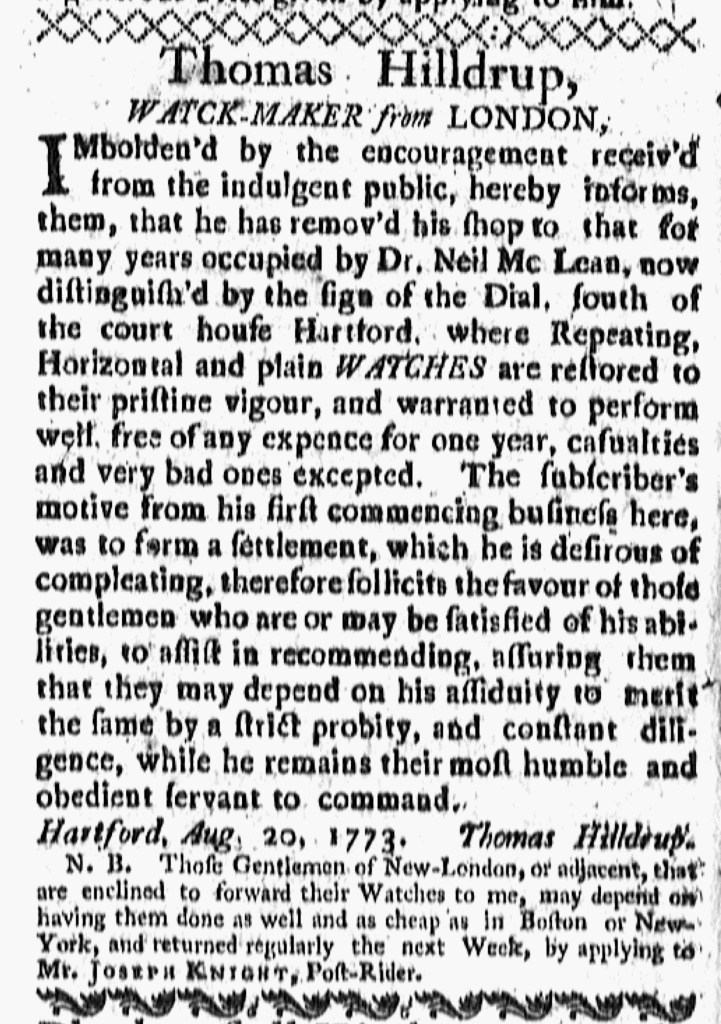
New-London Gazette (December 10, 1773).

“Forward their Watches to me … by applying to Mr. JOSEPH KNIGHT, Post-Rider.”

Thomas Hilldrup, “WATCK-MAKER from LONDON,” continued his advertising campaign in the fall of 1773.  Having settled in Hartford the previous year, he first set about cultivating a local clientele with advertisements in the Connecticut Courant, that town’s only newspaper.  Over time, he expanded his marketing efforts to include the Connecticut Journal and New-Haven Post-Boy and the New-London Gazette.  That meant that he advertised in every newspaper published in Connecticut at the time.  In an advertisement that ran for several months, Hilldrup declared that he had been “IMbolden’d by the encouragement receiv’d from the indulgent public” to move to a new location “now distinguish’d by the sign of the Dial.”  In other words, business had been good, customers had entrusted their watches to the enterprising newcomer for cleaning and repairs, and that demand for his services meant that others should engage him as well.

To that end, Hilldrup presented instructions for sending watches to his shop.  He appended a nota bene to his advertisement in the New-London Gazette, stating that the “Gentlemen of New-London, or adjacent, that are inclined to forward their Watches to me, may depend on having them done as well and as cheap as in Boston or New-York.”  In addition, Hilldrup offered speedy service, promising to return watches “the next Week.”  Clients could take advantage of these services, including a one-year warranty, “by applying to Mr. JOSEPH KNIGHT, Post-Rider.”  Knight did far more than deliver letters and newspapers from town to town.  He also contracted with various entrepreneurs to facilitate their businesses.  In addition to transporting watches for Hilldrup, Knight also sold “An ORATION, Upon the BEAUTIES of LIBERTY,” a popular political tract, in collaboration with Timothy Green, the printer of the New-London Gazette, and Nathan Bushnell, Jr., another post rider.  In forming a partnership with Knight, Hilldrup established an infrastructure for transporting watches to and from his shop, one that he could promote to prospective clients who might have otherwise been anxious about sending their watches over long distances.  Enlisting an associate already familiar in several towns in Connecticut, Hilldrup marketed an approved and secure method for sending watches to him to restore “to their pristine vigour.”

July 2

What was advertised in a colonial American newspaper 250 years ago today?

New-London Gazette (July 2, 1773).

Also at the Printing-Office in Norwich, and by Nathan Bushnell, jun. and Joseph Knight, Post Riders.”

In early July 1773, Timothy Green, the printer of the New-London Gazette, ran an advertisement for a pamphlet that he “Just Publish’d” and sold at the printing office.  He noted that it was the “Third EDITION corrected.”  The Adverts 250 Project has traced the marketing of earlier editions of that pamphlet, John Allen’s “ORATION, Upon the BEAUTIES of LIBERTY, Or the essential Rights of the AMERICANS,” a publication that John M. Bumsted and Charles E. Clark have described as “one of the best-selling pamphlets of the pre-Revolutionary crisis, passing through seven editions in four cities between 1773 and 1775.”[1]

In advertisements in the Massachusetts Gazette and Boston Weekly News-Letter and the Massachusetts Spy on January 14, 1773, Benjamin Kneeland and Nathaniel Davis announced that the pamphlet was “Now in the press, and will be published in a few days.”  A week later, the printers announced “This Day was published” the “SECOND EDITION.”  Newspaper advertisements did not account for the first edition.  It did not take long for Samuel Hall and Ebenezer Hall, the printers of the Essex Gazette, to advertise that they sold the pamphlet at their printing office in Salem.  Copies of the Oration circulated beyond Boston.

Green … or Joseph Knight, a post rider … apparently acquired the pamphlet and determined that the conditions were right to market a third edition in Connecticut.  The imprint on the title page stated, “Printed by T. Green, for Joseph Knight, post-rider.”  The efforts of the printer and the post rider to disseminate Allen’s Oration extended beyond the printing office in New London to include the printing office in Norwich, Knight, and another post rider, Nathan Bushnell, Jr.  Printer-booksellers frequently stocked books and pamphlets published by their fellow printer-booksellers.  They also served as local agents who collected subscriptions for proposed publications.  Newspaper advertisements, however, rarely mentioned post riders as publishers or even as local agents responsible for selling and distributing books and pamphlets.  Green and Knight devised an innovative method for marketing and disseminating this pamphlet, perhaps increasing its circulation and contributing to the popularity that led to four other editions appearing in the next two years.

**********

[1] John M. Bumstred and Charles E. Clark, “New England’s Tom Paine: John Allen and the Spirit of Liberty,” William and Mary Quarterly, 3rd ser., 21, no. 4 (October 1964): 562.