September 11

What was advertised in a revolutionary American newspaper 250 years ago today?
Newport Mercury (September 11, 1775).

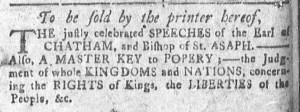
“THE justly celebrated SPEECHES of the Earl of CHATHAM, and Bishop of St. ASAPH.—Also, A MASTER KEY to POPERY.”

To fill the space at the bottom of the last column on the final page of the September 11, 1775, edition of the Newport Mercury, Solomon Southwick, the printer, inserted a short advertisement that listed several books and pamphlet that he sold at his printing office.  Most of them had been featured in longer advertisements, including “the Judgment of whole KINGDOMS and NATIONS, concerning the RIGHTS of Kings, the LIBERTIES of the People, &c.”  Southwick’s edition was one of three printed in the colonies in the past two years.  The printer also stocked the “justly celebrated SPEECHES of the Earl of CHATHAM, and Bishop of St. ASAPH.”  The bishop, a member of Parliament, opposed “altering the Charters of the Colony of Massachusetts Bay,” one of the Coercive Acts enacted by Parliament in retaliation for the Boston Tea Party.  When prevented from delivering his speech during deliberations, he instead published it.  That earned him significant acclaim in the colonies.  William Pitt, the first earl of Chatham, had been “dear to AMERICA” for a decade thanks to his opposition to the Stamp Act.  Southwick’s printing office was clearly a place for Patriots to shop for reading material.

The books on offer included “A MASTER KEY to POPERY.”  Southwick promoted that volume widely even before taking it to press, disseminating subscription proposals in newspapers throughout New England.  They promised an extensive anti-Catholic screed, an exposé of “popery” by a former priest.  Southwick either gained enough subscribers to make the project viable or felt strongly enough about the supposed dangers of Catholicism that he printed the book.  Once he had copies ready for sale, he linked religion and politics in an advertisement that condemned “the infernal machinations of the British ministry, and their vast host of tools, emissaries, &c. &c. sent hither to propagate the principles of popery and slavery, which go hand in hand, as inseparable companions.”  Such prejudices resonated as colonizers expressed dismay over the Quebec Act, yet another of their grievances against Parliament.  That legislation gave several benefits to Catholic settlers in territory gained from the French during the Seven Years War, an insult to Protestants in New England who had sacrificed so much in fighting the British Empire’s Catholic enemies.  For Southwick and many of the readers of the Newport Mercury, support for the American cause and anti-Catholicism went hand in hand during the imperial crisis and the beginning of the Revolutionary War.
July 1

What was advertised in a colonial American newspaper 250 years ago today?

Connecticut Gazette (July 1, 1774).

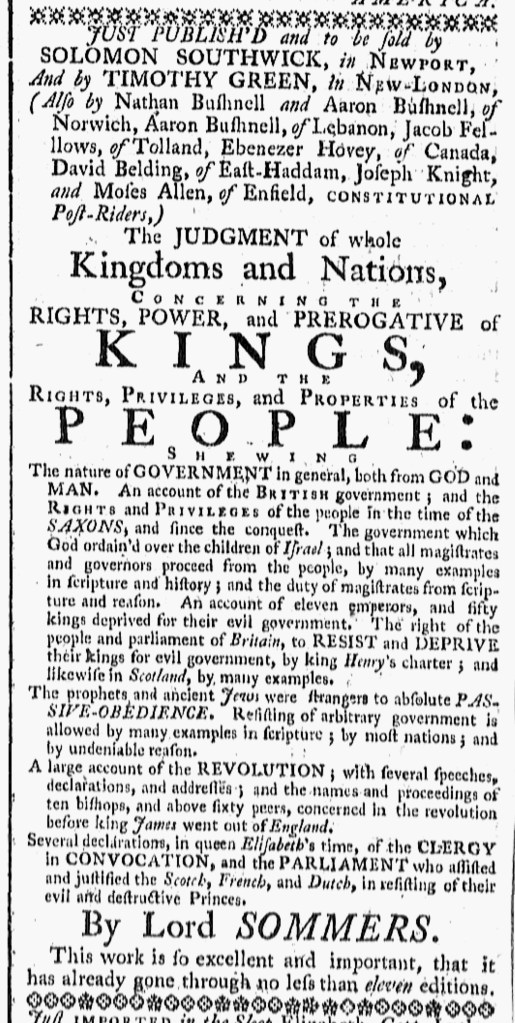
To be sold by … CONSTITUTIONAL Post-Riders.”

The front page of the July 1, 1774, edition of the Connecticut Gazette featured an open letter “TO THE KING” from “AMERICA” followed immediately by an advertisement for a book, The Judgment of Whole Kingdoms and Nations, Concerning the Rights, Power, and Prerogative of Kings, and the Rights, Privileges, and Properties of the People.  The petition requested a redress of grievances that took into account the “rights and privileges … solemnly given, granted, confirmed, ratified and recognized … by your royal predecessors and their parliaments.”  The book, a constitutional history of Great Britain, echoed that theme in much greater detail, making it hardly a coincidence that advertisement just happened to follow the letter.

American printers in three cities had recently produced American editions of The Judgment of Whole Kingdoms and Nations.  In 1773, John Dunlap printed it in Philadelphia and Isaiah Thomas printed it for John Langdon, a bookseller, in Boston.  The advertisement promoted a 1774 edition “JUST PUBLISH’D and to be sold by SOLOMON SOUTHWICH, in NEWPORT.”  Timothy Green, the printer of the Connecticut Gazette, also sold the book in New London.  In addition, readers could acquire it from “CONSTITUTIONAL Post-Riders” who operated out of Norwich, Lebanon, Tolland, East Haddam, and Enfield.  The National Postal Museum explains that the Constitutional Post was “an alternative to the British run Parliamentary Post.”  William Goddard originally established a “new constitutional Post … between [Philadelphia] and Baltimore” and quickly expanded it.  According to the National Postal Museum, Goddard considered the Parliamentary Post “unacceptable because it was not private – postmasters were allowed to intercept and open letters – and because he saw it as another form of taxation without the colonists’ consent.”  Many shared this view; the number of riders in Connecticut affiliated with the Constitutional Post just a few months after its founding demonstrates that was the case.  In July 1775, the Second Continental Congress assumed responsibility for the Constitutional Post, appointing Benjamin Franklin as postmaster.  Goddard desired the position, but he settled for Riding Surveyor of the Post.  By then, the Constitutional Post had demonstrated its capacity for delivering letters, newspapers, and books.  In the summer of 1774, for instance, the Constitutional Post served as a distribution network for The Judgment of Whole Kingdoms and Nations, consistent with Goddard’s vision for maintaining English rights and liberties in the colonies.

February 13

What was advertised in a colonial American newspaper 250 years ago this week?

Boston-Gazette (February 7, 1774).

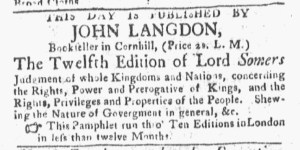
“This Pamphlet run thro’ Ten Editions in London in less than twelve Months.”

American printers and booksellers marketed and sold a variety of political pamphlets and treatises during the imperial crisis that led to thirteen colonies declaring independence from Great Britain.  In addition to hawking items printed in London and imported to the colonies, some of those printers and booksellers also published American editions, as was the case with The Judgment of Whole Kingdoms and Nations, Concerning the Rights, Privileges and Properties of the People.  Three American editions appeared in 1773 and 1774, one in Philadelphia, one in Boston, and one in Newport, Rhode Island.

Several rare book dealers, including Bauman Rare Books, offer overviews of the publication history, contents, and significance of The Judgment of Whole Kingdoms and Nations.  Originally published as Vox Populi, Vox Dei in London in 1709, the pamphlet “examines principles of limited monarchy and the right of resistance to tyranny,” drawing on “historical precedents and reiterat[ing] opposition to absolute monarchy during the time of England’s Glorious Revolution.”  Colonial printers and booksellers both answered the demand for this sort of political philosophy and helped to stoke opposition to king and Parliament by publishing and disseminating this pamphlet and other tracts and treatises.  The Judgment of Whole Kingdoms and Nations “contains the seed of what would become the American Bill of Rights – reprinting the English Bill of Rights – and was read by many of the Founding Fathers, including John Adams and Thomas Jefferson, who owned the Philadelphia 1773 edition.”

Adams may have acquired his copy after reading the advertisement that John Langdon placed in the February 7, 1774, edition of the Boston-Gazette, a newspaper that took an especially vocal stance in support of the Sons of Liberty and the rights of Americans.  Langdon, a bookseller, published the book, engaging the services of Isaiah Thomas as printer.  To incite demand, Langdon informed prospective customers that “This Pamphlet run thro’ Ten Editions in London in less than twelve Months.”  How could anyone interested in politics in the colonies miss out on what was such a popular and influential work in the capital of the empire?  Readers of the Boston-Gazette had to decide for themselves how much to trust Langdon’s assertion about the rapid sales of the pamphlet in London.

That report, however, may have contributed to colonizers overestimating how much the general public on the other side of the Atlantic supported them in their disputes with George III and Parliament.  In Misinformation Nation: Foreign News and the Politics of Truth in Revolutionary America, Jordan E. Taylor argues that American newspapers selectively published reports from London, creating narratives of recent events that matched the ideologies of the printers.  Langdon’s note at the end of his advertisement for a political pamphlet used to support the American cause may have buttressed the narrative that Benjamin Edes and John Gill advanced in the news items and editorials they published elsewhere in the Boston-Gazette.  Declaring that The Judgment of Whole Kingdoms and Nations sold so rapidly in London suggested widespread support for the principles it contained as well as applying them to the American colonies.