September 11

What was advertised in a revolutionary American newspaper 250 years ago today?
Newport Mercury (September 11, 1775).

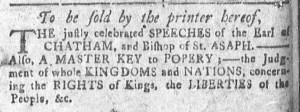
“THE justly celebrated SPEECHES of the Earl of CHATHAM, and Bishop of St. ASAPH.—Also, A MASTER KEY to POPERY.”

To fill the space at the bottom of the last column on the final page of the September 11, 1775, edition of the Newport Mercury, Solomon Southwick, the printer, inserted a short advertisement that listed several books and pamphlet that he sold at his printing office.  Most of them had been featured in longer advertisements, including “the Judgment of whole KINGDOMS and NATIONS, concerning the RIGHTS of Kings, the LIBERTIES of the People, &c.”  Southwick’s edition was one of three printed in the colonies in the past two years.  The printer also stocked the “justly celebrated SPEECHES of the Earl of CHATHAM, and Bishop of St. ASAPH.”  The bishop, a member of Parliament, opposed “altering the Charters of the Colony of Massachusetts Bay,” one of the Coercive Acts enacted by Parliament in retaliation for the Boston Tea Party.  When prevented from delivering his speech during deliberations, he instead published it.  That earned him significant acclaim in the colonies.  William Pitt, the first earl of Chatham, had been “dear to AMERICA” for a decade thanks to his opposition to the Stamp Act.  Southwick’s printing office was clearly a place for Patriots to shop for reading material.

The books on offer included “A MASTER KEY to POPERY.”  Southwick promoted that volume widely even before taking it to press, disseminating subscription proposals in newspapers throughout New England.  They promised an extensive anti-Catholic screed, an exposé of “popery” by a former priest.  Southwick either gained enough subscribers to make the project viable or felt strongly enough about the supposed dangers of Catholicism that he printed the book.  Once he had copies ready for sale, he linked religion and politics in an advertisement that condemned “the infernal machinations of the British ministry, and their vast host of tools, emissaries, &c. &c. sent hither to propagate the principles of popery and slavery, which go hand in hand, as inseparable companions.”  Such prejudices resonated as colonizers expressed dismay over the Quebec Act, yet another of their grievances against Parliament.  That legislation gave several benefits to Catholic settlers in territory gained from the French during the Seven Years War, an insult to Protestants in New England who had sacrificed so much in fighting the British Empire’s Catholic enemies.  For Southwick and many of the readers of the Newport Mercury, support for the American cause and anti-Catholicism went hand in hand during the imperial crisis and the beginning of the Revolutionary War.
December 16

What was advertised in a colonial American newspaper 250 years ago today?

Connecticut Gazette (December 16, 1774).

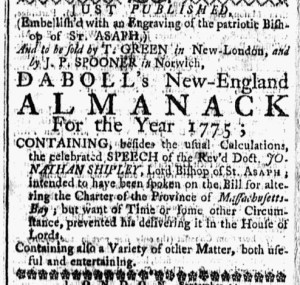
“Embellish’d with an Engraving of the patriotic Bishop of ST. ASAPH.”

With a new year only weeks away, advertisements for almanacs appeared in newspapers throughout the colonies in December 1774.  Most printers who published newspapers also produced almanacs as an alternate revenue stream, joined by other printers who supported themselves by performing job printing.  Consumers had an array of choices when they selected their almanacs for the coming year.

As a result, printers often marketed the contents of their almanacs, emphasizing anything that made them distinctive.  When Timothy Green, the printer of the Connecticut Gazette, advertised “DABOLL’s New-England ALMANACK For the Year 1775,” he indicated that it included the “usual Calculations” as a well as a “Variety of other Matter, both useful and entertaining.”  He emphasized a particular item: “the celebrated SPEECH of the Rev’d Doct. JONATHAN SHIPLEY, Lord Bishop of St. ASAPH; intended to have been spoken on the Bill for altering the Charter of the Province of Massachusetts-Bay; but want of Time or some other Circumstance, prevented his delivering it in the House of Lords.”  Shipley had gained acclaim in the colonies because he had been the only bishop in the Church of England who expressed opposition to the Massachusetts Government Act when Parliament considered how to respond to the Boston Tea Party.  When he did not have a chance to deliver the speech, he opted to publish it instead.

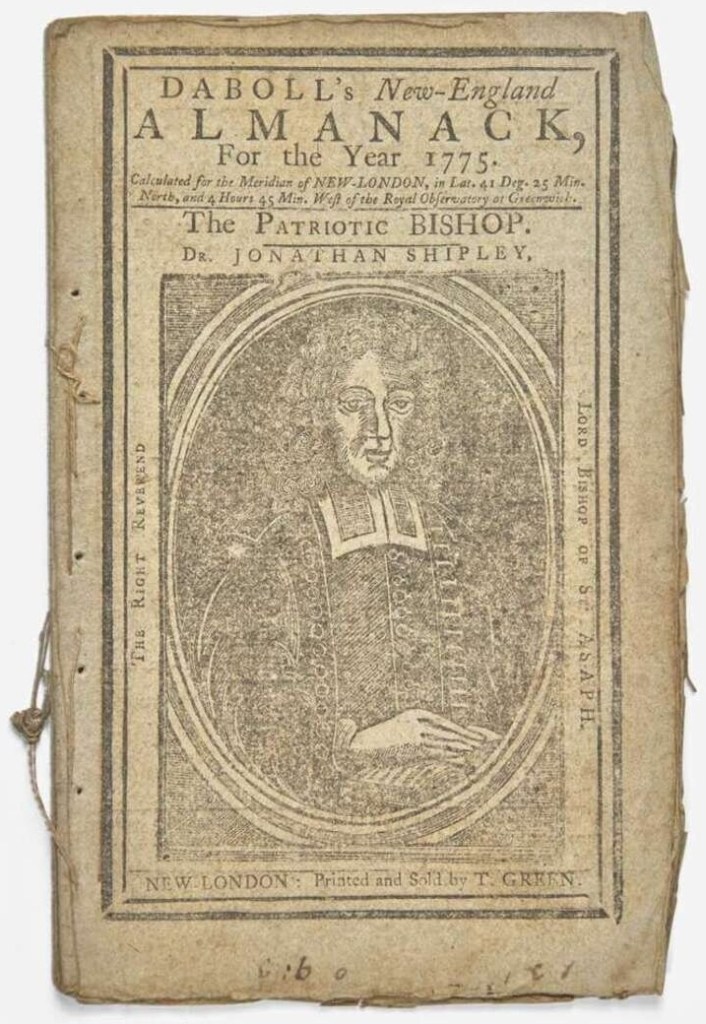
Though Shipley’s speech had little impact in England, the colonizers greeted it warmly.  Several newspapers published the speech, printers advertised pamphlets containing the speech, and Green devoted twelve of the thirty-two pages of Daboll’s New-England Almanack to the speech, anticipating that doing so would entice customers.  Furthermore, he “Embellished [the almanac] with an Engraving of the patriotic Bishop of ST. ASAPH” on the front cover.  Each time readers consulted any of the contents, they glimpsed the bishop whether or not they also read any portion of his speech.  Green advertised Daboll’s New-England Almanack at the same time he promoted his own edition of “The PROCEEDINGS and RESOLUTIONS of The Continental Congress,” joining other printers in producing and disseminating an array of items related to current events and, especially, making a case against the abuses perpetrated by Parliament.

Daboll’s New-England Almanack, For the Year 1775 (New London: Timothy Green, 1774). Courtesy Freeman’s | Hindman.

October 7

What was advertised in a colonial American newspaper 250 years ago today?

Connecticut Journal (October 7, 1774).

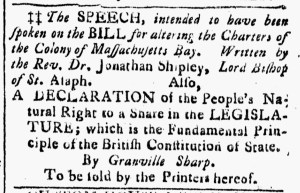
The SPEECH, intended to have been spoken on the BILL for altering the Charters of the Colony of Massachusetts Bay.”

Among the other advertisements that appeared in the October 7, 1774, edition of the Connecticut Journal and New-Haven Post-Boy, Thomas Green and Samuel Green inserted a notice for two political pamphlets “To be sold by the Printers hereof.”  They stocked “The SPEECH, intended to have been spoken on the BILL for altering the Charters of the Colony of Massachusetts Bay.  Written by the Rev. Dr. Jonathan Shipley, Lord Bishop of St. Asaph” as well as “A DECLARATION of the People’s Natural Right to Share in the LEGISLATURE; which is the Fundamental Principle of the British Constitution of State.  By Granville Sharp.”

Both pamphlets supported the American cause against abuses perpetrated by Parliament.  The first critiqued the Massachusetts Government Act, legislation that revoked the colony’s charter, gave greater authority to a governor appointed by the king, and prohibited town meetings without prior approval.  As a bishop of the Church of England, Shipley was a member of Parliament.  He intended to object to the Massachusetts Government Act, one of the Coercive Acts passed in retaliation for the Boston Tea Party, but was not allowed to deliver it.  Instead, he had it published.  Although it had little effect in England, the speech circulated widely and to great acclaim in the colonies.  In addition to imported editions sold by booksellers, colonial printers produced at least eleven American editions in Salem, Boston, Newport, Hartford, New York, Philadelphia, Lancaster, and Williamsburg.  The Massachusetts Gazette and Boston Post-Boy reprinted the speech in a supplement that accompanied its September 12, 1774, edition.  In addition, Daboll’s New-England Almanack, for the Year 1775 included the “Celebrated Speech” and a portrait of Shipley on the title page.  The bishop achieved great acclaim among colonizers for his support during their plight.

The Greens advertised and sold Shipley’s speech, but they did not publish their own edition.  They were so eager to disseminate the pamphlet to their customers that they first advertised it in the outer margin of the second page of the September 30 edition of the Connecticut Journal.  A single line declared, “The celebrated SPEECH, of the Bishop of St. Asaph, on the Bill for altering the Charter of the Colony of Massachusetts-Bay.  To be sold by the Printers, and Nathan Hicok, jun. price 4d.”  Hicok was a post rider who joined the ranks of post riders who not only delivered letters and newspapers but also sold political tracts that advocated for the rights of the colonies.  It appears that the Greens may have received copies of the bishop’s speech shortly before taking the September 30 edition to press, but rather than wait an entire week to promote it in the next issue they instead opted to squeeze it into the margin.  They then converted it into a regular advertisement to continue promoting it to readers.  The advertisements do not reveal how many customers purchased and read the pamphlet, but they do indicate that printers and post riders actively worked to distribute it widely.