December 29

What was advertised in a colonial American newspaper 250 years ago today?
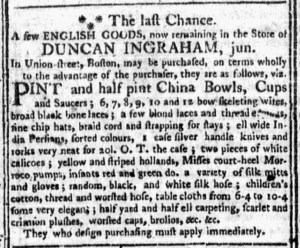
Massachusetts Spy (December 29, 1774).

“*** The last Chance.”

Prospective customers needed to act quickly or risk missing out on the opportunity entirely.  That was the message that Duncan Ingraham, Jr., emphasized in his advertisement for “A few ENGLISH GOODS, now remaining” in his store in Boston at the end of 1774.  His notice featured a headline that proclaimed “The last Chance” that he hoped would entice readers to look more closely at the list of merchandise in stock.  Unlike the headlines for other advertisements, Ingraham’s headline included three asterisks to help draw attention to the offer he made available for a limited time.  That offer included low prices that he described as “terms wholly to the advantage of the purchaser.”  Ingraham was so eager to liquidate his inventory that he passed along significant savings to consumers, but only if they acted quickly.  He concluded his advertisement with a warning that those “who design purchasing must apply immediately.”

Those “few ENGLISH GOODS, now remaining” had been on hand for six months or more.  The Boston Port Act closed the harbor on June 1, 1774.  Parliament asserted that the harbor would remain blockaded to commerce until the town made restitution for the property destroyed during the Boston Tea Party in December 1773.  As a result, merchants and shopkeepers did not receive shipments from their suppliers in England.  Ingraham peddled goods, including “China Bowls, Cups and Saucers,” “a variety of silk mitts and gloves,” and “children’s cotton, thread and worsted hose,” that had been on his shelves for some time.  Under other circumstances, advertisers often emphasized that they received their merchandise via the ships most recently arrived in port, anticipating that consumers would associate the newest goods with the most fashionables ones.  Such appeals, however, no longer held sway in Boston in the wake of the Boston Port Act.  Elsewhere in the colonies, similar appeals lost their effectiveness once the Continental Association, a nonimportation agreement enacted in response to the Boston Port Act and the other Coercive Acts, went into effect on December 1, 1774.

February 28

What was advertised in a colonial American newspaper 250 years ago this week?

Massachusetts Gazette and Boston Weekly News-Letter (February 25, 1773).

“The last Chance.”

An advertisement in the February 25, 1773, edition of the Massachusetts Gazette and Boston Weekly News-Letter advised readers of “The last Chance” to purchase a “very large and valuable Assortment Of English and India GOODS” at the store “lately improved by Mr. Ward Nicholas Boylston” on King Street.  Available either wholesale or retail, that inventory was “Suitable to all Seasons – and to all Tastes.”  Even better, the sellers offered the goods at bargain rates, “the neat Sterling Cost without any Charges.”  In other words, they did not mark up the prices.  A decorative border around “The last Chance” helped to direct readers to the marketing pitches in the advertisement.

The advertisers suspected that some prospective customers held off on making purchases because they expected that anything that did not sell would eventually go up for auction.  That meant opportunities to acquire this “valuable Assortment” of goods for even better prices, certainly an attractive proposition for both merchants and shopkeepers who intended to sell whatever they purchased from among this merchandise.  The advertisers included a note that cautioned against such assumptions and encouraged prospective customers to take advantage of the bargains already available to them.  “Those who have witheld buying hitherto,” they asserted, “on a dependence that the above Goods will be finally exposed to Public Sale,” or auction, “where they hoped for better Pennyworths,” or bargains, “are warned to improve the present and last Opportunity, as the Proprietors are determined, if the Sale of them is not finished this Week, to dispose of them otherwise than at Auction.”  In other words, prospective buyers who planned to scoop up even better deals if slow sales prompted the sellers to resort to an auction would be very disappointed … and they would miss out on the current low prices.

The proprietors of the “valuable Assortment” of goods acknowledged that buyers and sellers participated in a dance, each trying to lead by making moves they intended to guide or nudge their partner’s next steps.  When those proprietors realized that some buyers anticipated an auction as their next move, they attempted to twirl them in another direction with a stark warning about stumbling as a result of anticipating that the proprietors planned move in a different direction.  Such candor may have helped some buyers follow the proprietors’ lead and, as a result, maneuver toward a graceful outcome that included the current low prices rather than faltering and falling when the goods did not go to auction.