November 10

What was advertised in a colonial American newspaper 250 years ago today?
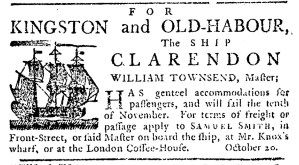
Pennsylvania Journal (November 10, 1773).

“For terms of freight or passage apply … at the London Coffee-House.”

The Clarendon prepared to sail from Philadelphia to Kingston and Old Harbour in Jamaica on November 10, 1773.  In advance of the ship’s departure, newspaper advertisements promoted “genteel accommodations for passengers” and solicited cargo for the voyage.  Those notices continued until the day the Clarendon was scheduled to leave port, appearing in the November 10 edition of the Pennsylvania Journal.  By then, neither Samuel Smith, the merchant who sponsored the voyage, nor William Townsend, the captain, probably did not accept freight that would cause delays by taking too long to load, but perhaps welcomed passengers who waited until the last minute.  Townsend likely gathered letters to deliver to correspondents in Jamaica for as long as the ship remained in port.  The advertisement advised that anyone with business for the Clarendon should apply to Smith “in Front-Street,” the captain “at Mr. Knox’s wharf, or at the London Coffee-House.”

It was not that only advertisement in that issue of the Pennsylvania Journal that listed the London Coffee House as one of the locations designated for meeting with masters of vessels to conduct business.  A notice for the Lovely Lass, departing for Jamaica under the command of Andrew Waid before the end of November, directed readers “to CRAIG and MORRELL, or the said Master, at the London Coffee-House.”  Similarly, the Lydia, under the command of Thomas Dean, “WILL sail with all convenient speed” to Liverpool, “having part of her cargo ready to go on board.”  To arrange freight or passage, readers needed to contact “Jeremiah Warder and Sons, said master on board, or at the London Coffee-House.”  Another ship, the Charming Nancy, would depart for Jamaica under the command of Charles Biddle on December 1.  A familiar refrain instructed readers to “apply to MATTHIAS ASPDEN, or said Master on board, or at the London Coffee-House.”

Not every advertisement adorned with a woodcut depicting a ship at sea made reference to the London Coffee House, but four out of ten in that edition of the Pennsylvania Journal listed that landmark as one of the places to meet with merchants and captains to arrange for freight or passage.  Readers did not have to reside in Philadelphia to realize that the London Coffee House was an important gathering place for conducting business during the era of the American Revolution.  Advertisements testified to how often merchants and captains frequented the establishment to meet with associates and customers.

August 3

What was advertised in a colonial American newspaper 250 years ago today?

Essex Gazette (August 3, 1773).

“A Variety of News-Papers, will be procured for the Amusement of his respectable Customers.”

Many residents of Salem and nearby towns knew Ephraim Ingalls as a tailor, but he launched a new endeavor in the summer of 1773.  He took to the pages of the Essex Gazette to announce that he “just opened” the “LONDON COFFEE-HOUSE” on Hanover Street, proclaiming that he provided the “best Entertainment usually met with at Coffee-Houses in large mercantile Places.”  In other words, Ingalls’s establishment rivaled its counterparts in Boston, Charleston, New York, Philadelphia, and other major ports.  Prospective patrons could “depend upon being treated and entertained with all possible Respect, in the neatest and genteelest Manner” when they gathered to socialize and drink coffee, tea, and chocolate.

Coffeehouses also served as places for conducting business and discussing politics.  Ingalls extended an invitation to “Merchants, Captains of Vessels, and all other Gentlemen,” declaring that he outfitted the London Coffeehouse with the “best Accommodations for transacting Business.”  That included supplying “English Magazines, and a Variety of News-Papers … for the Amusement of his respectable Customers” as well as for them to consult for the shipping news, entries from customs houses, prices current for commodities in various towns, and other news.  Ingalls almost certainly subscribed to the Essex Gazette as well as a couple of newspapers published in Boston.  He likely acquired copies of the New-Hampshire Gazette, the Providence Gazette, and the Newport Mercury as well as at least one newspaper from New York, another from Philadelphia, and another from Charleston.  Although colonial printers reprinted accounts of current events from newspaper to newspaper, they did not tend to reprint items like marine lists and prices current.  That made a “Variety of Newspapers” as well as access to “Captains of Vessels” who carried news that had not yet made it into the public prints especially attractive to merchants.

The London Coffeehouse in Salem, like coffeehouses in other ports in England and the colonies, also functioned as a library for merchants.  That library set relatively narrow parameters for its collections, especially compared to the variety of books and magazines available at subscription libraries.  Those collections, however, served the needs of the coffeehouse’s clientele … without an additional fee.  Throughout the colonies, proprietors of coffeehouses provided newspapers as a service to entice merchants and others into their establishments.

June 4

What was advertised in a colonial American newspaper 250 years ago today?

New-London Gazette (June 4, 1773).

“LONDON Coffee-House, Kept by THOMAS ALLEN.”

“THOMAS ALLEN’s Marine List.”

In the early 1770s, Thomas Allen operated the “LONDON Coffee-House” in New-London, Connecticut.  In an advertisement in that ran in the New-London Gazette in May and June 1773, he offered “genteel Entertainment … for Gentlemen Travellers.”  He also sold a variety of “Choice old Spirits by the Gallon” in addition to “Genuine” wines imported from Madeira, Faial, and Tenerife “By the Gal. or Quart.”  Presumably, he also served those wines and spirits as well as coffee, tea, and chocolate to “Gentlemen Travellers” and other patrons.

Like other coffeehouses, Allen’s establishment also served as a gathering place for merchants to conduct business and share information.  Allen likely subscribed to the New-London Gazette as well as newspapers printed in other colonies, making them available to patrons interested in all sorts of news and especially the shipping news that concerned networks of commerce that crisscrossed the Atlantic.

New-London Gazette (June 4, 1773).

In addition to that valuable service, Allen established himself as a purveyor of such information in the public prints.  Starting with the April 30 edition, the printer of the New-London Gazette supplemented the lists of ships “ENTERED IN” and “CLEARED OUT” of the customs house with “THOMAS ALLEN’s Marine List” that provided details about the location and progress of vessels.  Presumably, Allen spoke with captains when they arrived in port, then relayed the news to the printer, thus bolstering the kind of coverage offered by the newspaper.  The entry in the June 4 edition, for instance, included this news: “Capt. Newson in 21 Days from Nevis spoke with the following Vessels, viz. May 26th, Sloop Sally, Capt. Campbell, from Nevis, bound to Casco-Bay, Lat. 34 43. Long. 68 6.  May 29th, Ship Sally, Capt. Samuel Young, from Bristol, bound to Philadelphia, Lat. 38 10. Lon. 70. who had a number of Passengers on board.”  The “Marine List” also gave details about one other ship that Newsom encountered during the voyage from Nevis.  Not only merchants valued these updates; families of sailors did so as well.

Allen provided this service for more than fifteen years, bolstering his own reputation as a purveyor of shipping news.  The local newspaper benefited from his efforts, as did merchants and families who consulted “THOMAS ALLEN’s Marine List” in addition to the entries from the customs house.  The news that appeared in the public prints may have convinced some readers to visit Allen’s coffeehouse to see if they could glean more information from the proprietor, additional details that did not appear in the newspaper.

July 31

What was advertised in a colonial newspaper 250 years ago today?

Jul 31 - 7:31:1766 Pennsylvania Gazette
Pennsylvania Gazette (July 31, 1766).

“He is to be spoke with at the London, Coffee-House, at the usual Hours.”

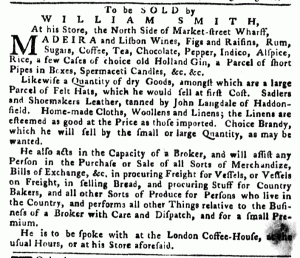
William Smith was a busy businessman. He sold an assortment of goods at his star on the “North Side of Market-street Wharff” and also “acts in the Capacity of a Broker, and will assist any Person in the Purchase or Sale of all Sorts of Merchandise” as well as a variety of other services.

Smith concluded his advertisement by informing potential customers and clients that “He is to be spoke with at the London Coffee-House, at the usual Hours, or at his Store aforesaid.” Rather than conduct business exclusively at his store, Smith spent time at the London Coffee House, an establishment where merchants and others gathered to make deals and settle accounts. Auctions of all kinds of merchandise (including slaves) took place just outside the coffeehouse. The proprietors provided newspapers printed in Philadelphia and other cities for patrons to keep up on political events and follow the shipping news. Men gathered at the London Coffee House to do business, talk politics, and gossip. It was Philadelphia’s exchange.

Philadelphia’s entrepreneurs so regularly gathered at the London Coffee House that Smith did not need to specify when he would be present beyond stating “at the usual Hours.” A dozen years after William Bradford first opened it in 1754, the London Coffee House was an integral part of the commercial landscape in colonial Philadelphia. More than two hundred merchants had contributed funds toward its construction, but an even greater number of people gathered there regularly over the next several decades. Smith did not need to specify that the London Coffee House was the corner of Front and High (present-day Market) Streets. Everybody in Philadelphia knew where it was, and visitors to the city could easily locate it by asking any local they encountered.

Jul 31 - London Coffee House
London Coffee House (lithograph by W.L. Breton:  Philadelphia, 1830).  Library Company of Philadelphia.