April 12

What was advertised in a revolutionary American newspaper 250 years ago today?
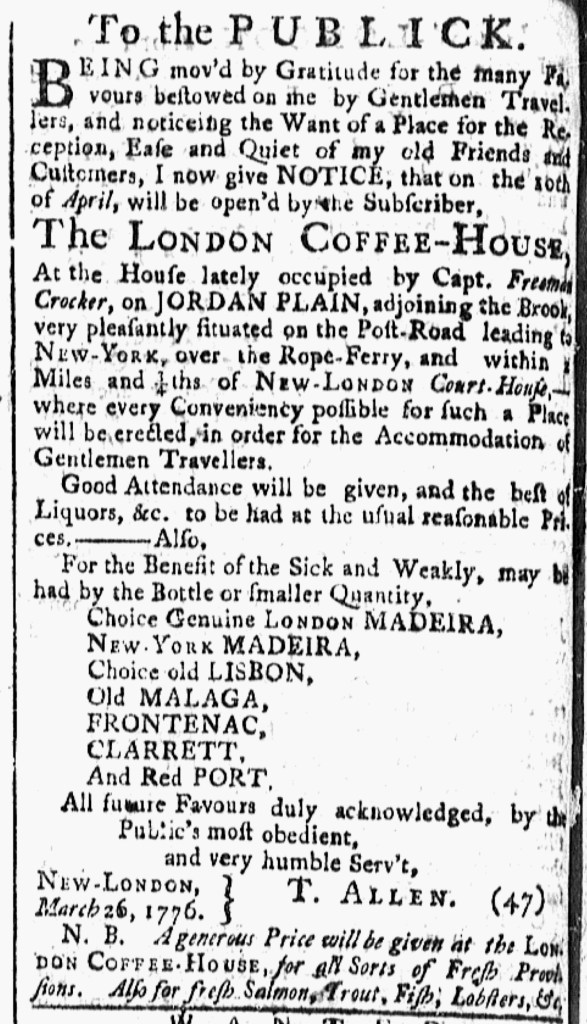
Connecticut Gazette (April 12, 1776).

“The LONDON COFFEE-HOUSE … situated on the Post-Road leading to NEW-YORK.”

In the spring of 1776, Thomas Allen announced his plans to open the “LONDON COFFEE-HOUSE” in New Haven.  He previously operated a similar business, advertising it in the New-London Gazette in the summer of 1773, but apparently that establishment closed at some point during the years that the imperial crisis intensified.  Now he acknowledged “the Want of Place for the Reception, Ease and Quiet of my old Friends and Customers,” those “Gentlemen Travellers” who previously stayed with him, and decided to open a new coffeehouse “At the House lately occupied by Capt. Freeman Crocker, on JORDAN PLAIN, adjoining the Brook, very pleasantly situated on the Post-Road leading to NEW-YORK, over the Rope-Ferry, and within 2 Miles and 3/4ths of NEW-LONDON Court-House.”  Allen expected that such a convenient location would attract patrons.

He also emphasized the amenities available at new London Coffee-House, especially “the best of Liquors … at the usual reasonable Prices.”  He resorted to an appeal that he used in his advertisement from 1773: with a wink and a nod, he listed a variety of spirits he stocked “For the Benefit of the Sick and Weakly.”  Those unfortunate souls could purchase “Choice Genuine LONDON MADEIRA,” “Old MALAGA,” “Red PORT,” and other drinks “by the Bottle or smaller Quantity.”  In a nota bene, Allen informed local farmers and fishermen that a “generous Price will be given … for all Sorts of Fresh Provisions.  Also for fresh Salmon, Trout, Fish, [and] Lobsters.”  That notice provided a preview of the quality and variety of food that customers could consume along with their beverages as they enjoyed a leisurely respite from their travels.

Allen first ran his advertisement on March 29, alerting the public that his new establishment would open on April 10.  It appeared in two consecutive issues before the coffeehouse opened, likely inciting anticipation among some of those “Gentlemen Travellers” who had bestowed “many Favours” on Allen through their patronage of his former endeavor.  Once the new enterprise opened, he ran the advertisement once again as a means of welcoming patrons and encouraging readers who had not yet visited to experience the coffeehouse for themselves.

June 4

What was advertised in a colonial American newspaper 250 years ago today?

New-London Gazette (June 4, 1773).

“LONDON Coffee-House, Kept by THOMAS ALLEN.”

“THOMAS ALLEN’s Marine List.”

In the early 1770s, Thomas Allen operated the “LONDON Coffee-House” in New-London, Connecticut.  In an advertisement in that ran in the New-London Gazette in May and June 1773, he offered “genteel Entertainment … for Gentlemen Travellers.”  He also sold a variety of “Choice old Spirits by the Gallon” in addition to “Genuine” wines imported from Madeira, Faial, and Tenerife “By the Gal. or Quart.”  Presumably, he also served those wines and spirits as well as coffee, tea, and chocolate to “Gentlemen Travellers” and other patrons.

Like other coffeehouses, Allen’s establishment also served as a gathering place for merchants to conduct business and share information.  Allen likely subscribed to the New-London Gazette as well as newspapers printed in other colonies, making them available to patrons interested in all sorts of news and especially the shipping news that concerned networks of commerce that crisscrossed the Atlantic.

New-London Gazette (June 4, 1773).

In addition to that valuable service, Allen established himself as a purveyor of such information in the public prints.  Starting with the April 30 edition, the printer of the New-London Gazette supplemented the lists of ships “ENTERED IN” and “CLEARED OUT” of the customs house with “THOMAS ALLEN’s Marine List” that provided details about the location and progress of vessels.  Presumably, Allen spoke with captains when they arrived in port, then relayed the news to the printer, thus bolstering the kind of coverage offered by the newspaper.  The entry in the June 4 edition, for instance, included this news: “Capt. Newson in 21 Days from Nevis spoke with the following Vessels, viz. May 26th, Sloop Sally, Capt. Campbell, from Nevis, bound to Casco-Bay, Lat. 34 43. Long. 68 6.  May 29th, Ship Sally, Capt. Samuel Young, from Bristol, bound to Philadelphia, Lat. 38 10. Lon. 70. who had a number of Passengers on board.”  The “Marine List” also gave details about one other ship that Newsom encountered during the voyage from Nevis.  Not only merchants valued these updates; families of sailors did so as well.

Allen provided this service for more than fifteen years, bolstering his own reputation as a purveyor of shipping news.  The local newspaper benefited from his efforts, as did merchants and families who consulted “THOMAS ALLEN’s Marine List” in addition to the entries from the customs house.  The news that appeared in the public prints may have convinced some readers to visit Allen’s coffeehouse to see if they could glean more information from the proprietor, additional details that did not appear in the newspaper.

April 21

What was advertised in a colonial American newspaper 250 years ago today?

Apr 21 - 4:21:1770 Providence Gazette
Providence Gazette (April 21, 1770).

“Genteel Entertainment for Man and Horse.”

As Thomas Allen prepared to open the “London COFFEE-HOUSE” near the courthouse in New London, Connecticut, at the end of April 1770, he placed an advertisement in the New-London Gazette to inform “Gentlemen Travellers, and others.”  The new establishment offered “genteel Entertainment for Man and Horse.”  For those interested in conducting business at the coffeehouse, Allen promoted the “large and commodious Wharff for Navigation” that adjoined it as well as “Stores, Stables, Yards, &c. for the Reception of Horses and Stock.”  The proprietor did not depict the new coffeehouse merely as a place of leisure.  Most of the amenities he highlighted contributed to mercantile pursuits.

Allen did not confine his advertising to the New-London Gazette.  He also inserted an advertisement in the April 21 edition of the Providence Gazette.  Featuring nearly identical copy, it also invited “Gentlemen Travellers, and others” to visit and do business at the new coffeehouse.  Allen believed that local custom alone would not support the new establishment.  He needed to incite interest and awareness among prospective customers who would be passing through New London.  The new coffeehouse and its infrastructure for conducting business had the capacity to convince others to add New London to the itinerary.

Apparently, Allen considered Rhode Island the best place to cultivate customers among “Gentlemen Travellers,” at least initially.  In addition to the Providence Gazette, he also placed his advertisement in the April 23 edition of the Newport Mercury.  He did not, however, insert a notice in any of the several newspapers published in Boston or New York at the time.  The additional expense may have prevented wider advertising, though Allen may have considered his reasonable approach sufficient for disseminating word about his new coffeehouse and its amenities.  He likely anticipated that some of his clients would continue their journeys to Boston or New York, spreading news of his establishment to their friends and associates without Allen needing to place additional advertisements.