February 12

What was advertised in a colonial American newspaper 250 years ago today?
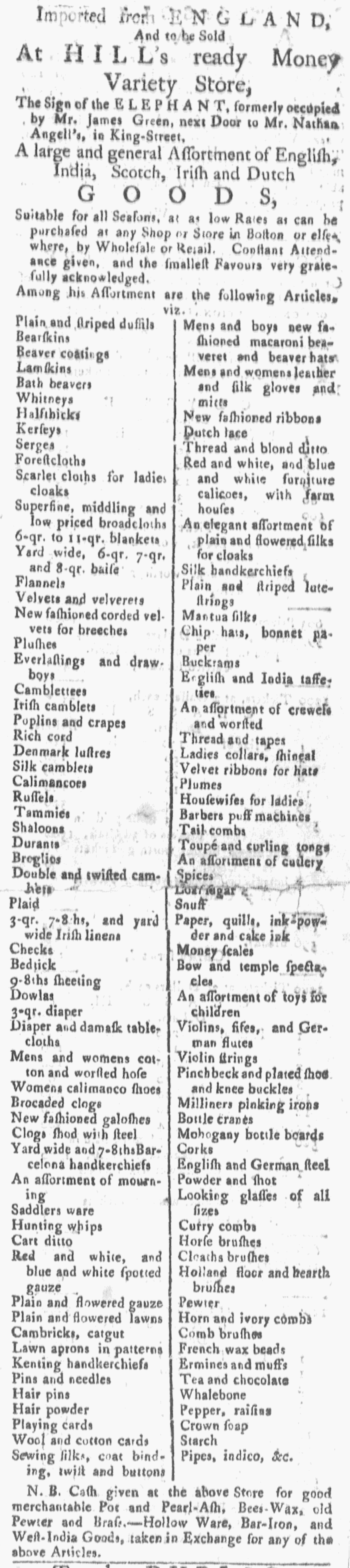
Providence Gazette (February 12, 1774).

“As low Rates as can be purchased at any Shop or Store in Boston or elsewhere.”

When the proprietor of “HILL’s Variety Store” took to the pages of the Providence Gazette near the end of January 1774, his advertisement promoted a “compleat Assortment of English, Scotch and India Goods,” listed about a dozen items, and promised “every other Article usually imported, too many to be enumerated in this Week’s Paper.”  That final note suggested that either the printer had truncated the advertisement due to space constraints or the advertiser had not yet compiled a more complete inventory to insert in the public prints.  It may very well have been the latter, considering that three weeks passed before a more extensive advertisement appeared in the Providence Gazette.

And more extensive it certainly was!  That advertisement filled nearly an entire column in the February 12 edition.  The merchant devoted most of that space to a catalog of “English, India, Scotch, Irish and Dutch GOODS,” demonstrating the range of choices available to consumers.  Divided into two columns with only one item per line, making it easier for readers to navigate than the dense paragraphs of text in some advertisements, this notice included many kinds of textiles and accessories, “Womens calamanco shoes,” “Mens and boys new fashioned macaroni beaveret and beaver hats,” “Mens and womens leather and silk gloves and mitts,” “Pinchbeck and plated shoe and knee buckles,” “Violins, fifes, and German flutes,” and even an “assortment of toys for children.”  Prospective customers could expect to discover much more at “HILL’s ready Money and Variety Store.”  (The variation on the name suggested that they would need to pay at the time of sale rather than purchase on credit, but a note at the end of the advertisements indicated “Hollow Ware, Bar-Iron, and West-India Goods, taken in Exchange for any of the above Articles.”)  The list of goods began with a clarification that “Among his Assortment are the following Articles,” while the catalog concluded with “&c.” (an abbreviation for et cetera) to signal that even more was available at the store.

Yet such appeals to consumer choice were not the only marketing strategies deployed by the merchant.  A preamble to his inventory reported that he sold his goods both wholesale and retail “at as low Rates as can be purchased at any Shop or Store in Boston or elsewhere.”  He realized that he did not compete solely with local merchants and shopkeepers but also with their counterparts in Boston, Newport, New York, and other towns.  He did not want shopkeepers in the countryside turning to importers in other ports to supply their inventory.  Such wholesale purchases could amount to significant revenue.  At the same time, he did not ignore consumers interested in retail purchases.  The merchant stated that “the smallest Favours” or purchases would be “gratefully acknowledged.”  Between the selection and the prices, he hoped prospective customers would come to the “Sign of the ELEPHANT” in King Street to acquire goods they needed to supplement inventories at their own shops or that they wanted for their own use.

January 1

What was advertised in a colonial American newspaper 250 years ago today?

New-Hampshire Gazette (January 1, 1773).

“GOODS … as cheap for Cash as at any Shop in Boston.”

Samuel Flagg, a shopkeeper in Salem, complained about “so many flashy Advertisements” that ran in the Essex Gazette in his own notice in that newspaper and others published in New England as 1772 came to an end.  In contrast, the advertisement that Caruth and Nash, who kept shop “at Mr. Abbot’s Tavern, on Kingston Plains,” was not flashy at all.  In the first issue of the New-Hampshire Gazette for 1773, the partners published an advertisement to inform prospective customers that the “JUST IMPORTED, AND … SOLD … A Large and general Assortment of Scotch and English GOODS.”  The way that their name appeared as a headline in all capital letters was the most flashy aspect of Caruth and Nash’s notice.

Yet Flagg had not commented on typography and graphic design alone.  He was even more dismissive of the “Story” that merchants and shopkeepers told consumers in their attempts to incite demand and generate revenue.  Caruth and Nash did not tell a story anywhere near as elaborate as those that Flagg found so absurd and cloying, but that did not mean that their notice lacked any of the marketing strategies in use at the time.  The partners were more reserved in how they presented those appeals to the public.

For instance, they did not go into great detail about their low prices or, especially, what kinds of relationships they cultivated with manufacturers and merchants in England that allowed them to offer great bargains to their customers.  They did, however, pledge that they sold their wares “Wholesale and Retail, as cheap for Cash as at any Shop in Boston.”  Their prices, they assured prospective customers in rural New Hampshire, were competitive with those in the largest urban center in New England.  Caruth and Nash also adopted another strategy that annoyed Flaff, commenting on their customer service.  “Those who are pleased to favour them with their Custom,” the partners advised, “may depend on the best Usage, and the smallest Favour gratefully acknowledged.”  Flagg was not impressed with merchants and shopkeepers who insincerely professed that they “held [themselves] obliged to the good People” for merely looking at their merchandise “without buying.”  Caruth and Nash, on the other hand, incorporated a brief version of that appeal into their newspaper advertisement.

Caruth and Nash’s advertisement was not flashy by the standards of the period, but that did not mean that it lacked marketing appeals intended to sway prospective customers.  They hardly published a mere announcement in the New-Hampshire Gazette.  Instead, their notice included appeals to price and customer service that they believed would help convince readers to purchase from them rather than their competitors.

December 11

What was advertised in a colonial American newspaper 250 years ago today?

New-London Gazette (December 11, 1772).

“All the above articles will be sold lower than can be bought either in [New] York or Boston.”

In the fall of 1772, Ebenezer Backus, Jr., ran multiple advertisements for goods available at his store in Norwich, Connecticut, in the New-London GazetteOne of those advertisements may very well have circulated separately as a broadside or handbill.  It occupied almost an entire page in the November 20 edition.  An advertisement of that size would have been expensive.  In subsequent issues, Backus published another advertisement, one more in line with the length of advertisements published by other purveyors of goods and services.

Like the longer advertisement, the shorter version included a list of goods.  To help prospective customers navigate that list, Backus divided his notice into two columns with only one or two items per line rather than including everything in a paragraph of dense text.  He stocked a variety of textiles, including checks, ginghams, damasks, “Pelong Sattins,” and “Plain Sattins” as well as accessories like buttons, “Barcelona Handkerchiefs of different colours,” and a “Compleat assortment of Ribbons.”  Beyond merchandise intended for making garments, Backus also sold “Cream coloured Ware of all Kinds.”

Although Backus included fewer goods in this advertisement than his previous one, he did add a new marketing appeal with the intention of capturing the attention of prospective customers.  In a nota bene that concluded the notice, Backus asserted that “All the above articles will be sold lower than can be bought either in [New] York or Boston.”  Consumers in and around Norwich may have expected to pay more to acquire goods in the small town of Norwich than in the region’s major urban ports, but Backus assured them that was not the case.  He hoped to entice them with bargains as good or even better than they would encounter elsewhere.  In so doing, he demonstrated that the consumer revolution reached even small towns where colonizers had access to the same goods at the same prices as their counterparts in the largest cities in the colonies.