March 26

What was advertised in a colonial American newspaper 250 years ago today?
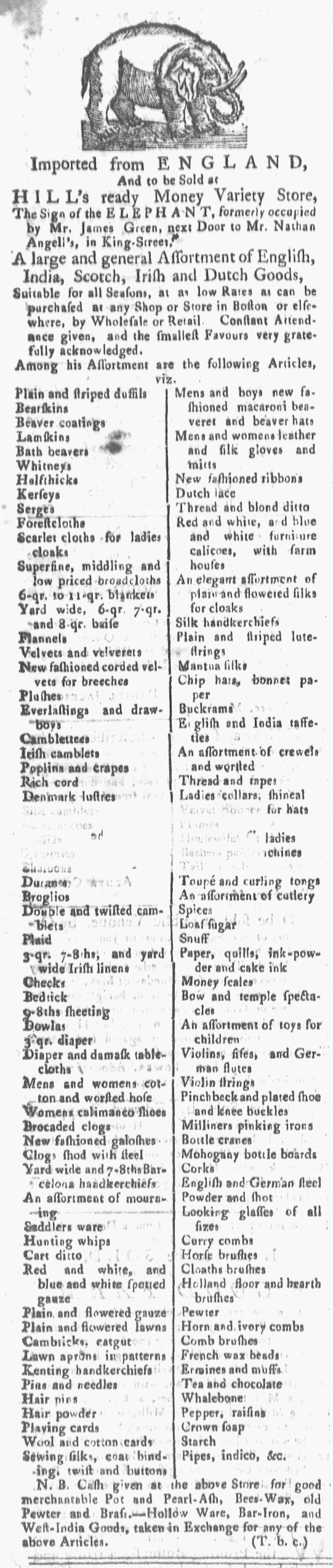
Providence Gazette (March 26, 1774).

“The Sign of the ELEPHANT.”

The advertising campaign for “HILL’s ready Money Variety Store” at the “Sign of the Elephant” in Providence went through stages in the winter and spring of 1774.  An initial advertisement in the January 22 edition of the Providence Gazette promoted a “compleat Assortment of English, Scotch and India GOODS,” listing about a dozen items available at the store.  It also promised “every other Article usually imported, too many to be enumerated in this Week’s Paper.”  That suggested that a portion of the advertisement had been omitted but would appear in a subsequent issue.

The initial advertisement ran for three weeks before a much longer version replaced it on February 12.  That notice almost filled an entire column since it extensively “enumerated” Hill’s inventory, everything from “Scarlet cloths for ladies cloaks” and “New fashioned corded velvets for breeches” to “Mens and boys new fashioned macaroni beaveret and beaver hats” and “Velvet ribbons for hats” to “Looking glasses of all sizes” and “An assortment of toys for children.”  The compositor divided the advertisement into two columns, listing one item per line to make it easier for readers to peruse and identify items of interest.  That advertisement ran for six consecutive weeks.

On March 26, Hill placed a new version.  The inventory remained the same, but it featured a new introduction and, most significantly, a woodcut depicting an elephant.  Hill intensified his effort to associate a logo with his business, presenting readers of the Providence Gazette with an image of an elephant to make his “Variety Store” even more memorable.  Except for the device that appeared in the masthead each week, it was the only image that appeared in that edition of the Providence Gazette.  With the addition of the woodcut, Hill’s advertisement filled an entire column in the newspaper.  Yet the image may have been the more powerful marketing strategy than the list that demonstrated choices for consumers.  By selecting an elephant, Hill emphasized goods, especially textiles, imported from India.  Most likely, none of the colonizers in Providence had ever glimpsed that exotic creature in real life.  Primitive as the woodcut might seem to modern eyes, it may have been one of the few visual depictions of an elephant that readers of the Providence Gazette ever encountered.  The novelty served an importance purpose in Hill’s marketing efforts.
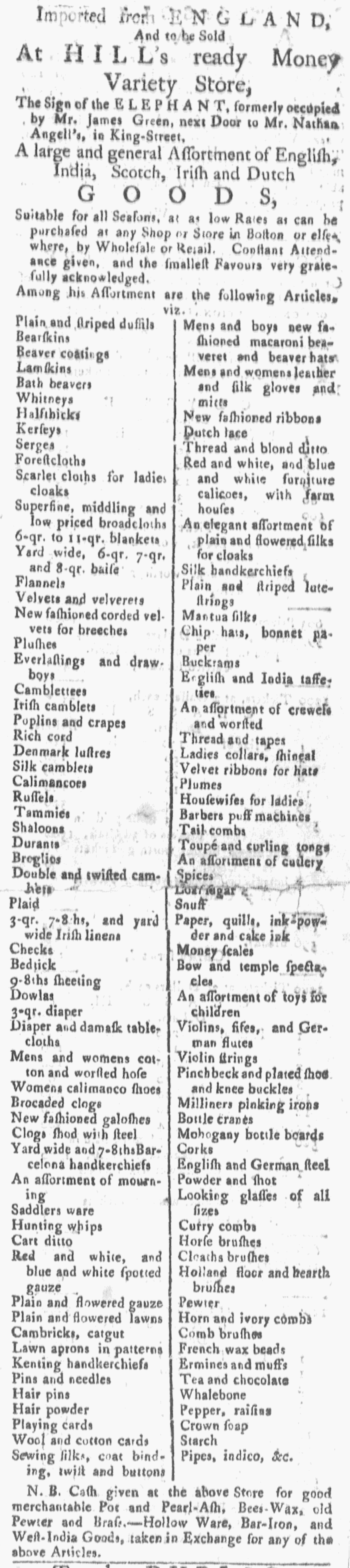
February 12

What was advertised in a colonial American newspaper 250 years ago today?

Providence Gazette (February 12, 1774).

“As low Rates as can be purchased at any Shop or Store in Boston or elsewhere.”

When the proprietor of “HILL’s Variety Store” took to the pages of the Providence Gazette near the end of January 1774, his advertisement promoted a “compleat Assortment of English, Scotch and India Goods,” listed about a dozen items, and promised “every other Article usually imported, too many to be enumerated in this Week’s Paper.”  That final note suggested that either the printer had truncated the advertisement due to space constraints or the advertiser had not yet compiled a more complete inventory to insert in the public prints.  It may very well have been the latter, considering that three weeks passed before a more extensive advertisement appeared in the Providence Gazette.

And more extensive it certainly was!  That advertisement filled nearly an entire column in the February 12 edition.  The merchant devoted most of that space to a catalog of “English, India, Scotch, Irish and Dutch GOODS,” demonstrating the range of choices available to consumers.  Divided into two columns with only one item per line, making it easier for readers to navigate than the dense paragraphs of text in some advertisements, this notice included many kinds of textiles and accessories, “Womens calamanco shoes,” “Mens and boys new fashioned macaroni beaveret and beaver hats,” “Mens and womens leather and silk gloves and mitts,” “Pinchbeck and plated shoe and knee buckles,” “Violins, fifes, and German flutes,” and even an “assortment of toys for children.”  Prospective customers could expect to discover much more at “HILL’s ready Money and Variety Store.”  (The variation on the name suggested that they would need to pay at the time of sale rather than purchase on credit, but a note at the end of the advertisements indicated “Hollow Ware, Bar-Iron, and West-India Goods, taken in Exchange for any of the above Articles.”)  The list of goods began with a clarification that “Among his Assortment are the following Articles,” while the catalog concluded with “&c.” (an abbreviation for et cetera) to signal that even more was available at the store.

Yet such appeals to consumer choice were not the only marketing strategies deployed by the merchant.  A preamble to his inventory reported that he sold his goods both wholesale and retail “at as low Rates as can be purchased at any Shop or Store in Boston or elsewhere.”  He realized that he did not compete solely with local merchants and shopkeepers but also with their counterparts in Boston, Newport, New York, and other towns.  He did not want shopkeepers in the countryside turning to importers in other ports to supply their inventory.  Such wholesale purchases could amount to significant revenue.  At the same time, he did not ignore consumers interested in retail purchases.  The merchant stated that “the smallest Favours” or purchases would be “gratefully acknowledged.”  Between the selection and the prices, he hoped prospective customers would come to the “Sign of the ELEPHANT” in King Street to acquire goods they needed to supplement inventories at their own shops or that they wanted for their own use.

January 22

What was advertised in a colonial American newspaper 250 years ago today?

Providence Gazette (January 22, 1774).

“Every other Article usually imported, too many to be enumerated in this Week’s Paper.”

The proprietor of “HILL’s Variety Store” at “the Sign of the ELEPHANT” advertised a “compleat Assortment of English, Scotch and India GOODS” in the January 22, 1774, edition of the Providence Gazette.  To incite interest in his wares, Hill proclaimed that he set prices “as low as can be purchased at any Shop or Store in Boston,” provided that customers paid cash rather than buying on credit.  Boston was a larger port that welcomed a greater number of vessels carrying imported goods, but that did not mean that shoppers there benefitted from better bargains than Hill made available in Providence.  The shopkeeper also listed several items, including several textiles, “new-fashioned Galloshes,” and “low-priced scarlet Broadcloths for Ladies Cloaks,” and promised “every other Article usually imported, too many to be enumerated in this Week’s Paper.”

That suggested that perhaps the printer, John Carter, abbreviated an advertisement received in the printing office due to lack of space.  Though that happened rarely, printers sometimes exercised such editorial discretion, especially when merchants and shopkeeper submitted their notices just before the newspaper went to press.  Alternately, Hill may not have prepared a longer advertisement intended for the January 22 edition but instead wanted to alert local consumers that his “Variety Store” was open for business, planning to compose an advertisement with a more complete inventory in time for the next issue.  On January 29, however, a slightly revised notice ran in the Providence Gazette.  The list of merchandise now concluded: “with every other Article usually imported, Wholesale and Retail.”  The same copy appeared on February 5.

It was not until February 12 that a longer advertisement ran in the Providence Gazette.  That one featured a far greater number of items, divided into two columns, that extended nearly an entire column.  In addition to listing dozens of items, it revised the name of the business to “HILL’s ready Money Variety Store,” underscoring that the proprietor did not allow credit.  The sequence of these advertisements suggests that it was not lack of space that resulted in the note about “too many [items] to be enumerated in this Week’s Paper” the first time the notice ran.  Hill may have had grand designs for updating his advertisement soon after it first appeared, but did not do so.  Once he submitted the copy, however, the longer advertisement ran for six consecutive weeks before he updated it once again on March 26, that time adding a woodcut depicting an elephant to match the sign that marked the location of the “ready Money Variety Store.”  The Adverts 250 Project will feature that advertisement in a future entry.