October 26

What was advertised in a revolutionary American newspaper 250 years ago today?

Rivington’s New-York Gazetteer (October 26, 1775).

“We think proper to notify the public, that the charge against us is wholly and totally false.”

Rumors and misrepresentations spread in conversation and in print when the imperial crisis intensified and hostilities between the colonies and Britain commenced.  Upon finding themselves the subjects of gossip that damaged their reputations, Abraham Hatfield and William Lounsbery published a newspaper advertisement to set the record straight.  It started with an entry in the October 5, 1775, edition of the New-York Journal.  Among the news received from correspondents in the city,  John Holt, the printer, inserted this report: “We understand from North Castle, that on last Saturday night, Abraham Hatfield, Esq; of the White Plains, and Lieutenant William Lownsburry, of Mamaroneck, were discovered in the very act of endeavouring to cut down a Liberty Pole, which was so well fortified with iron that it occasioned their being found out, and for that time disappointed in their loyal attempt.”

Whether or not they held Tory sentiments, Hatfield and Lounsbery vigorously denied that they had acted on them by attempting to cut down the liberty pole.  In the next issue of Rivington’s New-York Gazetteer, published on October 12, they inserted an advertisement that identified the allegations and dismissed them as fabrications.  “WE the subscribers” (or undersigned) “having understood that Mr. Holt has inserted in his last week’s paper, a piece charging us with being concerned, and of even being detected in the fact of attempting to cut down a Liberty-pole – we think proper to notify the public, that the charge against us is wholly and totally false.”  It ran twice more, on October 19 and 26.  Hatfield and Lounsbery disseminated their denial that they had anything to do with the incident multiple times in their effort to combat an accusation made in the public prints just once.

Why didn’t they submit a correction to Holt or place a similar advertisement in the New-York Journal since that newspaper carried the piece that spread what they claimed was misinformation?  Perhaps they did, but Holt, a Patriot printer, felt confident enough in the source of the report that he declined to publish anything submitted by Hatfield and Lounsbery.  Alternately, they may have been so upset with Holt that they did not wish to give him the satisfaction of acknowledging the allegations in his newspapers (or contributing to his advertising revenue) that they instead opted for another newspaper, one with a circulation that rivaled or exceeded the New-York Journal.  Whatever the case, they did not allow the accusation that they were Loyalists who had attempted to cut down a liberty pole go unanswered.

The same issue of the New-York Journal that featured the report that identified Hatfield and Lounsbery as the culprits involved in the liberty tree incident in New Castle also carried letters addressed to Holt concerning rumors that colonizers had scalped a British soldier and cut off his ears after the battles at Lexington and Concord.  The correspondents believed that Holt could “serve the cause of truth and liberty” by publishing their accounts of the actual events, stating that they “buried the dead bodies of the king’s troops that were killed at the north bridge in Concord, on the 19th day of April, 1775,” and none of them “were scalped, not their ears cut off, as has been represented” by those who sought to “dishonour the Massachusetts people, and to make them appear to be savage and barbarous.”  In articles, letters, and advertisements, accusations and rebuttals about the misbehavior and even depravity of Patriots and Loyalists circulated in the public prints during the Revolutionary War.
November 3

What was advertised in a colonial American newspaper 250 years ago today?

Massachusetts Spy (November 3, 1774).

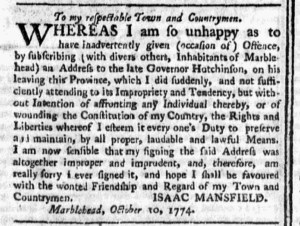
“I am now sensible that my signing the said Address was altogether improper and imprudent.”

Yet another colonizer who signed “an Address to the late Governor Hutchinson, on his leaving this Province” took to the public prints to recant and apologize.  Isaac Mansfield of Marblehead published his message to “my respectable Town and Countrymen” in the November 3, 1774, edition of the Massachusetts Spy.  Like others who claimed that they regretted their actions, he asserted that he had endorsed the address “suddenly, and not sufficiently attending to its Impropriety and Tendency.”  In other words, he had carelessly affixed his name without giving the contents or their implications much thought.  Upon further reflection, realizing what he had done (and facing the consequences of giving “Offence”), he declared that he had no intention of “affronting any Individual” or, especially, “wounding the Constitution of my Country, the Rights and Liberties whereof I esteem it every one’s Duty to preserve and maintain, by all proper, laudable and lawful means.”  Mansfield had strayed in expressing Tory sympathies, but he had seen the light.  He described signing the address as improper and imprudent, following immediately with an apology and a request for the “Friendship and Regard of my Town and Countrymen.”

Similar disavowals and retractions had been appearing in newspapers in Massachusetts and neighboring colonies for some time.  Much shorter versions by J. Fowle and John Prentice, both of Marblehead, that ran in three newspapers published in Boston and another in Salem during the past week also appeared in the November 3 issue of the Massachusetts Spy.  Some printers treated them as letters to place among news items, while others placed them with advertisements, making unclear which genre these letter-advertisements represented and whether printers charged for inserting them in their newspapers.  Isaiah Thomas, the printer of the Massachusetts Spy, ran the letter-advertisements from Fowle and Prentice below a letter to the editor from “A PROPRIETOR” and above Donald McAlpine’s advertisement for fencing lessons, similar to their placement in the Boston-Gazette three days earlier.  Had the men from Marblehead submitted their letter-advertisements to Thomas’s printing office?  Or had the patriot printer decided to reprint news from another newspaper?  In this instance, the double line separating different kinds of content appeared above the letter-advertisements, signaling to readers that they had finished with the news and began the advertisements.  The placement of Mansfield’s letter-advertisement was less ambiguous.  It ran on the final page, embedded among advertisements.  A notice from Silent Wilde, a post rider, appeared above it and an advertisement for William Hunter’s “Auction-Room” below it.  Does that mean that Thomas charged for printing Mansfield’s letter-advertisement?  Perhaps, though he may have been more interested in publicizing that another member of the community had seemingly come into conformity with patriot politics than generating revenue from Mansfield’s missive.  Either way, readers encountered news about current events as they perused the portion of the Massachusetts Spy that contained advertisements.

November 1

What was advertised in a colonial American newspaper 250 years ago today?

Essex Gazette (November 1, 1774).

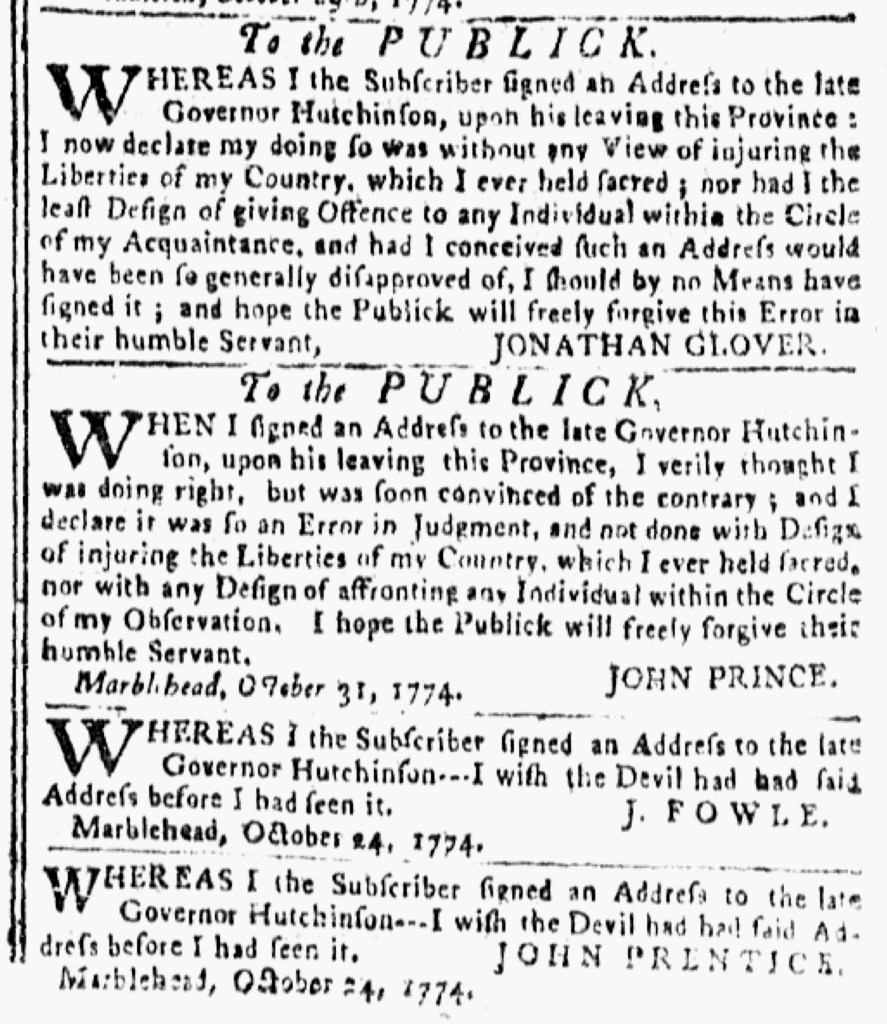
“WHEREAS I the Subscriber signed an Address to the late Governor Hutchinson — I wish the devil had had said Address before I had seen it.”

More advertisements from men who wished to recant after signing “an Address to the late Governor Hutchinson, upon his leaving the Province” appeared in the November 1, 1774, edition of the Essex GazetteJohn Stimpson’s letter to that effect ran as an advertisement a week earlier, joined now by letters from Jonathan Glover, John Prince, J. Fowle, and John Prentice.  The printers, Samuel Hall and Ebenezer Hall, positioned them one after another at the end of a column, following an advertisement about a stray cow.  Their position on the page indicated that the Halls considered these letters to be advertisements.  In that case, they would have charged to run them in their newspaper.

Other printers, however, treated some of these same letters differently.  The short missives from Fowle and Prentice each appeared in the Boston Evening-Post, the Boston-Gazette, and the Massachusetts Gazette and Boston Post-Boy the previous day.  In two of those newspapers, they ran with local news, while in the Boston-Gazette the printers placed them between news and advertisements.  They could have been the final news items or the first advertisements in that column.  Even if the printers considered them advertisements, they delivered news to readers.

In the Boston Evening-Post, Thomas Fleet and John Fleet, the printers, provided commentary, reporting that they “have received the Declarations and Acknowledgments of several Deputy Sheriffs, and other Persons, who by signing an Address to Governor Hutchinson had rendered themselves obnoxious to the People.”  They did not have room to publish all of them in that issue, but considered two of them “so concise we can’t omit obliging our Readers with them, as they may serve for a Specimen to other Addressers whose Principles are such as not to incline them to make long Confessions, even when they know they were to blame.”  Samuel Flagg had offered one of those “long Confessions” in the Essex Gazette a month earlier.

Fowle’s letter-advertisement succinctly stated, “WHEREAS I the Subscriber signed an Address to the late Governor Hutchinson — I wish the devil had had said Address before I had seen it.”  Prentice’s letter-advertisement contained an identical message.  Among the others that ran in the Essex Gazette, Glover asserted that he signed the address “without any View of injuring the Liberties of my Country, which I ever held sacred.”  Prince declared that he made “an Error in Judgment” without any “Design of injuring the Liberties of my Country, which I ever held sacred.”  Those two letter-advertisements had variations in wording yet had a similar structure.  For instance, Glover concluded with expressing his “hope the Publick will freely forgive this Error in their humble Servant,” while Prince stated, “I hope the Publick will freely forgive their humble Servant.”

In “Entering the Lists: The Politics of Ephemera in Eastern Massachusetts, 1774,” William Huntting Howell examines other recantations that were either similar or identical.  He questions whether any of them expressed sincerely held beliefs given that they seemed to be “performing by rote.”[1]  That aspect of Fowle’s letter-advertisement calls into question Glover’s invocations of “the Liberties of my Country, which I ever held sacred” and Flagg’s much more extensive reflection on his role in what had transpired. Furthermore, Howell argues, “recantations like these might have kept the Committee of Safety away from one’s house, or signaled to one’s neighbors that one no longer wished to disagree, but they cannot possibly have represented a legitimate conversion or deeply held belief.”[2]  That being the case, the signatories made public apologies in hopes of getting along with others.  By offering the identical letter-advertisements by Fowle and Prentice as prescriptive models for others to copy when ready to make their own “Declarations and Acknowledgments,” the Fleets also signaled that they also believed, as Howell puts it, that “the rote expression of allegiance is not the antithesis of ‘true patriotism,’ but rather its very essence.  The public spectacle of apology or ‘patriotic’ conversion – especially one that follows a pattern – better serves the larger cause than a private change of heart.”[3]

**********

[1] William Huntting Howell, “Entering the Lists: The Politics of Ephemera in Eastern Massachusetts, 1774,” Early American Studies 9, no. 1 (Winter 2011): 214.

[2] Howell, “Entering the Lists,” 215.

[3] Howell, “Entering the Lists, 215-6.

October 25

What was advertised in a colonial American newspaper 250 years ago today?

Essex Gazette (October 25, 1774).

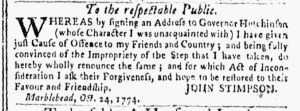
“By Signing an Address to Governor Hutchinson … I have given just Cause of Offence.”

It was another plea for forgiveness for exercising poor judgment, at best, or expressing unsavory political views by signing an address to Thomas Hutchinson that thanked him for his service as governor of Massachusetts.  At the end of October 1774, John Stimpson of Marblehead took to the pages of the Essex Gazette to a acknowledge to “the respectable Public” that he had “given just Cause of Offence to my Friends and Country” when he had done so.  He explained that he “was unacquainted” with Hutchinson’s character the previous spring, but in the time that elapsed since then he became “fully convinced of the Impropriety of the Step that I have taken.”  That being the case, he placed an advertisement to “wholly renounce the same” as well as seek forgiveness for that “Act of Inconsideration.”  Ultimately, Stimpson “hope[d] to be restored to their Favour and Friendship.”

He was not the first to insert an open letter in the Essex Gazette or other newspapers for that purpose.  Thomas Kidder published a similar apology in the Boston-Gazette in July 1774.  Samuel Flagg and Joseph Lee each did so in the Essex Gazette three weeks before Stimpson did.  Flagg’s extensive message to his “Fellow Citizens and Countrymen” incorporated an editorial on the “unjust and oppressive” legislation imposed by Parliament.  Others published similar missives explaining their error, assuring the public that they were not admirers of Hutchinson (and, by extension, the Tory perspective on current events), and asking for forgiveness so they could restore their standing within their communities.

Stimpson’s version of what was becoming a familiar feature in the newspapers did not appear among the news and editorials.  Samuel Hall and Ebenezer Hall, the patriot printers of the Essex Gazette, did not treat it as a letter to the editor to include alongside local news.  Instead, it ran between an advertisement offering a reward for the capture and return of an enslaved man, Caesar, who liberated himself from his enslaver, and a real estate notice announcing the sale of a house and land in Long Wharf Lane in Salem.  Stimpson’s message to “the respectable public” was an advertisement, a paid notice.  The Halls did not extend the opportunity to seek absolution for free.  They may have experienced a bit of satisfaction in generating revenue from someone who made such a poor decision in initially offering support to the royal governor so unpopular among Patriots.

October 20

What was advertised in a colonial American newspaper 250 years ago today?

Rivington’s New-York Gazetteer (October 20, 1774).

“We [were] suddenly and unwarily drawn in to sign a certain paper published in Mr. Rivington’s Gazetteer.”

Abraham Miller, William Crooker, James Jameson, and a dozen other men from the town of Rye had second thoughts about signing their names to an open letter that appeared as the first item on the first page of the October 13, 1774, edition of Rivington’s New-York Gazetteer.  That letter, initially endorsed by more than eighty men, stated, “WE … being much concerned with the unhappy situation of public affairs think it our duty to our King and country to declare, that we have not been concerned in any resolutions entered into, or measures taken, with regard to the disputes at present at present subsisting with the mother country.”  As other colonizers had participated in protests or proposed responses to the Coercive Acts, these men claimed that they had remained neutral, not taking any action or expressing any views on the matter.  Furthermore, they did not appreciate what they had observed happening in their communities and in the public prints.  “[W]e also testify,” the letter continued, “our dislike to many hot and furious proceedings, in consequence of said disputes, which we think are more likely to ruin this once happy country, than remove grievances, if any there are.”  In conclusion, they declared “our great desire and full resolution to live and die peaceable subjects to our gracious sovereign King George the third, and his laws.”

That letter apparently elicited responses that at least some of the men who affixed their signatures did not expect … and they experienced those unhappy responses very quickly.  Just four days after the letter appeared in print, Miller, Crooker, Jameson, and others signed another letter, that one backpedaling on the sentiments expressed in the first one.  The new letter ran as an advertisement, not a letter to the editor, in the October 20 edition of Rivington’s New-York Gazetteer.  The men who signed it moved quickly to submit it in time to appear in the first issue published after the one that carried the initial letter.  In addition, they paid to make sure that it found a place in the newspaper.  They claimed that they had been “suddenly and unwarily drawn in to sign a certain paper published in Mr. Rivington’s Gazetteer.”  When he published an advertisement in the Boston-Gazette to apologize for signing an address to Governor Hutchinson a few months earlier, Thomas Kidder claimed that he had sone so “suddenly and inadvertently.”  Colonizers who regretted expressing Tory sympathies suggested that they did not hold those views but had only signed their names in haste without taking the time to read and contemplate what they were signing.  After “mature deliberation,” Miller, Crooker, Jameson, and others realized “that we acted preposterously, and without adverting properly to the matter in dispute, between the mother country and her colonies.”  They apologized, asserting that they “are therefore sorry that we ever had any concern in said paper,” the original letter, “and we do by these presents utterly disclaim every part thereof, except our expressions of loyalty to the Kind, and obedience to the constitutional laws of the realm.”  They calculated that disavowal would be sufficient to satisfy most patriots who had made their lives difficult.  After all, few clamored for declaring independence in the fall of 1774.  Most colonizers still wanted a redress of their grievances with Parliament and looked to the king to intervene on their behalf.  They believed that the “constitutional laws of the realm” supported their cause, if applied appropriately.  Miller, Crooker, Jameson, and others did not go as far as endorsing “any resolutions entered into, or measures taken” in protest, but they did run an advertisement to advise the public that they did not discourage or disdain such actions.

October 4

What was advertised in a colonial American newspaper 250 years ago today?

Essex Gazette (October 4, 1774).

“Forgive my Error [and] restore me to their Favour and Friendship.”

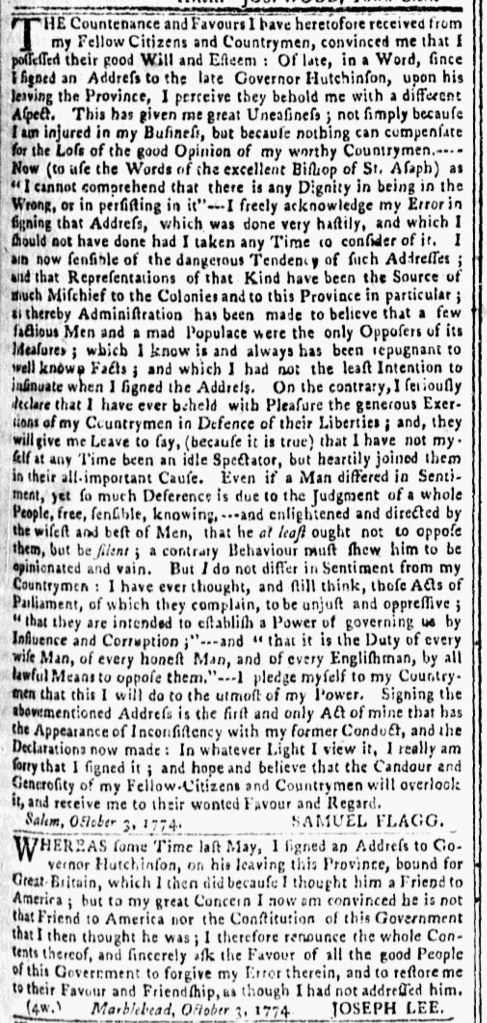
Samuel Flagg of Salem and Joseph Lee of Marblehead needed to do damage control and rehabilitate their reputations after signing “an Address to Governor Hutchinson, on his leaving this Province” in May 1774.  Like Thomas Kidder had done in July, they took to the public prints to confess their error and beg for the forgiveness of their friends and neighbors who believed they did not support the American cause.  The reaction they experienced became so overwhelming that they recanted a position that they claimed they never firmly held.  Lee, for instance, stated that he signed the address because at the time he “thought [Hutchinson] a Friend to America,” yet he had since reconsidered.  He expressed “great Concern” while confessing that “I am now convinced he is not that Friend to America nor the Constitution of this Government that I then thought he was.”  To that end, Lee renounced the entire address and “sincerely ask[ed] the Favour of all the good People of this Government to forgive my Error therein, and to restore me to their Favour and Friendship.”  His plea, dated October 3, first appeared in the October 4 edition of the Essex Gazette, with a notation that it would run for four weeks.  Rather than submitting a letter to the printer that might get printed once, Lee paid to run an advertisement that would present his story and his apology to readers multiple times.

Lee’s notice was brief compared to the one that Flagg inserted on the same day.  He had formerly been in good standing in the community, having the “good Will and Esteem” of his “Fellow Citizens and Countrymen,” but perceived “they behold me with a different aspect” after he signed an address in honor of the Governor Hutchinson upon his return to England.  Flagg confessed that this “has given me great Uneasiness; not simply because I am injured in my Business, but because nothing can compensate for the Loss of the good Opinion of my worthy Countrymen.”  Flagg acknowledged that his livelihood had suffered; apparently customers refused to shop at his store in Salem.  Yet participating in the marketplace was not the only or even the primary reason that Flagg wished to correct the record.  He desired the “Favour and Regard” that he had once enjoyed in relationships with other colonizers, plus he wanted to assure the public that he indeed supported the patriot cause.  He admitted his error while disavowing the address as “the Source of much Mischief to the Colonies and to this Province in particular,” but did not end there.  “I seriously declare,” he wrote, “that I have ever beheld with Pleasure the generous Exertions of my Countrymen in Defence of their Liberties.”  Furthermore, Flagg claimed that “I have note myself at any Time been an idle Spectator, but heartily joined them in their all-important Cause.”  In his advertisement for an “Assortment of ENGLISH and INDIA GOODS” on the next page, he indicated that he “is determined not to import any more Goods at Present,” signaling his support for nonimportation agreements as a means of protesting the Coercive Acts.

Beyond his confession and apology, Flagg incorporated an editorial into his advertisement seeking forgiveness from his “Fellow Citizens and Countrymen.”  He asserted, “I do not differ in Sentiment from my Countrymen; I have ever thought, and still think, those Acts of Parliament, of which they complain, to be unjust and oppressive.”  To demonstrate that point, he inserted quotations that made familiar arguments: “‘that they are intended to establish a Power of governing us by Influence and Corruption’” and “‘that it is the Duty of every wise Man, of every honest Man, and of every Englishman, by all lawful Means to oppose them.’”  Flagg thus had a duty to fulfill, prompting him to “pledge myself to my Countrymen that this I will do to the utmost of my Power.”  He reiterated that he regretted signing the “abovementioned Address,” insisting that it was “the first and only Act of mine that has the Appearance of Inconsistency with my former Conduct, and the Declarations now made.”  He apologized once again, requesting the “Candour and Generosity” of others in overlooking the entire incident.

Signing the address to Governor Hutchinson had been a lapse in judgment; at least that was how some of those who signed it depicted their actions when they repeatedly encountered hostile reactions.  Both Flagg and Lee sought to remedy the damage done to their reputations by placing advertisements in which they confessed their error.  Flagg did even more: he spilled a lot of ink in support of the American cause, hoping that doing so would convince the public of his sincerity and return him to their good graces.  News and editorials could not contain the politics of the period. Instead, advertisements became sites for participating in debates and controversies as the imperial crisis intensified in 1774.

July 18

What was advertised in a colonial American newspaper 250 years ago today?

Boston-Gazette (July 18, 1774).

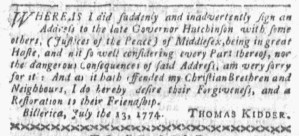
I did suddenly and inadvertently sign an Address to the late Governor Hutchinson.”

When he published an advertisement in the July 18, 1774, edition of the Boston-Gazette, Thomas Kidder of Billerica attempted to extricate himself from a difficult situation.  He explained that he had “suddenly and inadvertently sign[ed] an Address to the late Governor Hutchinson with some others, (Justices of the Peace) of Middlesex.”  Thomas Hutchinson, the outgoing governor, had received several letters praising his administration of the colony, each of them signed by dozens of colonizers.  Some of those letters found their way into print, revealing to the public which members of the community approved of the way the unpopular royal governor had participated in Parliament’s efforts to establish greater control over Boston, the rest of Massachusetts, and all the colonies.

That garnered the wrong kind of attention for Kidder and others, especially those who then professed that they did not actually harbor loyalist sympathies but had instead been “inadvertently” embroiled in the controversy.  Kidder explained that he had signed the letter to Hutchinson “in great Haste, and not so well considering every Part thereof, nor the dangerous Consequences of said Address.”  He did not enjoy the reception he received from colonizers who supported the patriot cause, prompting him to apologize.  He confessed that he was “very sorry” for signing the letter and “as it hath offended my Christian Brethren and Neighbours, I do hereby desire their Forgiveness, and a Restoration of their Friendship.”  Apparently, Kidder’s seeming endorsement of Hutchinson caused so many difficulties in his daily interactions with others that he found it necessary to take to the public prints to disavow an address that he claimed he had not fully considered or understood when he signed it.  It was no mistake that he ran his advertisement in the Boston-Gazette, a newspaper noted for advocating the political views of patriots who opposed the policies enacted by Parliament and Hutchinson’s collaboration in executing them.

In “Entering the Lists: The Politics of Ephemera in Eastern Massachusetts, 1774,” William Huntting Howell documents which newspapers published addresses to Hutchinson and broadsides printed in response, some of them identifying the occupations and places of business of the signatories.  That amounted to an eighteenth-century version of doxing people based on their political views.  Howell argues that such a response was designed “to coerce and secure individual compliance.”  He examines several “RECANTATIONS” that appeared in the newspapers as signatories of addresses to Hutchinson attempted to restore their standing among their fellow colonizers.[1]  Over the next several months, the Adverts 250 Project will feature advertisements, like the one place by Kidder, placed for similar purposes, demonstrating the pressure that patriots managed to bring to bear against real and perceived loyalists as the imperial crisis intensified in 1774.

**********

[1] William Huntting Howell, “Entering the Lists: The Politics of Ephemera in Eastern Massachusetts, 1774,” Early American Studies 9, no. 1 (Winter 2011): 191, 208-215.