August 15

What was advertised in a colonial American newspaper 250 years ago today?
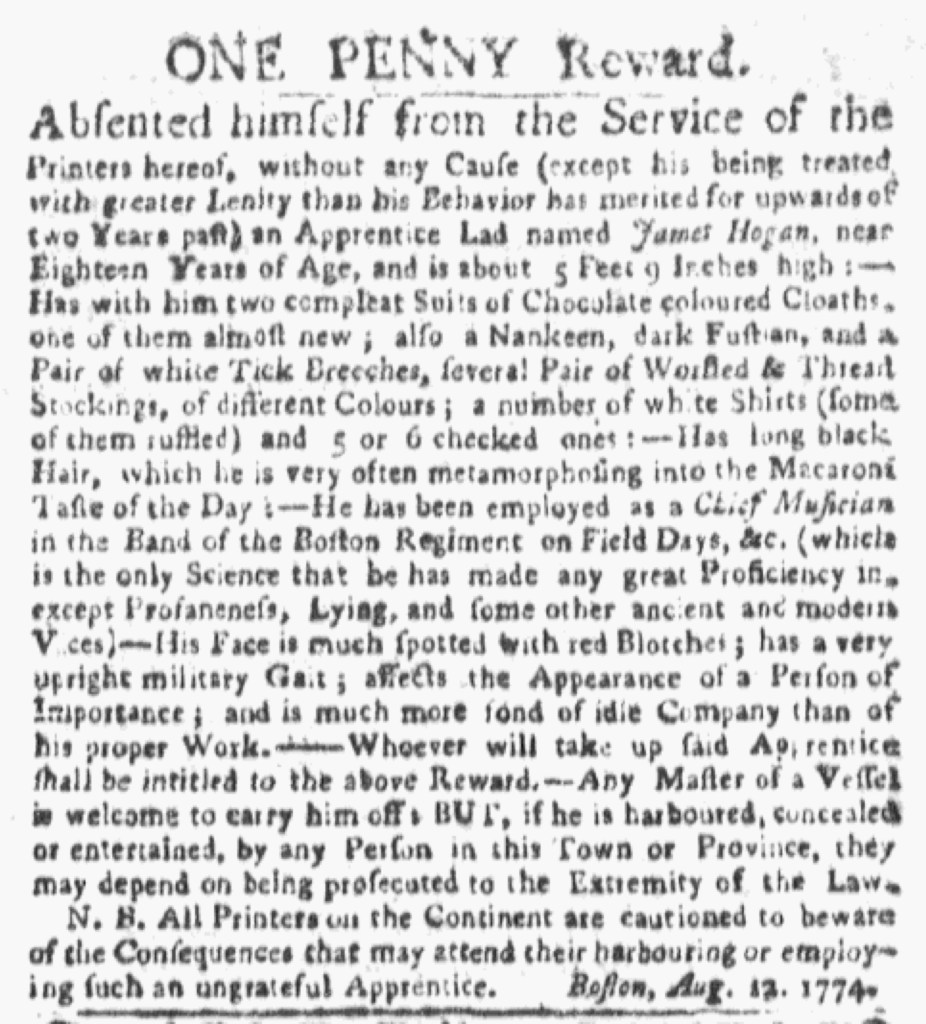
Boston Evening-Post (August 15, 1774).

“ONE PENNY Reward.”

Even though they offered a reward, Thomas Fleet and John Fleet, the printers of the Boston Evening-Post, did not really want anyone to return their runaway apprentice to them.  The reward, “ONE PENNY,” after all, was hardly an incentive but rather an insult to underscore how much contempt the printers had for James Hogan, their “ungrateful Apprentice.”  Contrary to standard language in runaway advertisements that advised ship captains against giving passage to runaway indentured servants and apprentices or enslaved people seeking freedom, the Fleets proclaimed that “Any Master of a Vessel is welcome to carry him off.”  They wished to be done with him, while also warning “All Printers on the Continent” against employing Hogan if he found his way to any of their printing offices.  Whatever skills he had gained, he was not worth the trouble.

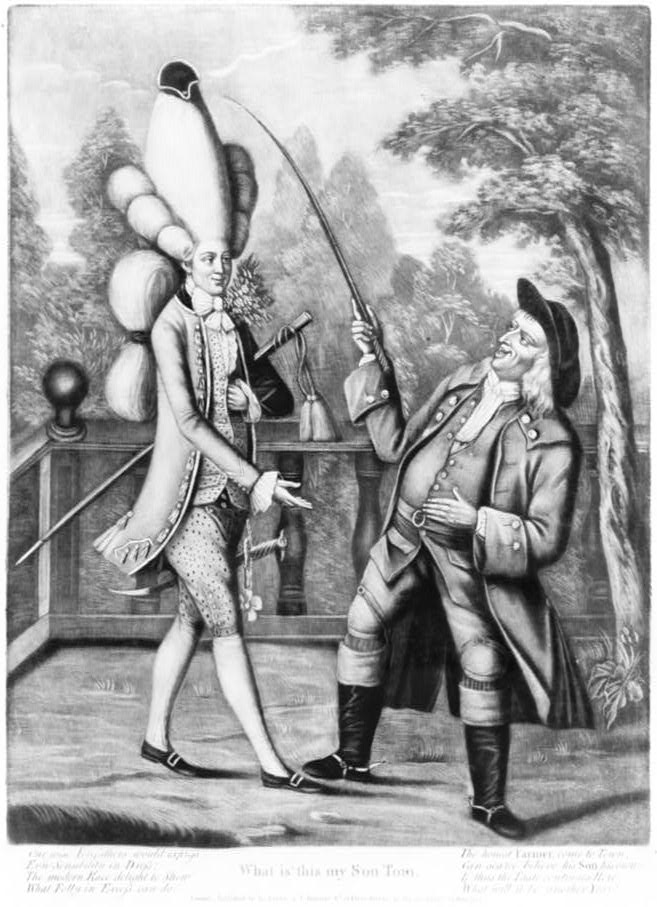
Masters did not always treat apprentices well, yet the Fleets claimed that Hogan absconded “without any Cause (except his being treated with greater Lenity than his Behavior has merited for upwards of two years past).”  In addition to working in their shop, Hogan “has been employed as a Chief Musician in the Band of the Boston Regiment on Field Days.”  That was the only quality to his credit, “the only Science that he has made any great Proficiency in, except Profaneness, Lying, and some other ancient and modern Vices.”  Like too many young men seeking to express themselves and gain attention in a transatlantic consumer society, Hogan put too much emphasis on fashion, one of those vices.  According to the fleets, he had “long black Hair, which he is very often metamorphosing into the Macaroni Taste of the Day” and an extensive wardrobe.  In describing Hogan as a macaroni, the printers invoked eighteenth-century slang for a dandy or fop, referring in particular to elaborate hairstyles that rose far above the forehead.  A print produced in London in June 1774 depicted the dismayed reaction of an “honest FARMER” upon encountering his son, Tom, in all his macaroni trappings, including a wig with hair piled high above his head.

The Fleets suggested that Hogan focused more on this ridiculous fashion than his responsibilities in their printing office.  Even though he “has a very upright military Gait” and “affects the Appearance of a Person of Importance,” he was an apprentice who was “much more fond of Idle Company than of his proper Work.”  The Fleets did not seem disappointed by his departure.  Rather than seek his return, they used their advertisement to denigrate Hogan and warn others against trusting him.

September 3

What was advertised in a colonial American newspaper 250 years ago today?

Connecticut Journal (September 3, 1773).

“Amos Morrisson, Wigg-Maker & Hair-Dresser.”

“Just published … THE MACARONIE JESTER.”

Amos Morrisson may not have been very happy about where his advertisement appeared in the September 3, 1773, edition of the Connecticut Journal.  The “Wigg-Maker & Hair-Dresser” likely did not appreciate that an advertisement for “THE MACARONIE JESTER” appeared immediately below his notice directed to fashionable ladies and gentlemen.  Eighteenth-century readers would have immediately recognized the derogatory term for a man who took current fashions, both clothing and hair, to absurd and preposterous lengths.  The Oxford English Dictionary explains that this synonym for dandy or fop was especially popular in the second half of the eighteenth century to describe “a member of a set of young men who travelled in Europe and extravagantly imitated Continental tastes and fashions.”  On both sides of the Atlantic, the term broadened to refer to any man whose overindulgence in fashion suggested idleness and vice.

Given such negative associations with too much luxury, Morrisson may have been dismayed by the proximity of his advertisement and one for The Macaroni Jester, “Just published, And to be sold by the Printers.”  The wigmaker and hairdresser promoted “various modes” of wigs and hairstyles for men and women, such as “Bagg Wiggs and Spencer Bobs” and “Ladies Roles and French Curls,” as well as accoutrements to adorn hair, including ribbons.  Furthermore, he confided, “If the above Articles should not happen to suit, Gentlemen can be suited in any Taste whatever, in the best Manner and at the shortest Notice.”  Morrisson catered to his clients, but the advertisement for The Macaroni Jester raised suspicions about the “Macaroni beau,” others who luxuriated in current fashions and consumerism, and the purveyors of goods and services who outfitted them.  According to the staff at the Library of the Society of Friends, the book include “includes a ditty on ‘The Origin of Macaronies,” [but] there’s little else of the Macaroni in it: the word has been used simply as a synonym for humour, satire and above all absurdity.”  The “original stories, witty repartees, comical and original Bull’s, [and] entertaining Anecdotes” promised in the advertisement “poke fun at many stock figures.”  Still, that would not have been apparent to readers of the Connecticut Journal, especially since the advertisement emphasized that “the origin of a Macaroni” was “illustrated with a curious and neat copperplate frontispiece of a Macaroni beau.”

Morrisson almost certainly did not want such associations with the goods and services he provided as wigmaker and hairdresser.  Did he complain to the printing office about the juxtaposition of the two advertisements?  In the next issue, Morrisson’s advertisement ran on the front page, while the advertisement for The Macaroni Jester appeared on the final page.  That may have been the result of the usual sort of reorganization that took place between issues.  Compositors regularly moved around advertisements that ran for multiple weeks.  All the same, nothing prevented Morrisson from voicing his concerns about the unfortunate proximity of the two advertisements.

May 24

What was advertised in a colonial American newspaper 250 years ago today?

Boston Evening-Post (May 24, 1773).

“A sprightly, active BOY … not much inclined to Macaronism, is wanted as an Apprentice.”

Thomas Fleet and John Fleet sought an apprentice to assist in their printing office at the Heart and Crown in Boston.  On May 24, 1773, the printers placed a notice in their own newspaper, the Boston Evening-Post, to advise readers that a “sprightly, active BOY, that can read and write, & not much inclined to Macaronism, is wanted as an Apprentice to the Printing Business.”

Most of those credentials make sense to modern readers.  The work undertaken in a printing office was physically demanding, so the Fleets needed a “sprightly, active” apprentice who was up to the challenge.  That apprentice would also assist in setting type and perhaps with some of the bookkeeping, making the ability to read and write almost essential (though some apprentices did learn to read in the process of setting type).  But what about a prospective apprentice “not much inclined to Macaronism”?

In that instance, the Fleets used a slang term recognized by eighteenth-century readers.  They did not seek a “Macaroni” or, as the Oxford English Dictionary explains, a “dandy or fop [who] extravagantly imitated Continental tastes and fashions.”  The OED also includes an example of “Macaroni” in use in 1770, revealing the derision bestowed on the young men who adopted the style: “There is indeed a kind of animal, neither male nor female, a thing of the neuter gender, lately started up amongst us.  It is called a Macaroni.  It talks without meaning, it smiles without pleasantry, it eats without appetite, it rides without exercise, it wenches without passion.”  In the colonies as in Britain, Macaronis participated in the consumer revolution to excess, wallowing in luxury and vice.

Such a character would not do in a printing office … and the Fleets did not want their business to become the venue for parents to attempt to correct such behaviors demonstrated by sons of an appropriate age to enter into apprenticeship agreements.  Many other employment advertisements of the era included “sober” (or, turning to the OED once again, “moderate in demeanour … indicating or implying a serious mind or purpose”) as one of the credentials.  The Fleets could have included “sober” in their notice, but perhaps they had recent encounters with Macaronis that made them particularly cautious about bringing an apprentice with such proclivities into their printing office.  They made it clear that Macaronis need not apply at the Heart and Crown.

April 28

What was advertised in a colonial American newspaper 250 years ago today?

Pennsylvania Gazette (April 28, 1773).

“A LARGE and curious collection of the most modern PRINTS and PICTURES.”

Nicholas Brooks regularly advertised a variety of merchandise available at his shop in Philadelphia in the early 1770s, though he specialized in visual images to adorn homes and offices and often highlighted those items.  Such was the case in his advertisement in the April 28, 1773, edition of the Pennsylvania Gazette.  Brooks promoted a “LARGE and curious collection of the most modern PRINTS and PICTURES” that he recently imported from London.

His new inventory included a “variety of maps of the world, and each quarter,” as well as a “general atlas, containing 36 new and correct maps.”  Those maps helped colonizers in Philadelphia, the largest city in British North America yet also an outpost in a global empire, envision their location in relation to London, other colonies, and faraway places connected via networks of trade that brought vessels from Europe, Africa, and the Caribbean to their bustling port.  Other items at Brooks’s shop also allowed colonizers to contemplate their connections to the empire, especially the cosmopolitan city at its center.  The collection of prints included “the different Macaronies of the present time, now in the greatest vogue in London.”  The term “macaroni” referred to young men, many of whom traveled in Europe, who imitated the extravagant fashions popular on the continent.  These prints gave colonizers in Philadelphia an opportunity to glimpse current fashions adopted by some of the elite in London, providing a guide for dressing themselves to demonstrate their sophistication and gentility.  For others, however, the prints served as a cautionary tale and a means of critiquing the excesses of young men who wallowed in too much luxury.  Satirical prints presented young men as feminized by their attention to fashion and their participation in consumer culture.

Even as Brooks offered such prints for sale at his shop, he also advertised jewelry and dry goods, almost certainly including textiles and garments, for customers to outfit themselves according to the latest fashions.  Colonizers had complicated relationships with consumer culture and the array of goods presented to them by merchants, shopkeepers, tailors, milliners, and other advertisers.  They critiqued even as they indulged, attempting to find the right level of participation that testified to their good taste without impugning their character by going too far.

December 12

What was advertised in a colonial American newspaper 250 years ago today?

Pennsylvania Chronicle (December 12, 1772).

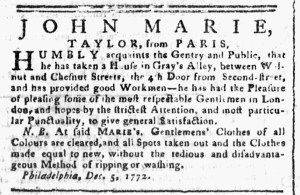
“He has had the Pleasure of pleasing some of the most respectable Gentlemen in London.”

John Marie, a tailor, wanted the better sort to know that he was well qualified to serve them at the shop he ran out of his house in Gray’s Alley in Philadelphia.  In an advertisement in the December 12, 1772, edition of the Pennsylvania Chronicle, he introduced himself as a “TAYLOR, from PARIS.”  He intended that his connection to one of the most cosmopolitan cities in Europe, a city where the fashionable often set tastes adopted in London, the most cosmopolitan city in the British Empire, would recommend him to genteel consumers in the largest and one of the most cosmopolitan cities in the colonies.  He made clear that he sought a particular kind of client by addressing “the Gentry and Public.”  Consumers and tailor would mutually benefit from their association as Marie enhanced the appearances of his clients and those clients gained the cachet of being dressed by a French tailor.

To demonstrate that he was prepared to work with the local gentry, Marie heralded his previous experience.  The tailor proclaimed that he “has had the Pleasure of pleasing some of the most respectable Gentlemen in London,” though he was too discreet to mention names.  That he served “respectable Gentlemen” suggested that he kept them outfitted according to the latest styles but did not resort to anything too frivolous or outrageous.  Prospective clients could depend on him dressing them well without transforming them into the macaronis who were the target of so much derision in both London and Philadelphia in the 1770s.  In “Fashion and the Culture Wars of Revolutionary Philadelphia,” Kate Haulman explains that the term macaroni “applied to elaborately powdered, ruffled, and corseted men of fashion” whose “suits were opulent and closely cut, with incredibly slim silhouettes.”[1]  A series of prints published in London depicted all sorts of men, “from farmers to barristers,” as macaronis.  Thus, Haulman argues, “macaroni could apply to any man who followed fashion to ape high status.”[2]  Marie suggested that he did not seek to serve such pretenders.  The gentry in Philadelphia could depend on him to dress them as “respectable Gentlemen,” just as he had done for his clients in London.

Print depicting a macaroni and his perplexed father. “What is this my Son Tom” (London: R. Sayer and J. Bennett, 1774). Courtesy Library of Congress.

[1] Kate Haulman, “Fashion and the Culture Wars of Revolutionary Philadelphia,” William and Mary Quarterly, 3rd ser., 62, no. 4 (October 2005): 635

[2] Haulman, “Fashion and the Culture Wars,” 636.