November 20

What was advertised in a revolutionary American newspaper 250 years ago today?
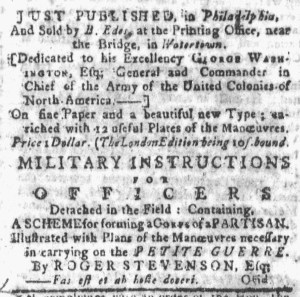
Boston-Gazette (November 20, 1775).

“MILITARY INSTRUCTIONS for officers Detached in the Field.”

On November 20, 1775, Benjamin Edes, the printer of the Boston-Gazette, ran an advertisement for a military manual “JUST PUBLISHED, in Philadelphia,” and available at his printing office in Watertown.  The printer had relocated there shortly after the battles at Lexington and Concord, though he did not update the name of his newspaper.  He advertised an edition of Roger Stevenson’s Military Instructions for Officers Detached in the Field published by Robert Aitken.  Although the advertisement proclaimed that the book had been “JUST PUBLISHED,” another edition had been available in Philadelphia since June.  At the time that Aitken advertised it, he noted that “A new Edition of this Book, with some Additions, is now in the Press and will soon be published.”  That likely referred to the edition that Edes stocked, especially considering that the appeals in his advertisement paralleled the advertisement that Aitken published in the Pennsylvania Ledger in August.

Both advertisements opened with an announcement that the book had been published and where to acquire copies, followed by a note that this edition was “Dedicated to his Excellency GEORGE WASHINGTON, Esq; General and Commander in Chief of the Army of the United Colonies of North-America.”  Next, both advertisements commented on the material aspects of the book, noting the “fine Paper and a beautiful new Type” as well as the “12 useful Plates [or illustrations] of the Manœuvres.”  The price in the local currency followed, along with a comparison to the price of a bound London edition.”  As was so often the case in advertisements for books, all that preamble appeared before the title of the book.  Aitken’s much longer advertisement then presented an address “TO THE PUBLIC” drawn from the preface.  Edes did not devote that much space to his advertisement in the Boston-Gazette.  Instead, he inserted a quotation from Ovid: “Fas est et ab roste doceri” (It is right to be taught from the pulpit).  That phrase invoked Stevenson’s experience as a British officer.  Edes did not devise it on his own.  Instead, he borrowed it from the title page.  Overall, Edes did not generate original copy for his advertisement for a military manual printed in Philadelphia.  Instead, he borrowed heavily from Aitken’s advertisement, revising the location where customers could purchase the book and the price in local currency.  He also substituted the quotation on the title page for an excerpt from the preface but did not compose anything new for his advertisement.  The marketing for the book in the Boston-Gazette thus replicated the strategies that Aitken introduced in the public prints in Philadelphia months earlier.  He may even have dispatched a clipping of the advertisement with the copies he sent to Edes.

August 12

What was advertised in a revolutionary American newspaper 250 years ago today?

Pennsylvania Ledger (August 12, 1775).

“MILITARY INSTRUCTIONS FOR OFFICERS DETACHED IN THE FIELD.”

On August 12, 1775, Robert Aitken, a printer in Philadelphia, launched a new advertising campaign to promote his American edition of Military Instructions for Office Detached in the Field by Roger Stevenson.  He began with advertisements in the Pennsylvania Evening Post and the Pennsylvania Ledger.  Two days later, he placed the same advertisement in Dunlap’s Pennsylvania Packet and then in the Pennsylvania Gazette another two days after that. Aitken’s new advertisement significantly expanded on the notice that he had published in June.

This time, for example, the printer announced that his American edition was “Dedicated to His Excellency GEORGE WASHINGTON, Esq; General and Commander in Chief of the Army of the United Colonies of North-America.”  The book itself featured a short dedication essay that extended four pages.  In the new advertisement, Aitken promoted some of the usual qualities that printers, publishers, and booksellers often highlighted, noting that the book was printed “On fine Paper, [with] a beautiful new Type” and the “twelve useful Plates” or illustrations “of the Manœuvres” supplemented the text.  Each bound copy cost six shillings and six pence, though Aitken also marketed a “few copies on a superfine paper” for one dollar to those who desired even higher quality.  The price was a bargain, the printer noted, with a bound copy of the London edition selling for ten shillings.

Beyond those details, Aitken incorporated an address “TO THE PUBLIC” into this advertisement, though he did not generate the copy himself.  Instead, he borrowed liberally from the preface of the book, making minor revisions here and there.  In effect, he gave prospective customers a preview of what they would read once they purchased Military Instructions for Officers Detached in the Field.  In the preface, Stevenson lamented that “inferior officers have had no source from whence they could derive instruction on the duties of their sphere in the field,” but he aimed to remedy that with this volume.  He almost certainly had not intended, however, that it would be used by officers in the “Army of the United Colonies of North-America” as they defended their liberties in what would eventually become a war for independence.  Aitken saw an opportunity to generate revenues in the wake of the battles at Lexington and Concord.

In a nota bene, the printer added that he stocked “A complete and elegant MAP of the country, shewing the Seat of the present unhappy Civil War in North-America.”  Bernard Romans, a prominent cartographer, distributed broadside subscription proposals a month earlier, listing Aitken among the many local agents who collected names of subscribers who ordered copies in advance.   The printer gave details about the map not included in the broadside subscription proposal and that had not appeared in newspaper notices.  The map featured a “beautiful Draught of the Provincial CAMP: Likewise, A perspective View of BOSTON, and Gen. Gage’s LINE.”  Current events certainly shaped which items Aitken produced, advertised, and sold at his printing office in Philadelphia.

June 24

What was advertised in a revolutionary American newspaper 250 years ago today?

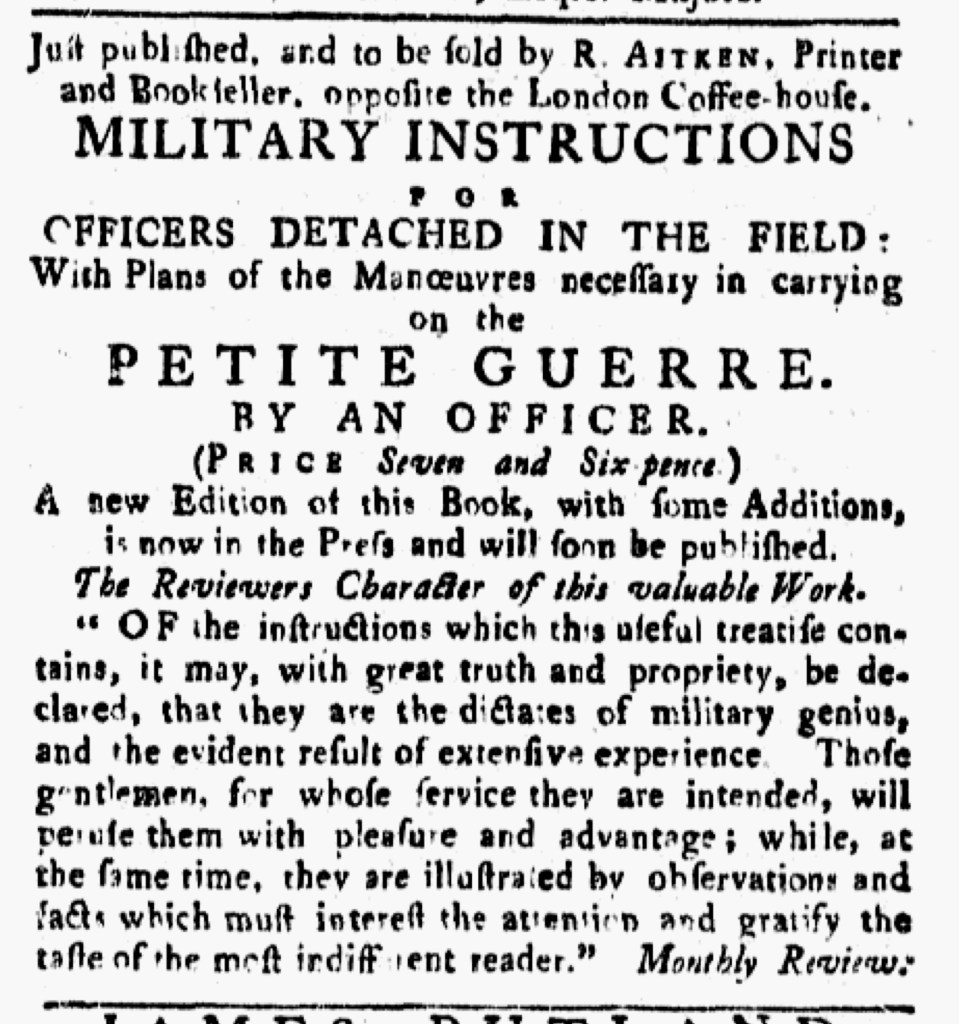
Pennsylvania Ledger (June 24, 1775).

“MILITARY INSTRUCTIONS FOR OFFICERS DETACHED IN THE FIELD.”

It was a timely volume for the summer of 1775.  The June 24 edition of the Pennsylvania Ledger carried an advertisement for Military Instructions for Officers Detached in the Field: With Plans of the Manoeuvres Necessary in Carrying on the Petite Guerre.  Robert Aitken, a printer and bookseller in Philadelphia, published and sold an American edition of a book that had been successful enough in England to go to a second edition the previous year.

Aitken marketed it at a time that readers of the Pennsylvania Ledger already knew about the battles at Concord and Lexington and the siege of Boston.  They were just learning about the Battle of Bunker Hill a week earlier.  In the column to the left of the advertisement for Military Instructions, the Pennsylvania Ledger reprinted a portion of a letter that reported “our people attempting to take possession of Bunker’s Hill and Dorchester Point … were attacked by the regulars.”  The correspondent did not have all the details, but did know that “three Colonels in our service were wounded, Col. Gardner, mortally; how many are slain on either side, is uncertain.”  The letter did not mention the death of Joseph Warren, a noted Patriot and the president of the Massachusetts Provincial Congress, nor did it reveal the outcome of the battle.  “When the post came away,” the letter stated, “our people kept their ground and made a stand; how they have fared at Dorchester, we do not hear.”  Incomplete, it was the most recent update available in Philadelphia at the time the June 24 edition of the Pennsylvania Ledger went to press.

Still, it likely primed some readers to take greater interest in Military Instructions written “BY AN OFFICER.”  To help in stimulating demand, Aitken inserted an excerpt of a review that appeared in the Monthly Review, a magazine published in London.  “OF the instructions which this useful treatise contains,” the reviewer asserted, “it may, with great truth and propriety, be declared, that they are the dictates of military genius, and the evident result of extensive experience.”  That made the book required reading for colonizers serving as officers.  “Those gentlemen, for whose service they are intended,” the reviewer pronounced, “will peruse them with pleasure and advantage.”  Yet that was not the only prospective audience for Military Instructions.  The reviewer insisted that “they are illustrated by observations and facts which must interest the attention and gratify the taste of the most indifferent reader.”  With battles being fought in New England and George Washington “appointed commander in chief of all the North-American forces by the Honourable Continental CONGRESS” (according to an update that appeared just below the initial report from Bunker Hill), could any prospective reader have been “indifferent” when they saw Aitken’s advertisement?