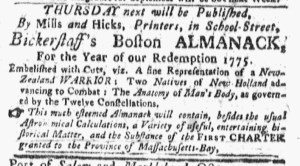
What was advertised in a colonial American newspaper 250 years ago today?
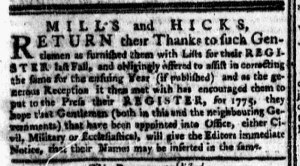
“They hope that Gentlemen … that have been appointed into Office … will give the Editors immediate Notice.”
Nathaniel Mills and John Hicks, the printers of the Massachusetts Gazette and Boston Post-Boy, used crowdsourcing as one means of gathering information for their publications. To one extent or another, all colonial printers who published newspapers did so, seeking news from ship captains and travelers and reprinting items from one newspaper to another. They also regularly asked the public to submit news. In the colophon for the Massachusetts Gazette and Boston Post-Boy, Mills and Hicks noted that “Letters of Intelligence for this Paper are taken in” at their printing office. It was a familiar invitation. Isaiah Thomas declared that “Articles of Intelligence, &c. are thankfully received” at the printing office where he published the Massachusetts Spy.
Yet Mills and Hicks did not limit crowdsourcing to their newspaper. They also incorporated it into gathering information for almanacs and registers. In early October 1774, they placed an advertisement requesting that “if any new Houses of Entertainment have been opened, or if any were omitted” in that year’s edition of Bickerstaff’s Boston Almanack that “such Tavern Keepers … send their Names immediately” so they could be included in the almanac for 1775. An advertisement for that almanac in the November 24, 1774, edition of the Massachusetts Spy featured a list of contents, including “the best Houses for Travellers to put up at.” The printers presumably added any taverns that came to their attention because of their previous notice.
Immediately above that advertisement, they issued another call for the public to assist in compiling Mills and Hicks’s British and American Register for 1775. The commenced with expressing “their Thanks to such Gentlemen as furnished them with Lists for their REGISTER last Fall, and obligingly offered to assist in correcting the same for the ensuing Year (if published).” The 1774 edition had met with sufficient success, a “generous Reception,” that the printers did indeed feel “encouraged” to “put to the Press” a new Register for the coming year. To make it as accurate and comprehensive as possible, they declared that “they hope that Gentlemen (both in this and the neighbouring Governments) that have been appointed into Office, either Civil, Military or Ecclesiastical, will give the Editors immediate Notice, that their Names may be inserted in the same.” Mills and Hicks relied on the public, especially newspaper readers, to supply them with current information for their compendium of officials in New England.