November 24

What was advertised in a colonial American newspaper 250 years ago today?
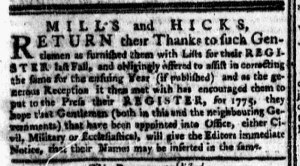
Massachusetts Spy (November 24, 1774).

“They hope that Gentlemen … that have been appointed into Office … will give the Editors immediate Notice.”

Nathaniel Mills and John Hicks, the printers of the Massachusetts Gazette and Boston Post-Boy, used crowdsourcing as one means of gathering information for their publications.  To one extent or another, all colonial printers who published newspapers did so, seeking news from ship captains and travelers and reprinting items from one newspaper to another.  They also regularly asked the public to submit news.  In the colophon for the Massachusetts Gazette and Boston Post-Boy, Mills and Hicks noted that “Letters of Intelligence for this Paper are taken in” at their printing office.  It was a familiar invitation.  Isaiah Thomas declared that “Articles of Intelligence, &c. are thankfully received” at the printing office where he published the Massachusetts Spy.

Yet Mills and Hicks did not limit crowdsourcing to their newspaper.  They also incorporated it into gathering information for almanacs and registers.  In early October 1774, they placed an advertisement requesting that “if any new Houses of Entertainment have been opened, or if any were omitted” in that year’s edition of Bickerstaff’s Boston Almanack that “such Tavern Keepers … send their Names immediately” so they could be included in the almanac for 1775.  An advertisement for that almanac in the November 24, 1774, edition of the Massachusetts Spy featured a list of contents, including “the best Houses for Travellers to put up at.”  The printers presumably added any taverns that came to their attention because of their previous notice.

Immediately above that advertisement, they issued another call for the public to assist in compiling Mills and Hicks’s British and American Register for 1775.  The commenced with expressing “their Thanks to such Gentlemen as furnished them with Lists for their REGISTER last Fall, and obligingly offered to assist in correcting the same for the ensuing Year (if published).”  The 1774 edition had met with sufficient success, a “generous Reception,” that the printers did indeed feel “encouraged” to “put to the Press” a new Register for the coming year.  To make it as accurate and comprehensive as possible, they declared that “they hope that Gentlemen (both in this and the neighbouring Governments) that have been appointed into Office, either Civil, Military or Ecclesiastical, will give the Editors immediate Notice, that their Names may be inserted in the same.”  Mills and Hicks relied on the public, especially newspaper readers, to supply them with current information for their compendium of officials in New England.


April 26

What was advertised in a colonial American newspaper 250 years ago today?

Massachusetts Gazette and Boston Post-Boy (April 26, 1773).

“Hope the Customers to the Paper will continue to encourage it by advertising.”

The first advertisement in the April 26, 1773, edition of the Massachusetts Gazette and Boston Post-Boy concerned the operation of the newspaper.  For nearly sixteen years, since August 1757, John Green and Joseph Russell printed the newspaper, but starting on that day “the Printing and Publishing of this PAPER will, in future be carried on by NATHANIEL MILLS and JOHN HICKS.”  Neither the printers nor readers knew it at the time, but the newspaper would not continue for nearly as long under Mills and Hicks.  They published the last known issue on April 17, 1775, two days before the skirmishes at Lexington and Concord that marked the beginning of the Revolutionary War.

At the time that ownership of the newspaper changed hands, Green and Russell expressed “their respectful Thanks for the Favours they have received.”  Furthermore, they expressed their “hope the Customers to the Paper will continue to encourage it by advertising, &c.”  That “&c.” (an abbreviation for et cetera) included subscribing to the newspapers and providing content, such as editorials and “Letters of Intelligence.”  The printers realized that the continued viability and success of the newspapers depended most immediately on maintaining advertising revenue since readers but subscribed for a year while most advertisements ran for only three or four weeks.

Readers likely noticed a new feature in the first issue published by Mills and Hicks, a colophon that ran across the bottom of the final page.  Green and Russell did not always include a colophon, perhaps because they considered the newspaper so well established that they did not consider it necessary to devote space to it in each issue.  Their final issue, the April 19 edition, for instance, did not feature a colophon.  On April 12, the colophon at the bottom of the last column on the final page simply stated, “Printed by Green and Russell.”  Mills and Hicks, on the other hand, opted for a more elaborate colophon that served as a perpetual advertisement for the newspaper and other services available in their printing office, a practice adopted by some, but not all, colonial printers.  Distributed over three lines, it read, “BOSTON: Printed by MILLS and HICKS, at their PRINTING-OFFICE in School-street, next Door to CROMWELL’S HEAD TAVERN, where Subscriptions, Advertisements, and Letters of Intelligence for this Paper are taken in; and the Printing Business carried on, in its different Branches, with the greatest Care.”

Mills and Hicks could not depend on their reputations to market the Massachusetts Gazette and Boston Post-Boy in the same way that Green and Russell did after more than a decade of publishing the newspaper.  In their first issue, they placed greater emphasis on soliciting advertisements to help support their enterprise.  Subsequent issues included the colophon, a regular feature that encouraged colonizers to advertise as well as purchase subscriptions and submit orders for job printing.

Colophon from Massachusetts Gazette and Boston Post-Boy (April 26, 1773).