August 5

What was advertised in a revolutionary American newspaper 250 years ago today?
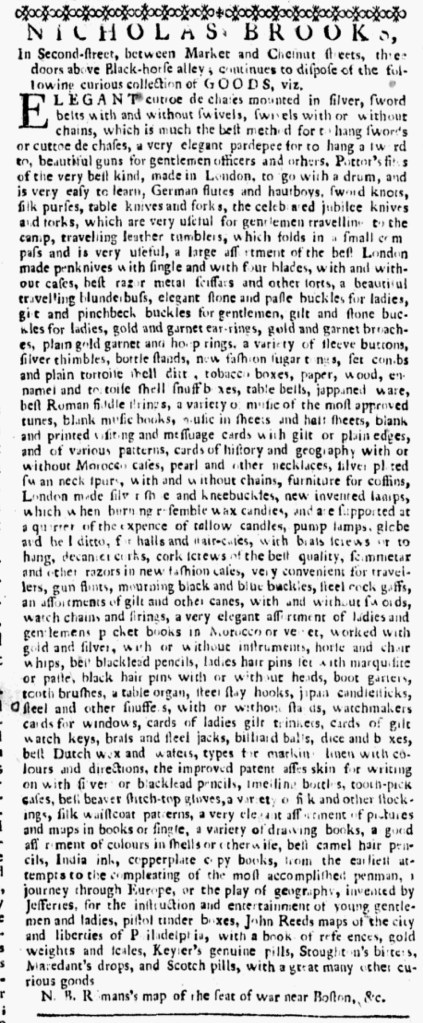
Pennsylvania Ledger (August 5, 1775).

“Romans’s map of the seat of war near Boston.”

At the end of July 1775, Nicholas Brooks began running a new advertisement in the Pennsylvania Ledger.  It first appeared on July 29 and then again in the next two issues.  In it, Brooks hawked a “curious collection of GOODS” that he sold at his shop on Second Street in Philadelphia.  He listed everything from sword belts and “beautiful guns for gentlemen officers” and “gilt and stone buckles for ladies” to “razors in new fashion cases, very convenient for traveling” and “cork screws of the best quality” to “a very elegant assortment of ladies and gentlemans pocket books in Morocco velvet, worked with gold and silver” and “a variety of music of the most approved tunes.”  He also stocked “a very elegant assortment of pictures and maps in books or single.”  Brooks had already established “PRINTS and PICTURES” as a specialty.

He concluded this advertisement with a nota bene that indicated he sold “Romans’s map of the seat of war near Boston,” but he did not say anything more about that item.  In addition, neither Brooks nor Bernard Romans, the cartographer and “AUTHOR” of the map, previously advertised the project in the Pennsylvania Ledger or any of the other newspapers printed in Philadelphia at the time.  Perhaps Brooks expected that readers were familiar with a broadside subscription proposal, dated July 12, that had been circulating or posted around town and beyond.  The subscription proposal featured the same copy as the advertisement for the map that ran in the August 3 edition of Rivington’s New-York Gazetteer, though the newspaper notice listed only local agents while the broadside gave a much more extensive list of printers, booksellers, and others who collected subscriptions in towns from New England to South Carolina.  James Rivington apparently adapted the broadside rather than composing copy for the advertisement when he inserted it in his newspaper.  That broadside documented a sophisticated network for inciting demand for the map and distributing it to subscribers.  In addition to the five printers and booksellers who collected subscriptions in Philadelphia, twenty-two local agents in eighteen towns in ten colonies collaborated with Brooks and Romans.  That list represented an “imagined community,” a concept developed by Benedict Anderson, of readers and consumers near and far who simultaneously examined the same map “Shewing the SEAT of the present unhappy CIVIL WAR in NORTH-AMERICA.”

Brooks did not limit his marketing of the map to the broadside subscription proposal and the nota bene at the end of an advertisement that cataloged dozens of items available at his shop.  He eventually ran newspaper advertisements devoted exclusively to the map, seeking to generate more interest and demand for such a timely and important work.
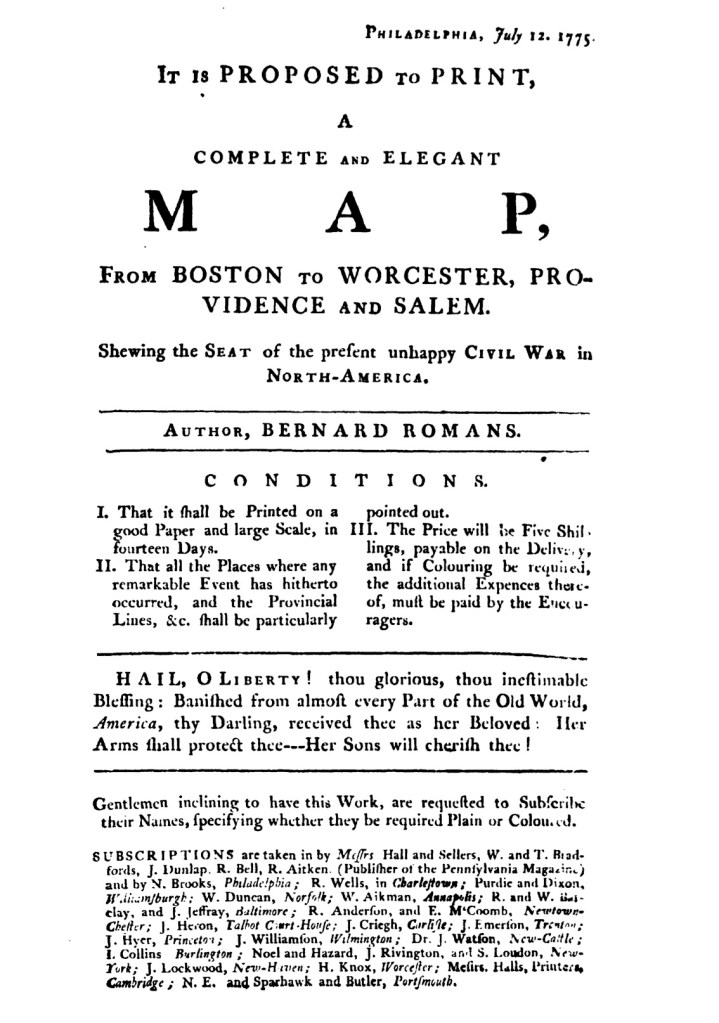
Broadside Subscription Proposal: “It Is Proposed to Print, A Complete and Elegant Map” (Philadelphia, 1775). Courtesy Library Company of Philadelphia.

**********

The Massachusetts Historical Society has digitized Romans’s map, accompanied by a brief overview of its significance and a short essay about Romans and other cartographers active during the era of the American Revolution.
July 13

What was advertised in a colonial American newspaper 250 years ago today?

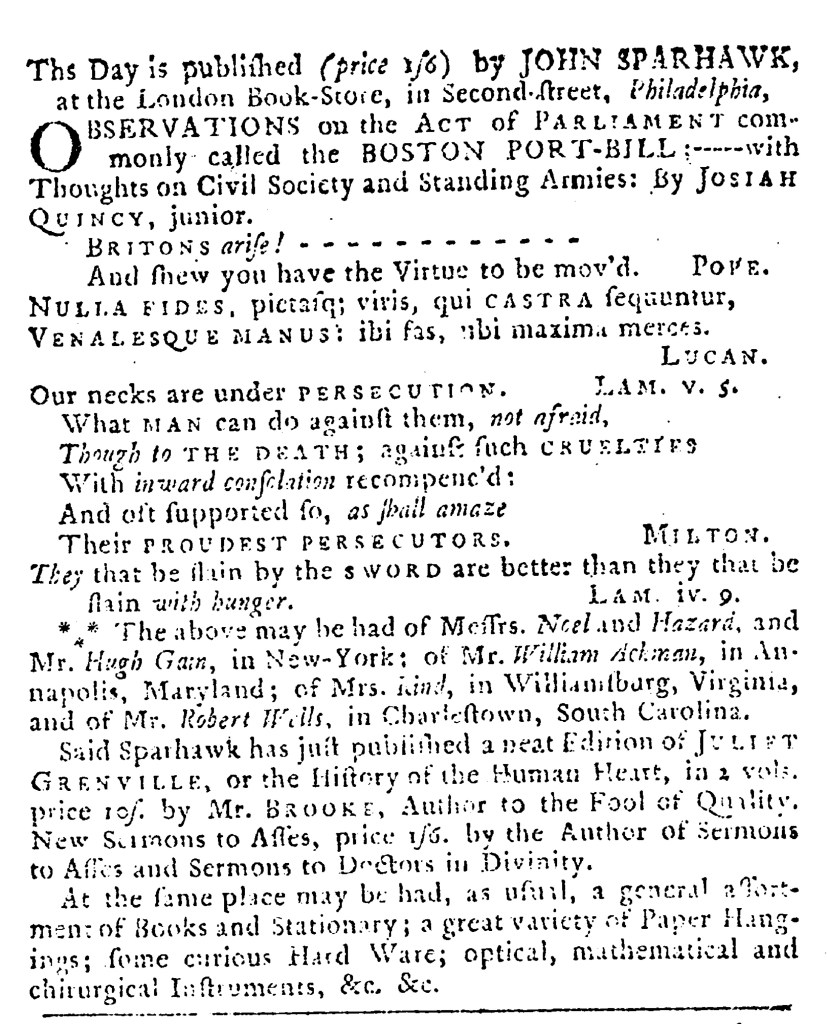
Pennsylvania Journal (July 13, 1774).

“OBSERVATIONS on the ACT of PARLIAMENT commonly called the BOSTON PORT-BILL … BY JOSIAH QUINCY, junior.”

In the spring of 1774, Josiah Quincy, Junior, of Boston, a prominent lawyer and noted patriot, penned Observations on the Act of Parliament Commonly Called the Boston Port-Bill: With Thoughts on Civil Society and Standing Armies.  In it, Quincy encouraged colonizers to unite in opposition to abuses perpetrated by Parliament, continuing work he had undertaken in 1773 when he visited South Carolina to strengthen ties among patriots in northern and southern colonies.  He had also published political essays in the Boston-Gazette, known for its support of the patriot cause, for several years. According to Daniel R. Coquillette and Neil Longley York, the editors of his major political and legal papers, the pamphlet “was the culmination of his thinking and writing about the problem of balancing imperial authority and colonial liberty.”

Benjamin Edes and John Gill printed the tract and advertised it in their newspaper, the Boston-Gazette, a publication known for advocating the patriot cause.  Soon, advertisements appeared widely in other newspapers published in Boston as well as newspapers in other towns in New England.  In general, they were brief announcements that merely named the title and author; Quincy’s reputation as writer, orator, and political philosopher was so well established that printers and booksellers did not consider it necessary to elaborate on what he had written to convince colonizers to purchase copies of the Observations.  Quincy’s pamphlet experienced even greater dissemination when John Sparhawk, a bookseller in Philadelphia, published an edition there and advertised it in the Pennsylvania Journal.  In addition to stocking it at his “London Book-Store,” Sparhawk advised readers that they could acquire copies from local agents, most of them printers and booksellers, in New York, Annapolis, Williamsburg, and Charleston.  That distribution network certainly made Quincy’s Observations more accessible to colonizers beyond New England, helping to explain how his “attempt to define and defend American rights” became, as Coquillette and York assert, “an essential part of the debate over rights in the empire.”

August 24

What was advertised in a colonial American newspaper 250 years ago today?

Connecticut Courant (August 24, 1773).

“PROPOSALS, For printing by SUBSCRIPTION, A NEW Periodical Production, entitled, The ROYAL American Magazine.”

Isaiah Thomas, the printer of the Massachusetts Spy, continued his efforts to garner subscribers for a new publication, the Royal American Magazine, in August 1773.  He previously disseminated subscription proposals in his own newspaper, first on June 24 and then in four of the five issues published in July.  By the end of that month, he inserted the extensive proposals in two other newspapers published in Boston (the Massachusetts Gazette and Boston Post-Boyand the Massachusetts Gazette and Boston Weekly News-Letter) as well as both newspapers published in Rhode Island (the Newport Mercury and the Providence Gazette) and one each in New York (the New-York Journal) and Philadelphia (the Pennsylvania Chronicle).  In total, subscription proposals for the Royal American Magazine appeared fourteen times in seven newspapers in five towns in July.

In August, those proposals ran another thirteen times, as listed below.  Thomas inserted them in his own newspaper three more times.  He also concluded the cycle in three other newspapers.  Most printers charged a set rate for an advertisement to run three times and then additional fees for each insertion after that.  The proposals made their second and third appearances in both the Newport Mercury and the Pennsylvania Chronicle in August (and already made three appearances in the Massachusetts Gazette and Boston Post-Boy in July).  According to the colophon for the New-York Journal, advertisements ran four times before the printer assessed additional fees.  The proposals made their third and fourth appearances in the New-York Journal in August 1773.  They also ran for the first time in the Boston Evening-Post and the Boston-Gazette.  That meant that all of the newspapers published in Boston carried the proposals at least once, reaching readers in that city and beyond who did not regularly read the Massachusetts Spy.  Thomas may have struck a deal with his fellow printers in town since three of those newspapers printed the proposals only once.  Thomas also added another newspaper to the roster of those that disseminated the subscription proposals.  The Connecticut Courant, published in Hartford, carried them on August 24, the first time for a newspaper in that colony.  The proposals filled nearly two columns (out of twelve) in that issue.  Three days later, the proposals ran in the New-London Gazette.

Thomas realized that to successfully attract enough subscribers to make the only magazine published in America at the time a viable venture, he needed to market the proposed publication widely.  That meant saturating the market in Boston as well as establishing a network that included towns in other colonies.  Advertisements in newspapers published in New York, Philadelphia, Providence, New London, Newport, and Hartford reached even wider audiences than the Massachusetts Spy and its counterparts in Boston.  Thomas engaged “the printers and booksellers in America,” near and far, to act as local agents who collected subscriptions for the Royal American Magazine on his behalf.

  • August 2 – Boston-Gazette (first appearance)
  • August 2 – Newport Mercury (second appearance)
  • August 2 – Pennsylvania Chronicle (second appearance)
  • August 5 – Massachusetts Spy (sixth appearance)
  • August 5 – New-York Journal (third appearance)
  • August 9 – Newport Mercury (third appearance)
  • August 9 – Pennsylvania Chronicle (third appearance)
  • August 12 – Massachusetts Spy (seventh appearance)
  • August 12 – New-York Journal (fourth appearance)
  • August 16 – Boston Evening-Post (first appearance)
  • August 19 – Massachusetts Spy (eighth appearance)
  • August 24 – Connecticut Courant (first appearance)
  • August 27 – New-London Gazette (first appearance)
Connecticut Courant (August 24, 1773).