December 23

What was advertised in a colonial American newspaper 250 years ago today?
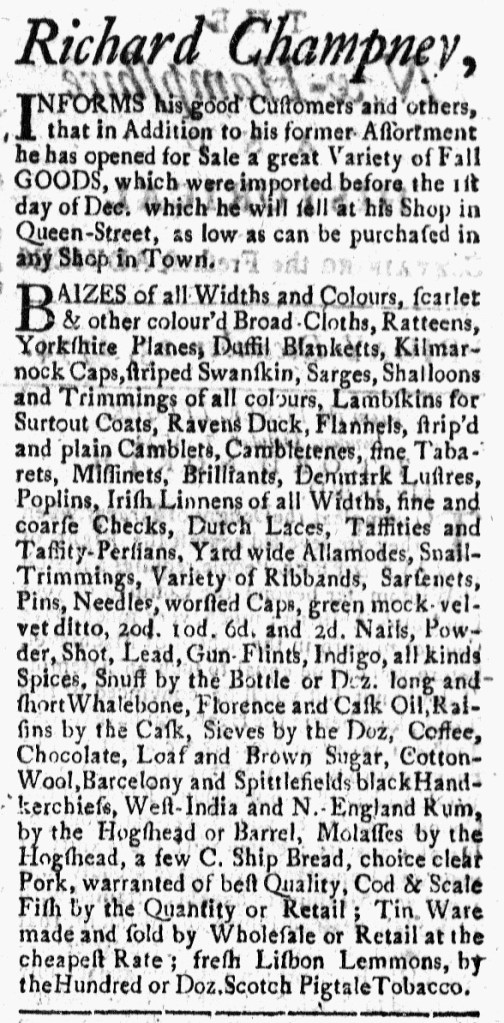
New-Hampshire Gazette (December 23, 1774).

“Fall GOODS, which were imported before the 1st of Dec.”

Richard Champney’s advertisement in the December 23, 1774, edition of the New-Hampshire Gazette looked like many others that had appeared in that newspaper and others throughout the colonies for about two decades.  The shopkeeper emphasized that he stocked “a great Variety of Fall GOODS” and promised competitive prices, declaring that consumers could acquire his merchandise “as low as can be purchased in any Shop in Town.”  To demonstrate the array of choices he offered, he devoted most of his advertisement to an extensive list that included “BAIZES of all Widths and Colours,” “Shalloons and Trimmings of all colours,” “strip’d and plain Camblets,” “fine and coarse Checks,” a “Variety of Ribbands,” “worsted Caps,” and “Barcelony and Spittlefields black Handkerchiefs.”  Although many of those textiles and accessories may not be immediately familiar to modern readers, they resonated with readers immersed in the consumer revolution of the eighteenth century.  They fluently spoke the language of consumption.

Despite the similarities with longstanding forms of advertising, Champney’s notice included one detail that distinguished it from what he would have published even a month earlier.  Although he had “opened” a new stock to supplement his “former Assortment,” those new goods “were imported before the 1st day of Dec[ember].”  That clarification was important for the shopkeeper to bring to the attention of prospective customers in Portsmouth and nearby towns and anyone who might read the New-Hampshire Gazette far and wide.  Champney explicitly specified that he observed the Continental Association, a nonimportation agreement adopted by the First Continental Congress that went into effect on December 1.  Since he had received this “great Variety of Fall GOODS” before that date, he could sell them with a clear conscience.  Similarly, consumers could purchase them without worrying whether they aided the shopkeeper in breaking the agreement.  For many years advertisers had noted when they imported their merchandise as a means of assuring prospective customers that they carried new items of the latest styles and taste.  After December 1, 1774, however, when a shipment arrived had political significance and new sorts of ramifications for both advertisers and buyers.
January 21

What was advertised in a colonial American newspaper 250 years ago this week?

Jan 21 - 1:18:1770 Pennsylvania Gazette
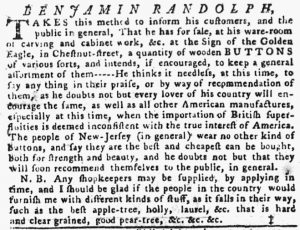
Pennsylvania Gazette (January 18, 1770).

“Every lover of his country will encourage … American manufactures.”

Benjamin Randolph, one of Philadelphia’s most prominent and successful cabinetmakers, was also a savvy advertiser. He inserted notices in the city’s newspapers, but he also distributed an elegant trade card that clearly demonstrated the influence of Thomas Chippendale’s Gentleman and Cabinet-maker’s Director (1754). Known for his furniture, Randolph also promoted other carved items produced in his shop “at the Sign of the Golden Eagle,” including “a quantity of wooden BUTTONS of various sorts.”

Buttons often appeared among the extensive lists of imported merchandise published in advertisements placed by merchants and shopkeepers. When consumers purchased textiles and trimmings to make garments, they also acquired buttons. At a time when colonists participated in nonimportation agreements to protest the duties on imported goods imposed by the Townshend Acts, Randolph offered an alternative to buttons from England. He made it clear to prospective customers that purchasing his buttons served a political function; doing so signaled support for the American cause. Rather than depend on consumer’s familiarity with current events and popular discourse about the political meaning of goods, Randolph plainly stated, “[E]very lover of his country will encourage [his buttons by purchasing them], as well as all other American manufactures, especially at this time, when the importation of British superfluities is deemed inconsistent with the true interest of America.” Randolph encouraged colonists to reject the “Baubles of Britain,” as T.H. Breen has so memorably named the consumer goods produced on the other side of the Atlantic and sent to American markets. Randolph made a bid not only for support of the items he produced but also others made in the colonies, showing solidarity with fellow artisans as they did their part in opposition to Parliament.

Such efforts, however, did not depend solely on Randolph and other artisans. Ultimately, consumers determined the extent of the effectiveness of producing “American manufactures” through the decisions they made about which and how many items to purchase and which to boycott. Randolph had “a quantity” of buttons on hand, but producing more depended on the reception he received from the residents of Philadelphia and its hinterlands. He would “keep a general assortment of them” but only “if encouraged.” Consumers had to demonstrate that they would partner with him in this act of resistance once Randolph presented them with the opportunity.