December 7

What was advertised in a revolutionary American newspaper 250 years ago today?
Maryland Gazette (December 7, 1775).

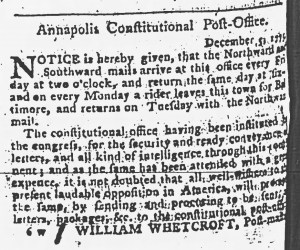
“Annapolis Constitutional Post-Office.”

In early December 1775, William Whetcroft became the latest postmaster to run a newspaper advertisement promoting a local branch of the Constitutional Post Office established by the Second Continental Congress.  In October, Mary Katharine Goddard placed a notice about the Baltimore office in the Maryland Journal.  Otherwise, advertisements for local branches appeared in newspapers published in New England, New York, and Pennsylvania, but not yet in newspapers from colonies south of Maryland.  The headline for this newest advertisement proclaimed, “Annapolis Constitutional Post-Office,” alerting readers of the Maryland Gazette that they had an alternative to the British imperial system.  Whetcroft commenced with an overview of his office’s schedule: “the Northward and Southward mail arrive at this office every Friday at two o’clock, and return the same day at six.”  In addition, “on Monday a rider leaves this town for Baltimore, and returns on Tuesday with the Northward mail.”

Yet Whetcroft used his advertisement to relay more than just the logistical details.  He gave an overview of the purpose that the Constitutional Post Office served as the imperial crisis intensified, hostilities commenced, and some colonizers considered whether they should declare independence rather than continue seeking redress of their grievances against Parliament.  “The constitutional office having been instituted by the congress,” the postmaster explained, “for the security and ready conveyance of letters, and all kinds of intelligence through this continent; and as the same has been attended with a great expence, it is not doubted that all well-wishers to the present laudable opposition in America, will promote the same, by sending and procuring to be sent all letters, packages, &c. to the constitutional post-office.”  Supporters of the American cause had a civic duty, Whetcroft asserted, to make use of this service.

Frederick Green, the printer of the Maryland Gazette, gave Whetcroft’s notice a privileged place the first time it appeared in that newspaper.  It appeared as the second advertisement following the news, preceded only by Green’s own advertisement for the almanac he just published and sold at the printing office.  As much as Green may have been a supporter of the Constitutional Post Office, he still had to earn his livelihood with his own endeavors!  Still, the printer had room for only two advertisements at the bottom of the final column on the second page.  He could have chosen from among several of a similar length to Whetcroft’s advertisement, yet he selected the notice about the Constitutional Post Office to appear alongside news of the revolutionary events taking place in Maryland and beyond.  In subsequent editions, that advertisement ran intermingled among others, but that was common practice for notices that printers initially gave privileged places the first time they ran in their newspapers.
November 17

What was advertised in a revolutionary American newspaper 250 years ago today?

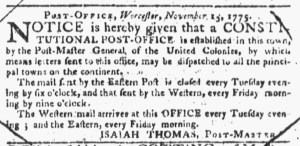
Thomas’s Massachusetts Spy (November 17, 1775).

“A CONSTITUTIONAL POST-OFFICE is established in this town.”

Isaiah Thomas, the printer of Thomas’s Massachusetts Spy, gained a new title in the fall of 1775.  He became the postmaster for the “CONSTITUTIONAL POST-OFFICE” in Worcester.  In an advertisement in the November 17 edition of his newspaper, he informed the public that “the Post-Mater General of the United Colonies” established the post office in Worcester.  That meant that “letters sent to this office, may be dispatched to all the principal towns on the continent” via a network of post offices and riders authorized by the Second Continental Congress as an alternative to the imperial postal system.  Thomas provided a schedule.  Outgoing mail “sent by the Eastern Post is closed every Tuesday evening by six o’clock.”  For outgoing mail, the post office dispatched letter received “Friday morning by nine o’clock.”  That corresponded with the arrival of new mail: “The Western mail arrives at this OFFICE every Tuesday evening; and the Eastern, every Friday morning.”  Patrons who planned accordingly could use the new postal system to correspond with friends, relatives, and associates throughout the colonies.

Thomas gave this advertisement a prominent place when he published it, placing it immediately below a notice that the Second Continental Congress created a committee to compile a “just and well authenticated account of the hostilities committed by the ministerial troops and navy in America since March last,” including “proper evidence of the truth of the facts related.”  In documenting buildings destroyed, vessels seized, and stock taken, they justified their resistance and engaged in public relations to demonstrate that colonizers had legitimate grievances.  Thomas could have placed any number of other advertisements below that notice, yet he opted for one that promoted another effort undertaken by the Second Continental Congress to protect American liberties.  It was a fitting editorial decision for a newspaper with American Oracle of Liberty as its secondary title.  In this instance, Thomas deployed an advertisement as a continuation of news about current events, keeping readers updated not only about what occurred but also about how they could support the American cause.

October 29

What was advertised in a revolutionary American newspaper 250 years ago this week?

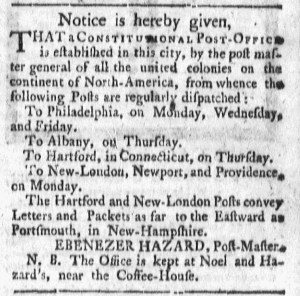
Rivington’s New-York Gazetteer (October 26, 1775).

“A CONSTITUTIONAL POST-OFFICE is established in this city.”

Yet another advertisement for a “CONSTITUTIONAL POST-OFFICE,” an alternative to the British postal system, appeared in the public prints at the end of October 1775.  It ran in Rivington’s New-York Gazetteer, despite the reputation of that newspaper and its printer, James Rivington, for expressing Loyalist sentiments.  William Goddard originally envisioned the Constitutional Post and set about establishing local offices before the battles at Lexington and Concord, but after hostilities commenced the Second Continental Congress assumed responsibility for maintaining and expanding its services.  That included appointing Benjamin Franklin as the postmaster general, much to the chagrin of Goddard.  Ebenezer Hazard, a bookseller, became the postmaster in New York, though John Holt, the printer of the New-York Journal, lobbied for the position.  According to the nota bene in the advertisement, “The Office is kept at Noel and Hazard’s, near the Coffee-House,” the same location where the new postmaster and his partner, Garrat Noel, stocked the “JOURNAL OF THE PROCEEDINGS” of the First Continental Congress.

The notice in Rivington’s New-York Gazetteer, signed by Hazard as the “Post-master,” informed the public that a “CONSTITUTIONAL POST-OFFICE” is established in this city, by the post master general of all the united colonies on the continent of North-America.”  Hazard offered the most complete schedule of any that yet appeared in newspaper advertisements, stating that the “Posts are regularly dispatched” to Philadelphia on Mondays, Wednesdays, and Fridays, to Albany on Thursdays, to Hartford on Thursdays, and to New London, Newport, and Providence on Mondays.  The routes to both Hartford and New London extended “as far to the Eastward” as Portsmouth, New Hampshire.  Unlike some other postmasters, Hazard did not mention that service continued as far south as Georgia.  He focused primarily on the network that connected New York to New England and Pennsylvania.  As new advertisements for the Constitutional Post appeared in newspapers in multiple towns and cities, the public became more aware of an enterprise that competed with the imperial postal system to carry “Letters and Packets,” delivering news and information without interference from British authorities.

October 11

What was advertised in a revolutionary American newspaper 250 years ago today?

Maryland Journal (October 11, 1775).

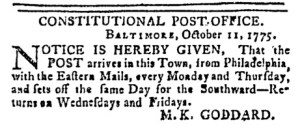
“CONSTITUTIONAL POST-OFFICE.  BALTIMORE.”

The contents of the October 11, 1775, edition of the Maryland Journal were organized such that the first advertisement that readers encountered promoted the Baltimore branch of the “CONSTITUTIONAL POST-OFFICE” established by the Second Continental Congress as an alternative to the imperial postal system operated by the British government.  It completed the middle column on the third page, a column otherwise filled with news from Cambridge, Hartford, New York, and Philadelphia.  Two lines separated it from other content, indicating a transition from news to advertising, yet the notice seemed a continuation of updates about current events, including an inaccurate report that General Richard Montgomery had captured Montreal as part of the American invasion of Quebec.  Advertisements inserted for other purposes, such as fencing lessons and descriptions of runaway indentured servants, appeared in the next column and on the next page.

“NOTICE IS HEREBY GIVEN,” the advertisement proclaimed, “That the POST arrives in this Town, from Philadelphia, with the Eastern Mailes, every Monday and Thursday, and sets off the same Day for the Southward.”  It returned from that direction on Wednesdays and Fridays.  The notice was signed, “M.K. GODDARD.”  The colophon at the bottom of the final page also listed “M.K. GODDARD, at the PRINTING-OFFICE in MARKET-STREET” as the printer of the Maryland Journal.  Mary Katharine Goddard operated the printing office in Baltimore.  Like many other printers, she simultaneously served as postmaster.  Many of them, as Joseph M. Adelman explains, had been “associated with the old imperial system” and “shifted [their] service from the British post office to the American one.”  They included Solomon Southwick, the printer of the Newport Mercury, John Carter, the printer of the Providence Gazette, and Alexander Purdie, the printer of the Virginia Gazette.  Appointed to the position in 1775, Goddard served as postmaster in Baltimore for fourteen years “until she lost her position in 1789 to a new postmaster more closely connected to the new Federal Postmaster General.”[1]

Women participated in the American Revolution in many ways.  They signed nonimportation agreements and made decisions in the marketplace that reflected their political principles, they spun wool and made homespun garments as alternatives to British imports, and they raised funds to support the Continental Army.  Some served in more formal roles, including Mary Katharine Goddard as both the printer of the Maryland Journal and the postmaster at the “CONSTITUTIONAL POST-OFFICE” in Baltimore.

**********

[1] Joseph M. Adelman, “‘A Constitutional Conveyance of Intelligence, Public and Private’: The Post Office, the Business of Printing, and the American Revolution,” Enterprise and Society 11, no. 4 (December 2010): 742.

June 12

What was advertised in a revolutionary American newspaper 250 years ago today?

Connecticut Courant (June 12, 1775).

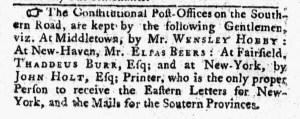
“The Constitutional Post-Offices on the Southern Road, are kept by the following Gentlemen.”

Although William Goddard established the Constitutional Post as an alternative to the British Post Office in 1773, advertisements for the service appeared in colonial newspapers only sporadically until after the battles at Lexington and Concord in April 1775.  After the Revolutionary War began, however, the number and frequency of newspaper notices promoting the Constitutional Post increased, especially in New England, New York, and Pennsylvania.  In May 1775, for instance, Nathan Bushnell, Jr., a postrider in Connecticut, stated that he was affiliated with the Constitutional Post in advertisements that ran in both the New-England Chronicle, published in Cambridge, Massachusetts, and the Connecticut Gazette, published in New-London.  John Holt, the printer of the New-York Journal, inserted a lengthy advertisement to advise readers that a “Constitutional POST-OFFICE, Is now kept” at his printing office in early June.

An unsigned advertisement in the June 12, 1775, edition of the Connecticut Courant, published by Ebenezer Watson in Hartford, listed four branches: “The Constitutional Post-Offices on the Southern Road, are kept by the following Gentlemen, viz. At Middletown, by the Mr. WENSLEY HOBBY: At New-Haven, Mr. ELIAS BEERS: At Fairfield, THADDEUS BURR, Esq; and at New-York, by JOHN HOLT, Esq; Printer.”  Holt may have been responsible for the notice, considering that it described him as “the only proper Person to receive the Eastern Letters for New-York, and the Mails for the Sout[h]ern Provinces.”  One of the other postmasters could have placed the notice, though Watson may have done it of his own volition as a public service.  Joseph M. Adelman persuasively argues that “printers had a direct financial and business interest in promoting a post office to their liking both because it distributed their newspapers and other print goods and because they were the chief beneficiaries of a patronage system centering on the post office.”[1]  He also acknowledges that printers “enlisted merchants and members of the revolutionary elite … to provide financial and political support.”[2]  The notice in the Connecticut Courant included only one printer, John Holt, among the four postmasters.  Fairfield and Middletown did not have newspapers, but they did have need of reliable post offices and trustworthy postmasters.  In New Haven, Thomas Green and Samuel Green printed the Connecticut Journal, yet the notice did not indicate that they had an affiliation with the Constitutional Post Office.  While printers played an important role in establishing the service, they worked alongside postmasters from other occupations in creating an infrastructure for disseminating news and information.

**********

[1] Joseph M. Adelman, “‘A Constitutional Conveyance of Intelligence, Public and Private,’: The Post Office, the Business of Printing, and the American Revolution,” Enterprise and Society 11, no. 4 (December 2010): 713.

[2] Adelman, “Constitutional Conveyance,” 709.

June 4

What was advertised in a revolutionary American newspaper 250 years ago this week?

New-York Journal (June 1, 1775).

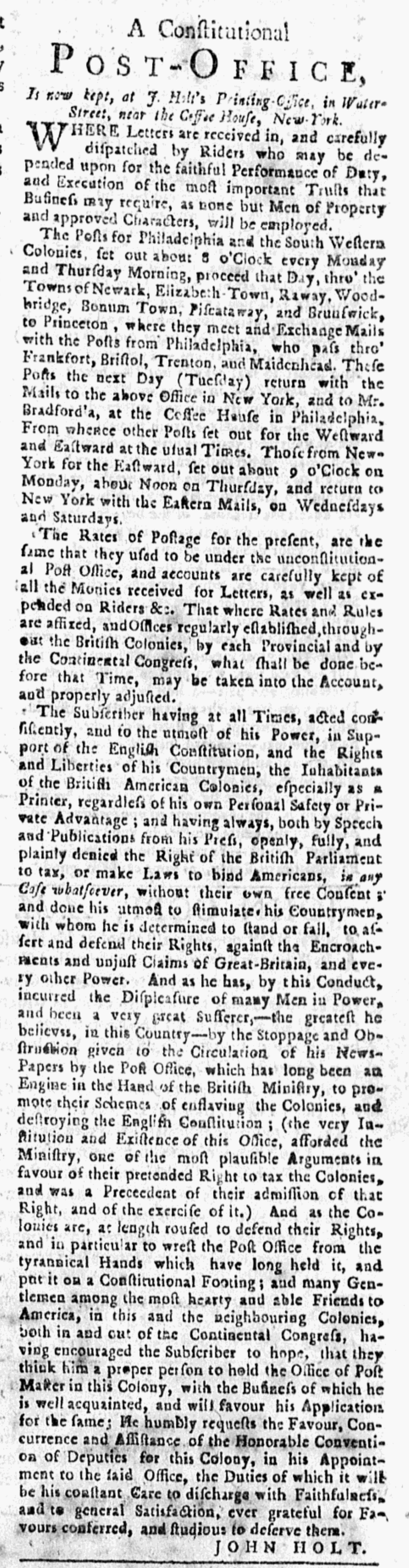
“A Constitutional POST-OFFICE, Is now kept, at J. Holt’s Printing-Office, in … New-York.”

William Goddard’s Pennsylvania Chronicle had a reputation for supporting the Patriot cause, so much so that the Crown Post drove it out of business by refusing to deliver it.  That prompted Goddard to establish the Constitutional Post, independent of British authority, as an alternative.  That service began with a route that connected Baltimore and Philadelphia in the summer of 1773.  The network expanded, yet the First Continental Congress decided to table Goddard’s plan rather than endorse it when he submitted it for consideration in the fall of 1774.  The Second Continental Congress took it up again following the battles at Lexington and Concord, adopting the plan on July 16, 1775.  To Goddard’s disappointment, the delegates named Benjamin Franklin as the first Postmaster General; he settled for serving as Riding Surveyor.

By the time that the Second Continental Congress acted on the measure, Goddard and others had already made progress putting an infrastructure in place.  For instance, newspaper advertisements confirm that “CONSTITUTIONAL Post-Riders” operated in Connecticut in the summer of 1774 and Massachusetts in the spring of 1775.  In June 1775, John Holt, the printer of the New-York Journal, advertised that a “Constitutional POST-OFFICE, Is now kept” at his printing office in New York.  He provided a schedule and noted that the “Rates of Postage for the present, are the same that they used to be under the unconstitutional Post Office.”  He would adjust the “Rates and Rules” as provincial congresses in the several colonies and the Continental Congress approved them.  In addition, “accounts are carefully kept of all the Monies received for Letters, as well as expended on Riders” and other costs.  Holt anticipated that the Continental Congress would indeed adopt Goddard’s plan for the Constitutional Post in the aftermath of Lexington and Concord.  Seeking an appointment as postmaster for New York, he devoted half of his advertisement to giving his credentials in hopes of attracting the attention of the delegates and other who might influence them:

“The Subscriber having at all Times, acted consistently, and to the utmost of his Power, in Support of the English Constitution, and the Rights and Liberties of his Countrymen, the Inhabitants of the British American Colonies, especially as a Printer, regardless of his own Personal Safety or Private Advantage; and having always, both by Speech and Publications from his Press, openly, fully, and plainly denied the Right of the British Parliament to tax, or make Laws to bind Americans, in any Case whatsoever, without their own free Consent; and done his utmost to stimulate his Countrymen, with whom he is determined to stand or fall, to assert and defend their Rights, against the Encroachment and unjust Claims of Great-Britain, and every other Power.”

That rationale corresponded to arguments advanced far and wide by Patriots.  Holt continued making his case with a review of the consequences he endured for his devotion to the cause:  “And as he has, by this Conduct, incurred the Displeasure of many Men in Power, and been a very great Sufferer,– the greatest he believes, in this Country – by the Stoppage and Obstruction given to the Circulation of his News-Papers by the Post Office, which has long been an Engine in the Hands of the British Ministry, to promote their Schemes of enslaving the Colonies, and destroying the English Constitution.”

With the siege of Boston continuing, Holt asserted that “the Colonies are, at length roused to defend their Rights, and in particular to wrest the Post Office from the tyrannical Hands which have long held it, and put it on a Constitutional Footing.”  Having established a Constitutional Post Office in New York, Holt hoped that the Continental Congress would appoint him “Post Master in this Colony.”  To that end, he “humbly requests the Favour, Concurrence and Assistance of the Honorable Convention of Deputies for this Colony, in his Appointment to the said Office,” pledging that “it will be his constant Care to discharge” the duties “with Faithfulness.”  From Holt’s perspective, there was no better candidate for the position.

The printer’s lengthy advertisement served two purposes.  He attempted to attract customers for the Constitutional Post Office now that New York had a branch at his printing office.  He did so by deploying familiar rhetoric that outlined the stance taken by those who supported the American cause against the abuses of Parliament.  He intended that as both a reason for colonizers to entrust their letters to the Constitutional Post Office and a demonstration of his devotion to the cause that merited an appointment as postmaster for the colony.  Holt supplemented familiar arguments with his own experience, further demonstrating that he deserved to be appointed as postmaster.  He sought the patronage of those who could award him the position while simultaneously seeking patrons for the Constitutional Post Office.