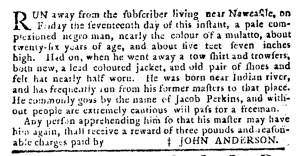
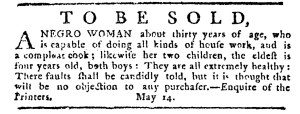
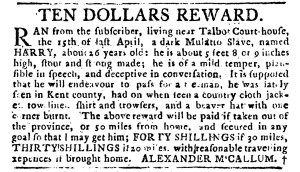
What was advertised in a revolutionary American newspaper 250 years ago this week?
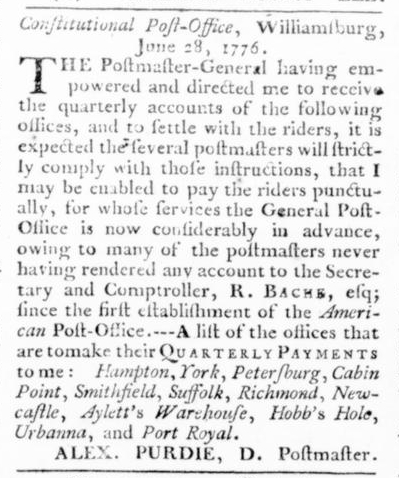
“Constitutional Post-Office, Williamsburg, June 28, 1776.”
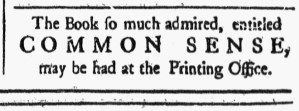
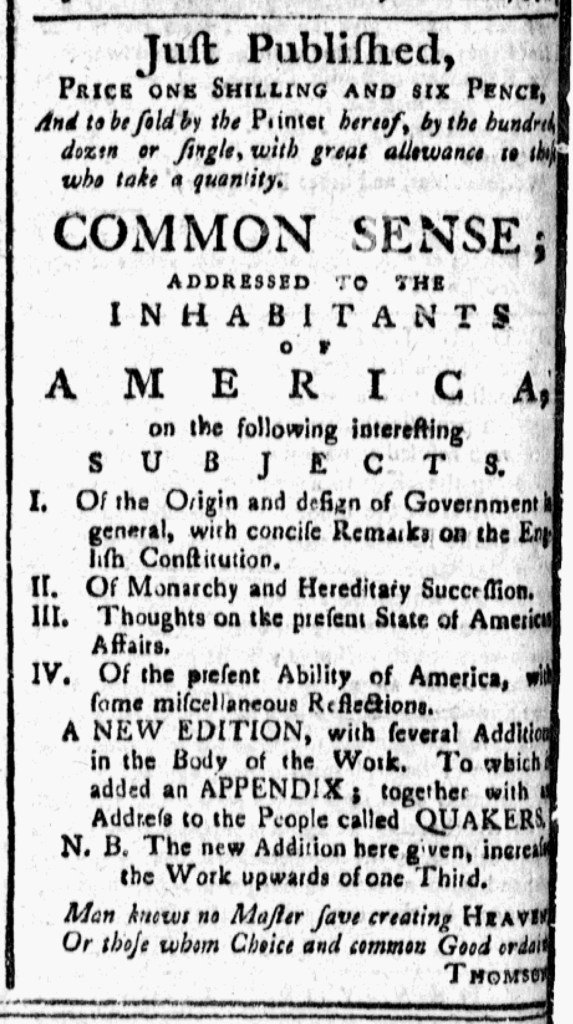
The colophon that ran across the bottom of the final page of the June 28, 1776, edition of Alexander Purdie’s Virginia Gazette testified to the multiple roles that the printer played in the community: “WILLIAMSBURG: Printed by ALEXANDER PURDIE, at the CONSTITUTIONAL POST-OFFICE.” Note that Purdie did not describe his location as printing office but rather as the local branch of the Constitutional Post Office approved by the Second Continental Congress as an alternative to the imperial postal system in the summer of 1775. Purdie took the same approach in giving his location in an advertisement for Thomas Paine’s Common Sense, two military manuals, and writing paper in the May 17 edition, stating that he sold them “at the CONSTITUTIONAL POST OFFICE, Williamsburg,” rather than at his printing office. The two locations were the same, but Purdie chose to emphasize the responsibility entrusted to him as a supporter of the American cause.
In addition, he ran advertisements to conduct business on behalf of the Constitutional Post Office, underscoring his position to readers of his newspaper. Some advertisements featured a dateline that included the location and date, such as John Moody’s notice that the smith and farrier opened a shop. That dateline stated, “WILLIAMSBURG, June 28, 1776.” For his advertisement placed as a deputy to the Postmaster General, Purdie included more than just the town in the dateline: “Constitutional Post-Office, Williamsburg, June 28, 1776.” He advised readers and especially the postmasters in several towns in Virginia that the “Postmaster-General … empowered and directed me to receive the quarterly accounts” from a dozen offices and “to settle with the riders” who carried mail between them. In turn, “it is expected the several postmasters will strictly comply with those instructions” to maintain the services of the “American Post-Office.”
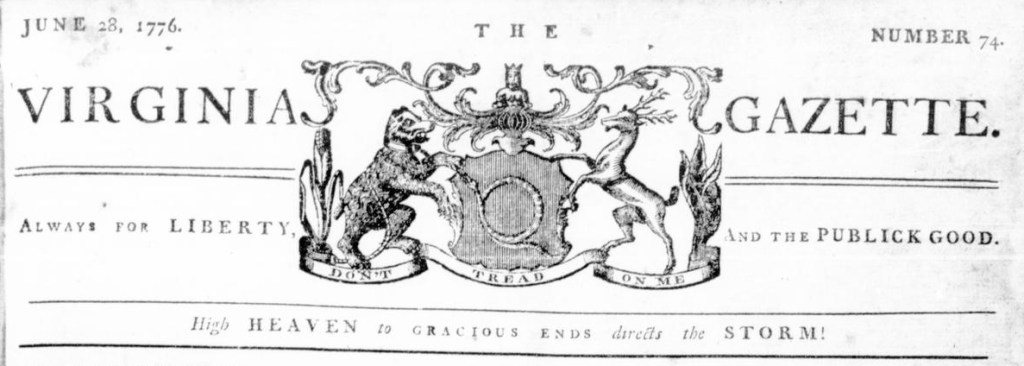
That advertisement and the colophon helped to make Purdie’s politics clear to readers, distinguishing his Virginia Gazette from John Dixon and William Hunter’s Virginia Gazette, also published in Williamsburg but not at a branch of the Constitutional Post Office. The competing newspapers often took a more measured approach in covering current events, perhaps because Hunter was a Loyalist. In addition, Purdie’s Virginia Gazette had yet another new masthead. The decorative type enclosing “THIRTEEN UNITED COLONIES. United, we stand—Divided, we fall” appeared in the masthead of only three issues before being replaced with a more sophisticated image depicting a bear and a stag, symbolizing the British Empire, flanking a snake, a symbol of the colonies that previously appeared in mastheads of other newspapers. Below the bear, the snake, and the stage, a ribbon featured the motto “DON’T TREAD ON ME.” As a printer and as a postmaster, Purdie signaled his allegiance to the American colonies.