What was advertised in a colonial newspaper 250 years ago this week?
Newport Mercury (April 28, 1766).
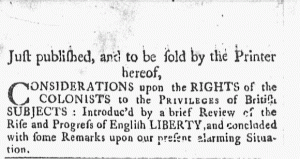
“Just published, and to be sold by the Printer hereof, CONSIDERATIONS upon the RIGHTS of the COLONISTS.”
When the Stamp Act was repealed a major political crisis came to a close (though the simultaneous passage of the Declaratory Act signaled that not all was resolved between Parliament and Britain’s colonies in North America). Colonial merchants imported goods from Britain. Advertisers encouraged consumers to purchase those goods.
Printers and booksellers continued to market other wares that had been for sale during the Stamp Act crisis: books and pamphlets about the “RIGHTS of the COLONISTS to the PRIVILEGES of British SUBJECTS.” Such items had been advertised frequently before the Stamp Act went into effect in 1765 and continuing through its repeal in the spring of 1766. The Stamp Act may have been repealed, but existing stock of these pamphlets did not disappear. Printers and booksellers needed to sell the leftovers in order to profit or at least break even on their investments. Surplus pamphlets did not suit their needs.
Newport Mercury (April 28, 1766).
So they continued to advertise. Today’s featured advertisement was not the only one of its kind in the April 28, 1766, issue of the Newport Mercury. Other notices promoted books and pamphlets that advanced a similar political position. They appeared in the same issue that reprinted an “ADVERTISEMENT Extraordinary” from the Boston Gazette (which we saw also reprinted in the New-Hampshire Gazette earlier this week) celebrating the repeal of the Stamp Act.
In all fairness, decisions to continue selling and marketing pamphlets about the “RIGHTS of the COLONISTS” did not necessarily depend solely on financial considerations to the exclusion of sincere political anxieties. Although the immediate crisis was over, the Declaratory Act dampened the colonists’ victory. Astute printers and booksellers likely realized that Parliament and the colonies would continue to experience tensions. By selling pamphlets like the one from today’s advertisements, printers and booksellers performed a civic duty that kept their fellow colonists informed and helped to frame future debates and discourse.
What was advertised in a colonial newspaper 250 years ago today?
New-Hampshire Gazette (April 25, 1766).
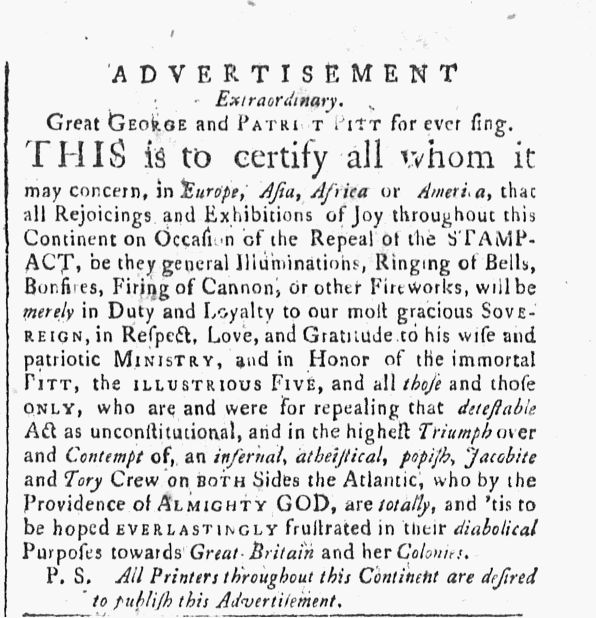
“ADVERTISEMENT Extraordinary. … Repeal of the Stamp-Act.”
This “ADVERTISEMENT Extraordinary” hailed the “Repeal of the Stamp-Act” and encouraged other patriotic Britons to do the same. In particular, the advertisement encouraged a variety of public displays” “general Illuminations, Ringing of Bells, Bonfires, Firing of Guns, or other Fire-Works” to be conducted “in Duty and Loyalty to our most gracious SSEVERIGN” and “in Respect, Love and Gratitude to his patriotic MINISITRY.”
This advertisement helps to demonstrate that the American Revolution did not take place as soon as Parliament passed the first act intended to better regulate colonial commerce and raise revenues after the Seven Years War. Most colonists did not immediately clamor for political independence from Great Britain. Instead, that decision took place only after a lengthy process that extended more than a decade as colonists and Parliament acted and reacted to each other.
In the spring of 1766, however, colonists were overjoyed to return to what they considered their rightful place in the global British Empire. Once “that detestable Act” – a measure also described as “unconstitutional” – was repealed, opponents in Britain’s North American colonies encouraged “Rejoicings and Exhibitions of joy thro-out this Continent” but also desired that “all whom it may concern, in Europe, Asia, Africa, or America” would join in their celebrations. In saluting the “Great GEORGE and PATRIOT PITT” along with the king’s “patriotic MINISTRY” colonists signaled that they considered themselves Britons and wished to be part of the British Empire. Only in the wake of greater disruptions and the “Contempt of an infernal, atheistical, Popish and Jacobite Crew” over the course of the next decade would revolution be fomented. The crisis had been averted – temporarily – but the promulgation of the Declaratory Act at the same time the Stamp Act was repealed suggested that “Rejoicings and Exhibitions of joy” might not last long.
**********
Take note of the first and last lines of this advertisement: “From the Boston Gazette, April 21.” and “P. S. All Printers throughout this Continent are desired to publish this Advertisement.” Just as printers had shared and reprinted news of the Stamp Act and protests against it throughout 1765 and into 1766, they also exchanged and shared news of its repeal. This advertisement, originally printed in Boston four days earlier, was inserted in the very next issue of Portsmouth’s New-Hampshire Gazette. This was how news went viral in eighteenth-century America
What was advertised in a colonial newspaper 250 years ago this week?
Pennsylvania Gazette (April 3, 1766).
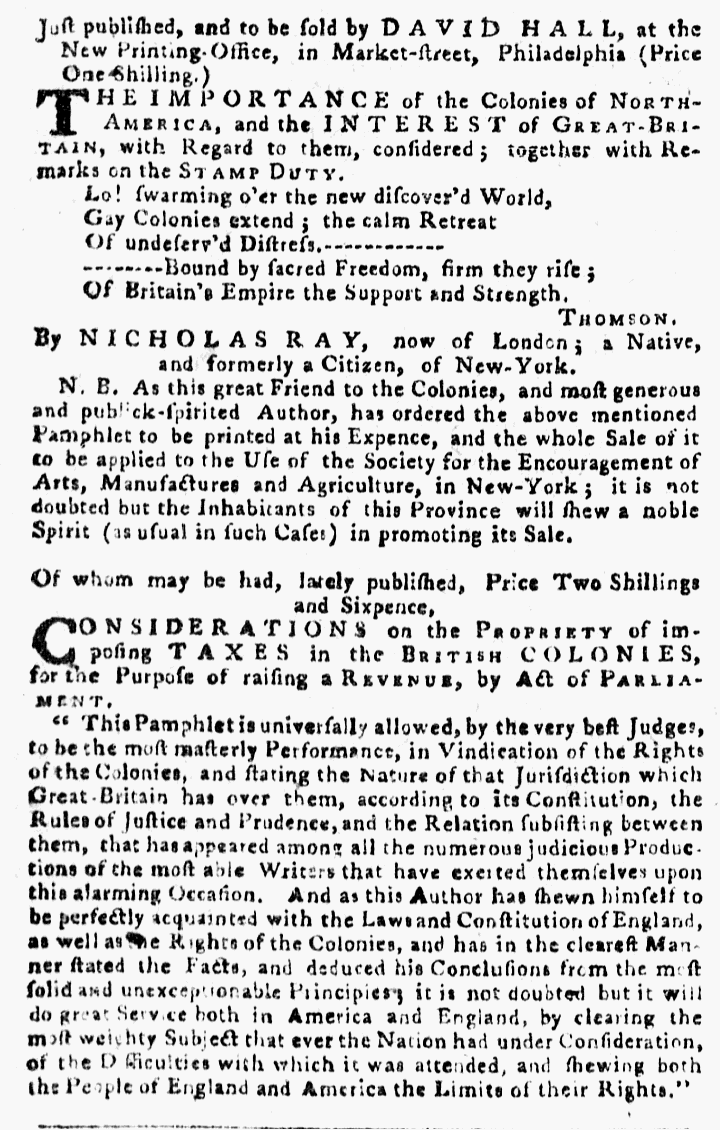
“Just published, and to be sold … THE IMPORTANCE of the Colonies of NORTH-AMERICA, and the INTEREST of GREAT-BRITAIN, with Regard.”
This advertisement caught my eye because it is the most direct reference to the events leading up to the Revolutionary War that I have encountered. The advertisement addresses the tensions that had been present after the French and Indian War, which really damaged the colonists’ perception of Britain as their mother country. This advertisement mentions explicitly that the colonies and Great Britain were having a strained relationship.
The “just published” work included remarks on the widely despised Stamp Act, which would have been sure to draw in many readers. This also depended on public literacy. Newspapers were a part of it, but there were also smaller works, such as the pamphlets advertised here, published for ordinary colonists to read. Although the most famous, Thomas Paine’s Common Sense, would not be published for another decade, these publications and others were meant to reach the minds of many Americans, giving them much to think about in regards to their relationship to Britain.
**********
ADDITIONAL COMMENTARY: Carl Robert Keyes
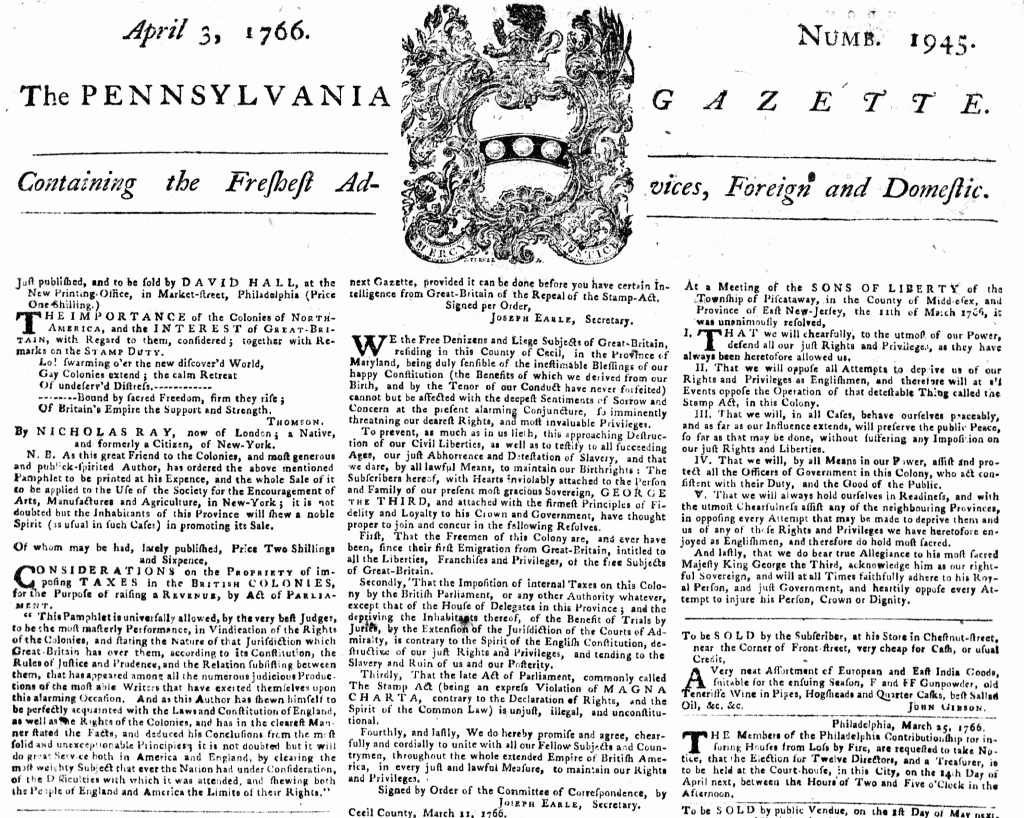
Like several of the other guest curators from my Public History class, Maia has been keeping her eyes open for advertisements that illuminate the political history of the period, especially the role of the Stamp Act in the unfolding imperial crisis. It would have been difficult to miss this advertisement. The printer inserted it at the top of the first column on the first page, immediately below the masthead, making it the first item – either news or commercial notice – that a subscriber would have read.
Pennsylvania Gazette (April 3, 1766).
Note how the layout of this page provides further context and suggests how the printer likely intended readers to interact with this advertisement. It appeared immediately to the left of a list of anti-Stamp Act resolutions from the Committee of Correspondence in Cecil County, Maryland. Continuing to scan across the top of the page, readers encountered a list of resolutions passed at a recent “Meeting of the SONS OF LIBERTY of the Township of Piscataway, in the County of Middlesex, and Province of East New-Jersey.”
Of all the possible news items and advertisements that could have appeared at the top of the first column, it hardly seems like a coincidence that an advertisement for anti-Stamp Act pamphlets appeared there. The printer stoked potential customers’ outrage with the resolutions from the Committee of Correspondence and the Sons of Liberty, increasing the chances they would be interested in purchasing pamphlets about colonists’ rights and the appropriate responses to the abuses they were suffering at the hands of a Parliament that overstepped its authority. The printer yoked politics and commerce, each in the service of the other.
The story becomes more interesting when we realize that David Hall, who advertised the pamphlets, was also the printer and publisher of the Pennsylvania Gazette! He used his newspaper to advance political views. At the same time, he looked to make a profit from the controversy that incited the interest that made it possible to sell these pamphlets. In designing the first page of this issue of the Pennsylvania Gazette, David Hall revealed himself to be a savvy printer and entrepreneur.
What was advertised in a colonial newspaper 250 years ago this week?
Connecticut Courant (March 10, 1766).
“Just Published … The Necessity of Repealing the American STAMP-ACT.”
Protesting the Stamp Act continued to occupy many American colonists in March 1766. It was certainly a primary concern of the printer of the Connecticut Courant and many of that newspaper’s readers. The Connecticut Courant was a more modest publication than some of its counterparts in larger cities – its four pages featured only two columns rather than three – but it opposed the Stamp Act with the same vigor as many more robust publications.
The first two (of four total) pages of the March 10, 1766, issue were devoted to coverage of the Stamp Act, including a letter from London (dated November 1 and reprinted from the Public Ledger), an extract of another letter from London (dated December 14 and reprinted from a Boston newspaper published February 27), and several shorter reports about the reactions of colonial officials near and far.
Advertisements of any sort did not appear until the third page. Today’s featured advertisement demonstrates that the commercial notices took on a political valence during the Stamp Act crisis. Printers, authors, and other members of the book trades marketed books and pamphlets about “The Necessity of Repealing the American STAMP-ACT.” And this particular advertisement should not be considered an isolated example. It appeared immediately above a similar advertisement for a pamphlet about “THE RIGHTS of the COLONIES TO THE PRIVILEGES Of British SUBJECTS.” The former was published in Boston and the latter in New York.
Third page of the Connecticut Courant (March 10, 1766).
Both appeared in a column headed with an announcement that “THE last Tuesday of this Month (being the 25th Day) there is to be a General Congress of the SONS OF LIBERTY, in this Colony, to meet in Hartford, by their Representatives chosen for that Purpose.” (Was this an advertisement? It appeared alongside other advertisements, but given the printer’s political proclivities it is quire possible he inserted this notice gratis.) News coverage of the Stamp Act continued in the column to the left.
The content of the newspaper provides important context for understanding today’s advertisement. The other items formed a narrative that may have influenced potential customers to purchase one or both of the pamphlets offered for sale.
Boycotts of imported goods certainly gave decisions about which goods to purchase (or not) political valence in the 1760s and 1770s, but advertisements for books and pamphlets defending the “RIGHTS of the COLONIES” encouraged colonists to become readers who were better informed and who could better articulate why the actions of Parliament were so dangerous.
What was advertised in a colonial newspaper 250 years ago today?
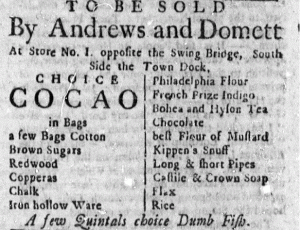
Massachusetts Gazette (February 13, 1766).
“TO BE SOLD By Andrews and Domett At Store No. 1. opposite the Swing Bridge, South Side the Town Dock.”
Andrews and Domett marketed bags of cocao, cotton, brown sugar, redwood, copper, chalk, iron hollow ware, flour, indigo, Bohea tea (an item advertised often during Colonial times, previously featured on Adverts 250), chocolate, mustard, snuff, pipes, soap, flax, and rice. Each of these items are interesting on their own, so I chose a few of the items to focus on which some might not recognize, as they are not commonplace items during the twenty-first century, though they were in eighteenth-century America.
I did not recognize “Iron hollow Ware.” I hypothesized that this item was a type of Colonial dishware. Of course, this lack of knowledge led to an investigation. Iron hollow ware was a type of cooking pot that was made from cast iron. Today there are many individuals who collect this and other Colonial cookware for their personal home collections as a hobby. To learn more about “Iron hollow Ware” consult this book.
Another item on the list of goods in the advertisement that I find intriguing, is the “French Prize Indigo.” Indigo is a powder derived from plants that was utilized during Colonial times as a dye to create blue clothing. Its importance was high, as blue was a highly desirable color for clothing, despite the fact that it could only be derived from indigo plants at this time. In appearance, it was a blue powder which is derived from the leguminous plant of the Indigofera genus, a plant that has over 300 identifiable known species in the world. Only two varieties of this plant are used to make indigo, including the indigofera tinctoria, which is native to both India and Asia, and the indigofera suffructiosa, which is native to South and Central America. Due to the fact that indigo was an import, it would likely be one of the more pricey items on the list in the advertisement. The University of Minnesota has an excellent historical account of “Indigo in the Early Modern World.”
During the late nineteenth century, German chemist Adolf von Baeyer created synthetic indigo and production of the synthetic dye began during the early twentieth century. Research about formulating a chemical composition for synthetic indigo was furthered due to the fact that dyes derived from natural indigo were not a significant enough source due to the rise of its use within the nineteenth-century clothing industry. The color of indigo is always a blue hue, but use of different amounts of indigo can result in a variety of shades that the substance produces when using it for dying.
**********
ADDITIONAL COMMENTARY: Carl Robert Keyes
Kathryn focuses on some of the goods marketed to colonial consumers. Each item stocked by Andrews and Domett merits its own investigation. What, for instance, distinguished “Castile & Crown Soap” from each other? Colonial consumers certainly would have known, but as Kathryn points out many of the goods commonly advertised and purchased in the eighteenth century are no longer as familiar to twenty-first century consumers. Advertisements are often classified or catalogued as ephemera (especially advertising media other than newspapers, such as handbills, trade cards, or billheads), but consumer goods had their own ephemeral qualities as well.
In addition to the items for sale, I am interested in the format of this advertisement. Rather than listing their wares in a single, dense paragraph, Andrews and Domett utilized two columns with only one item per line, making it easier for potential customers to identify items of interest. The advertisement also strategically includes fonts of different sizes as well as capitals and italics. Why did “CHOICE COCAO” and “A few Quintals choice Dumb Fish” receive special treatment in this advertisement? Did Andrews and Domett imagine that these would be especially popular with customers once they knew these items were available? Or perhaps these items had been overstocked and tied up too many of the shopkeepers’ resources. Did they merit special attention in the advertisement because the shopkeepers needed to sell them most quickly?
I also wonder who made some of the decisions about the format of the advertisement. To what extent did Andrews and Domett describe to the printer how they wished their advertisement to appear in the newspaper? Did they give detailed instructions about columns, font size, and type? Vague or general instructions? No instructions at all? Advertisements like this one may testify to the creativity of the printer as much as the marketing savvy of the advertisers.