What was advertised in a colonial American newspaper 250 years ago this week?
New-Hampshire Gazette (February 8, 1767).
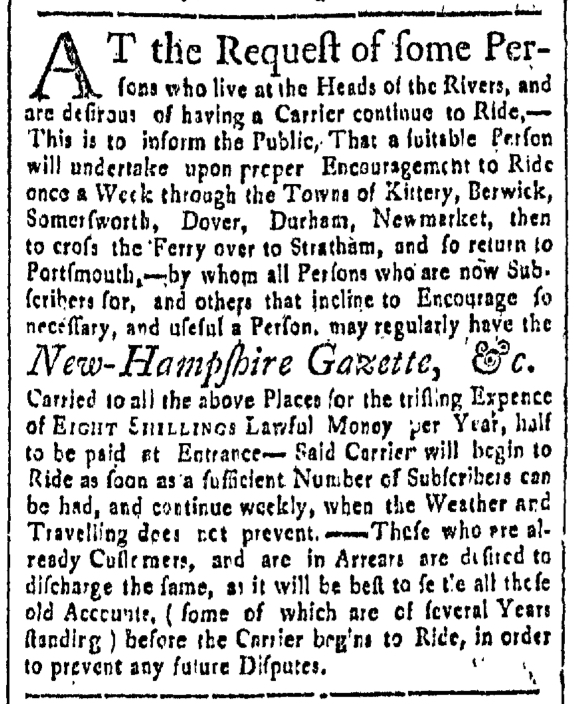
“Said Carrier will begin to Ride as soon as sufficient Number of Subscribers can be had.”
Like other colonial printers, Daniel and Robert Fowle inserted advertisements for their own business endeavors in the newspaper they published (though they did not use the colophon as a standing advertisement for the various services provided at their printing office in Portsmouth). The Fowles were responsible for four of the advertisements that appeared in the February 6, 1767, issue of the New-Hampshire Gazette.
Three of those advertisements were fairly short: four lines each. Two of them peddled leftover almanacs for 1767 and the third informed readers that the Fowles supplemented the revenues from newspaper subscriptions and advertisements by selling “BLANKS of all sorts – and a variety of Books, Pamphlets, &c.”
The fourth advertisement took up considerably more space on the page. It advertised the newspaper itself, the title appearing in a larger font and on a line by itself in the middle of the notice. The Fowles outlined a plan to have a rider continue to deliver newspapers to subscribers in towns and villages beyond Portsmouth. The proposed route included “the Towns of Kittery, Berwick, Somersworth, Dover, Durham, Newmarket, [and] Stratham.” The Fowles offered this as a service to subscribers, though they also indicated that demand already existed among “some Persons who live at the Heads of the Rivers” who were “desirous of having a Carrier continue to Ride.”
The printers placed this notice to gauge interest in this plan, stating that “Said Carrier will begin to Ride as soon as a sufficient Number of Subscribers can be had.” Yet interest was not sufficient to bring the plan to fruition: subscribers needed to demonstrate their commitment by paying half of the delivery in advance. The printers also requested that current subscribers “in Arrears” pay up “before the Carrier begins to Ride, in order to prevent any future Disputes.”
This advertisement made clear that the rider would provide a continuation of an existing service, delivery to the local town (if not directly to each subscriber’s home). In so doing, it demonstrated the geographic reach of colonial newspapers beyond the cities where they were printed and into the towns and villages in the hinterland. Certainly some copies were disseminated even further afield, but the success (or even the continuation) of newspapers depended on cultivating local and regional customers and readers.
What was advertised in a colonial American newspaper 250 years ago this week?
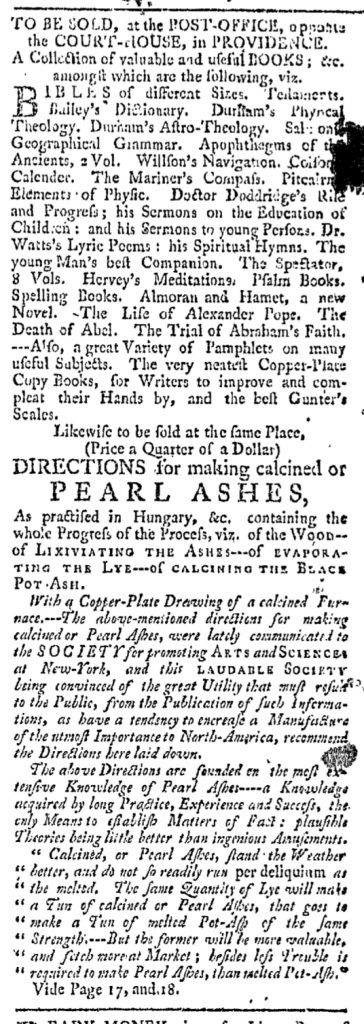
“TO BE SOLD, at the POST-OFFICE … A Collection of valuable and useful BOOKS.”
Providence Gazette (January 31, 1767).
The methodology that guides the Adverts 250 Project sometimes makes it difficult to choose which advertisement to feature on certain days. Each advertisement must have been published 250 years ago that day. If no newspapers were printed in colonial America on any particular date, then the advertisement should come from the most recently published newspaper available anywhere in the colonies. This means that there are days – Thursdays in 2017 (Mondays in 1767) and Sundays in 2017 (Thursdays in 1767) – for choosing among multiple newspapers from colonial America’s largest urban ports, many overflowing with advertisements to the point that they sometimes issued supplements to contain then all.
On other days, however, only one newspaper was published anywhere in the colonies. For Fridays (Mondays in 1767) the project draws from South-Carolina and American General Gazette, on Saturdays (Tuesdays in 1767) from the Georgia Gazette, and on Tuesdays (Saturdays in 1767) from the Providence Gazette.
Note that the Providence Gazette was the only colonial American newspaper published on Saturdays in 1767. Recall that no newspapers were printed on Sundays. That means that on Wednesdays in 2017 (Sundays in 1767), featured advertisements must come from the Providence Gazette. As a result, this methodology privileges the Providence Gazette, a newspaper from a smaller port, over its counterparts in larger and busier cities. The Providence Gazette did not include nearly as many advertisements as the four newspapers printed in Boston, four others in New York, three in Philadelphia, and three in Charleston. This greatly constrains the choices when selecting which advertisements to feature on the Adverts 250 Project.
It does not help that the methodology also asserts that advertisements should not be featured twice, though exceptions can be made to demonstrate significant aspects of marketing practices in eighteenth-century America. Such is the case today. The featured advertisement previously appeared in the Providence Gazette on multiple occasions, sometimes as a single advertisement and other times divided into two parts. The few advertisements in the January 31 issue all appeared in earlier editions.
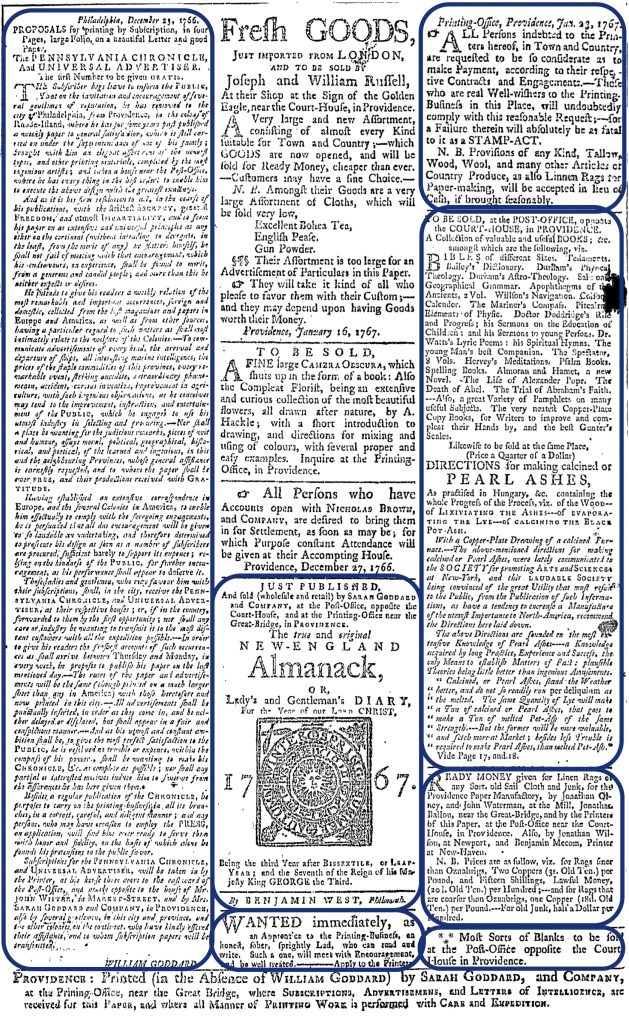
Advertisements inserted by the printers on the final page of the Providence Gazette (January 31, 1767).
Examining those advertisements to make that determination yields an interesting revelation: the printers of the Providence Gazette occupied most of the advertising space on the final page. This includes William Goddard. After all, the colophon indicates that the newspaper was “Printed (in the Absence of WILLIAM GODDARD) by SARAH GODDARD, and COMPANY.”
This gives that impression that the Providence Gazette may have been struggling to attract advertisers in 1767, unlike its counterparts in other larger port cities. Even the new Pennsylvania Chronicle, promoted in one of the advertisements inserted by the printers of the Providence Gazette in their own publication, ran copious advertisements within its first month. Sarah Goddard and Company made an editorial decision to fill the final page of their newspaper with advertisements, even if they were their own notices. In comparison, other printers in smaller towns opted to print news items almost exclusively and forego similar amounts of advertising. Such decisions merit additional investigation as the Adverts 250 Project continues.
What was advertised in a colonial American newspaper 250 years ago today?
Providence Gazette (December 6, 1766).
“This Almanack is embellished with the above Cut of the Four Seasons of the Year.”
In colonial America, December was the time for marketing and selling almanacs. Yesterday the Adverts 250 Project featured an advertisement for the New-Hampshire Almanack from the New-Hampshire Gazette. Today’s advertisement for the “true and original” New-England Almanack, printed by Mary Goddard and Company, appeared in the Providence Gazette.
To spruce up their advertisement, Goddard and Company included a “Cut of the Four Seasons of the Year.” As the only image that appeared in that issue of the Providence Gazette (except for the lion and union that always appeared in the masthead), the woodcut certainly distinguished this advertisement from the others. It did more, however, than entice potential customers by merely previewing the almanac’s contents. It also served as a means of distinguishing the almanac printed by Goddard and Company “from an Almanack under the same Title, published at Boston” that did not incorporate the woodcut.
“The PRINTERS” devoted nearly half of their advertisement to a dispute with printers in Boston, claiming that a copy of Benjamin West’s calculations and other contents of the New-England Almanack had been “insidiously obtained, and unhappily sold, after the SOLE PROPERTY justly became ours, by a fair and honorable Purchase.” Goddard and Company stated that they possessed exclusive rights to print and distribute this particular almanac. When they read the newspapers from Boston they were dismayed to discover that competitors also printed it and distributed it to booksellers to sell. To their chagrin, they had supported West’s almanac “at our own Risque, ever since it had a Name, and ay a considerable Expence before it had Credit,” yet other printers now undermined their investment.
Potential customers might purchase the edition printed by Goddard and Company because the woodcut of the seasons was an attractive bonus or because the calculations were accurate and the contents “correctly printed.” If this was not enough to convince prospective readers to choose Goddard and Company’s edition over the other, then purchasers were encouraged to think of their choice in terms of justice. Unlike their competitors, Goddard and Company printed their edition “without the Prostitution of Virtue and Honor.” They encouraged potential customers to simultaneously reward them and deprive the Boston printers of their patronage.
What was advertised in a colonial American newspaper 250 years ago today?
Boston Evening-Post (October 6, 1766).
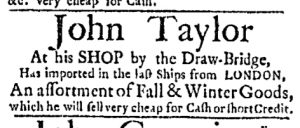
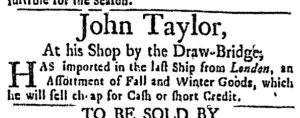
“John Taylor At his SHOP by the Draw-Bridge.”
I originally picked this advertisement from the Boston Evening-Post because John Taylor’s shop was in close proximity to a drawbridge that I researched for an entry last semester. Then this particular advertisement became more interesting when I found it in a second newspaper, the Boston-Gazette, printed on the same day by a rival publisher. As I did more research on the people and places in Boston, I learned about the printers of the Boston Evening-Post and the Boston-Gazette.
Boston-Gazette (October 6, 1766).
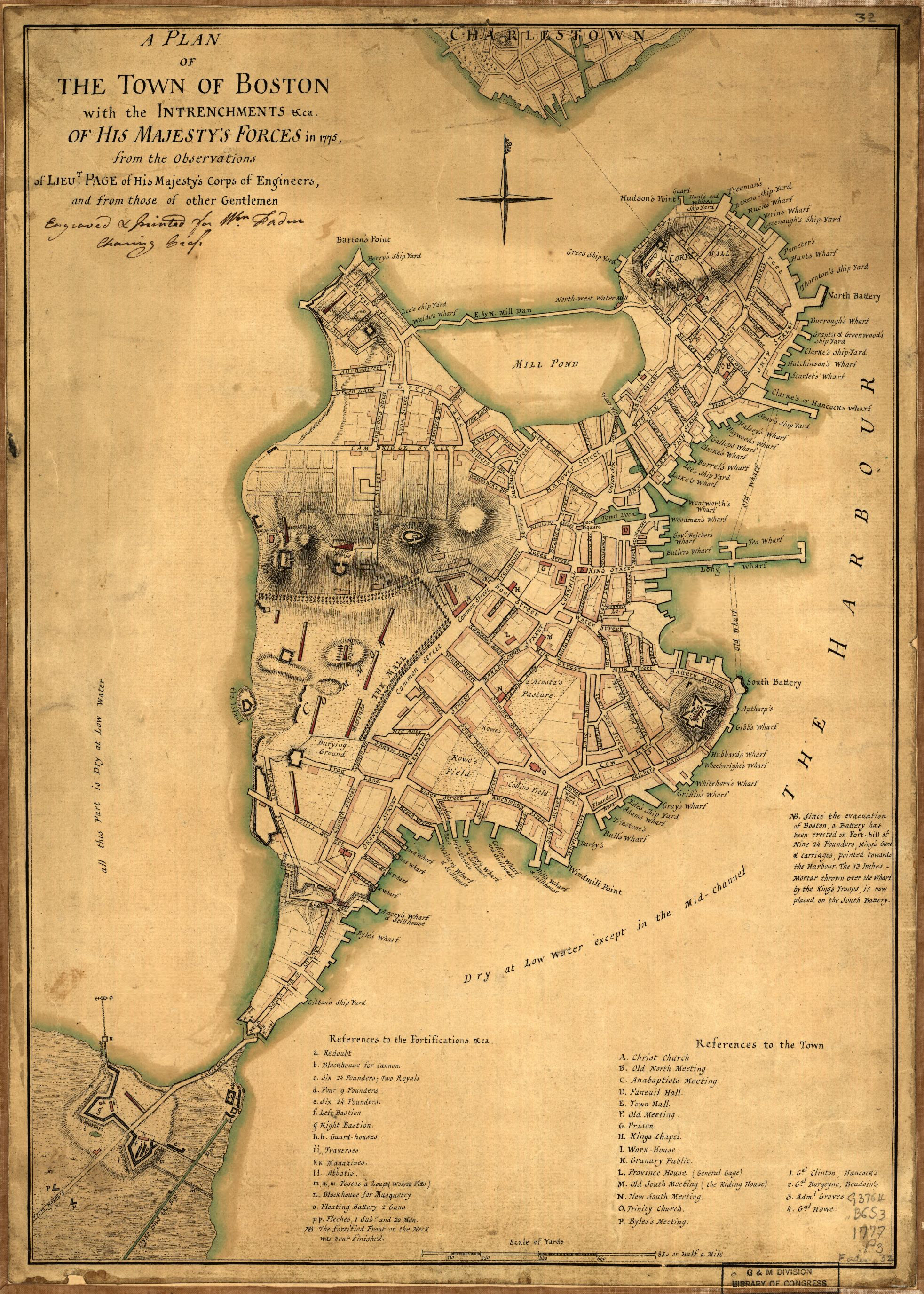
Printers have an interesting role in early American history, especially in colonial Boston. They were the ones who provided various types of entertainment and, more importantly, news and communication to the populace. Printers T. and J. Fleet at the Heart and Crown printed many items other than newspapers. They operated their shop on Cornhill Street, which was laid out in 1708 and ran from Water Street to Dock Square. (In 1789 it was renamed Washington Street.) Even from its earliest days Cornhill Street was full of intellectuals and publishers and printers. The Fleet family lived on Cornhill and ran their print shop beneath their residence.
Detail of A Plan of the Town of Boston.A Plan of the Town of Boston with the Intrenchments &ca. of His Majesty’s Forces in 1775, from the Observations of Lieut. Page of His Majesty’s Corps of Engineers, and from Those of Other Gentlemen (1777?). Library of Congress.
Thomas and John Fleet were prominent printers during the 1760s. In addition to newspapers, they sold broadsides and other important printed items that spread news and information. According to the Massachusetts Historical Society, their father started the newspaper that became the Boston Evening-Post, which they continued to print until 1776.
Benjamin Edes and John Gill printed the Boston-Gazette. These partners would over time get themselves in trouble with British authorities because of what they printed. J. L. Bell has written about many examples of the printers of the Boston-Gazette closely walking the line of legal and illegal; for an example, see “Henry Bass Spills the Beans on a Political Protest.” Edes and Gill had a large circulation and may have been the Boston Evening-Post’s biggest competition. One reason that they may have had such a large circulation and got in to trouble often was Benjamin Edes was a member of the Loyal Nine, which was a secret group of patriots, nine “young business men” who planned a protest of the Stamp Act in 1765.
**********
ADDITIONAL COMMENTARY: Carl Robert Keyes
Elizabeth brings a sense of excitement to the research she does for the Adverts 250 Project. I’m continuously impressed with the primary and secondary sources she consults and incorporates into her analysis of the advertisements she has selected. As we work through revising and refining her first drafts, often we determine that some material should be eliminated in the interest of producing a concise entry that addresses one major theme. I know from experience how difficult and disappointing it can be to jettison portions of my own research and writing when certain parts of it just don’t work out. Unfortunately, that’s one of the hard lessons that Elizabeth and the other guest curators learn as we work collaboratively through the writing, revision, and publication process.
I appreciate the way that Elizabeth has used today’s advertisement as a jumping off point for examining the printers who produced newspapers and the advertisements they contained. However, she contemplated an alternate analysis of John Taylor’s advertisement that appeared in the October 6, 1766, issue of the Boston Evening-Post. Elizabeth located the same advertisement in the Boston-Gazette, prompting her to think about how “marketing and exposure were key to drawing in consumers, even in colonial America.” This is the third week that Elizabeth has been a guest curator for the Adverts 250 Project. With that statement from her first draft, she demonstrated that she really understands some of the questions that I find most interesting about the ongoing project.
Since this is a collaborative effort, I picked up Elizabeth’s research by consulting the other two newspapers printed in Boston in 1766. John Taylor’s advertisement also appeared later in the week in the October 9, 1766, issue of the Massachusetts Gazette, furthering strengthening Elizabeth’s suspicion that Taylor was being savvy by marketing his wares in multiple newspapers, increasing his shop’s exposure to as many readers as possible. The October 6, 1766, issue of the Boston Post-Boy did not carry Taylor’s advertisement. That does not mean that he did not attempt to place it in that publication. News items and other advertisements may have squeezed out Taylor’s advertisement in that particular issue.
Massachusetts Gazette (October 9, 1766).
At the very least, Elizabeth and I have identified three newspapers that carried Taylor’s advertisement 250 years ago this week, demonstrating that the shopkeeper did calculate the benefits of increased exposure from multiple publications. As we saw in June, Jolley Allen pursued a similar strategy, placing the same advertisement in all four newspapers printed in Boston. Were these two advertisers outliers? Answering that question will require a lot more roll-up-the-sleeves research.
Who was the subject of an advertisement in a colonial American newspaper 250 years ago today?
South-Carolina Gazette and Country Journal (September 16, 1766).
“A LIKELY young Negro Fellow, who is a good Ship-Carpenter and Caulker.”
As this advertisement vividly demonstrates, enslaved people contributed far more than just involuntary labor to the developing economies of the American colonies. The unnamed “LIKELY young Negro Fellow” offered for this sale in this advertisement was “a good Ship-Carpenter and Caulker” who possessed very specialized skills that could be gained only through training and experience. His work required knowledge of various materials and resources as well as proficiency with an assortment of tools. This “LIKELY young Negro Fellow” was an artisan in his own right, even if his master and other colonists did not accord him that status but instead chose to think of him as a laborer.
In addition to illustrating the expertise possessed by some slaves in colonial America, this advertisement also testifies to the relationship between print and slavery in the eighteenth century. My students recently read an article by David Waldstreicher, “Reading the Runaways.”[1] Although Waldstreicher examined the Middle Colonies, advertisements like this one suggest that his arguments extend to other regions in British mainland North America. For instance, printers enjoyed financial gains thanks to slavery and the slave trade every time they included advertisements for runaways or seeking to buy and sell slaves in their newspapers. It was not necessary to own slaves or sell slaves to benefit from the enslavement of Africans.
Also note that this advertisement directs interested parties that “For farther Particulars, enquire of the Printer of this Paper.” Such maneuvers placed printers, rather than slave traders or auctioneers, at the center of some networks for buying and selling slaves. Printers often facilitated and oversaw the sales of enslaved men, women, and children. In addition, this advertisement did not name the seller or the slave. Waldstreicher points out that this allowed potential sales to remain secret from those who might be sold. Some slaves were literate and shared the contents of newspapers with their peers, but the absence of names meant that the “LIKELY young Negro Fellow” would not be tipped off about an impending sale and choose to avoid it by running away.
This short advertisement, only five lines, opens up a much broader world of colonial commerce, labor, and culture than might be readily apparent at first glance.
**********
[1] David Waldstreicher, “Reading the Runaways: Self-Fashioning, Print Culture, and Confidence in Slavery in the Eighteenth-Century Mid-Atlantic,” William and Mary Quarterly, 3rd ser., 56, no. 2 (April 1999): 243-272.
What was advertised in a colonial American newspaper 250 years ago this week?
Providence Gazette (August 30, 1766).
“JUST IMPORTED … BY THOMPSON AND ARNOLD …”
“Still carries on the Business of cleaning and repairing CLOCKS …”
“The Partnership … being now expired …”
“TO BE SOLD … A FARM containing seventy acres of good land …”
“READY MONEY given for Linen Rags of any Sort …”
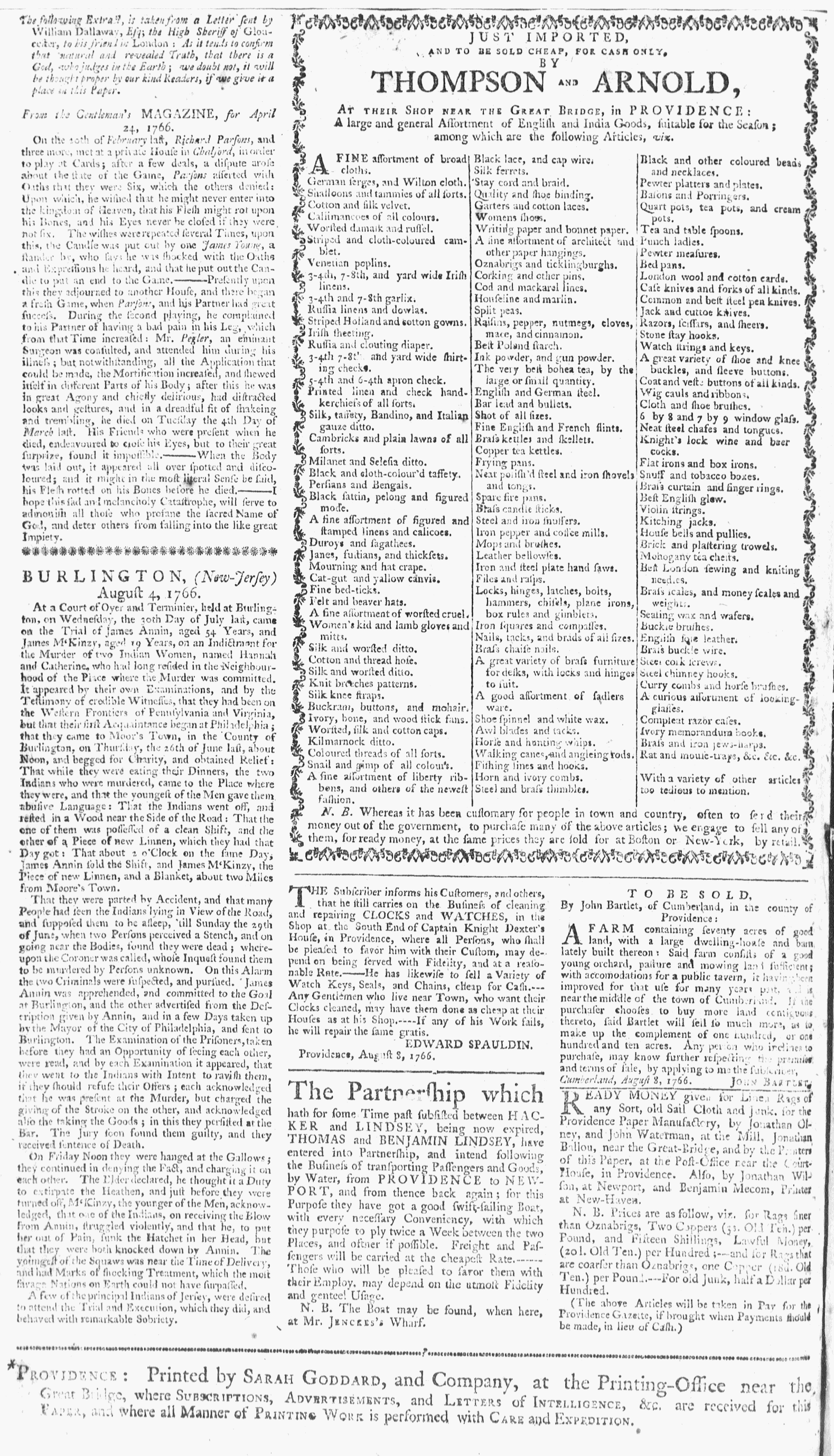
Rather than examine a single advertisement, today’s entry explores the day-to-day operations of the printing trade by examining the advertisements and news items that appeared in the final pages of two consecutive issues of the Providence Gazette: August 23 and 30, 1766. At a glance, these two pages look nearly indistinguishable from each other, thanks in part to the way that Thompson and Arnold’s oversized advertisement draws the eye. But it is not merely the repetition of that particular advertisement that creates the perception of two nearly identical pages. In addition, all five advertisements in the August 30 issue were repeated from in the same configuration that they appeared in the August 23 issue. Finally, the Providence Gazette’s colophon runs across the bottom of each page. New content appeared only in the first column: an extract from the Gentleman’s Magazine and a report about a trial and execution in New Jersey had been replaced with reports of bandits in western Massachusetts and slaves attaching their masters in New Hampshire.
Providence Gazette (August 23, 1766).
Here we see that printing advertisement offered several advantages to the men and women who printed newspapers. Not only did these notices generate revenue, once set in type they also streamlined the production of newspapers from week to week. In an age when all type was set by hand, printers benefited from inserting advertisements for multiple weeks. In most instances individual advertisements moved around the page, though it is clear from their format that the type had not been reset. Today we see a more extreme example: none of the advertisements moved at all. For the ease of the printer, they likely stayed in the form, reducing the amount of time and labor necessary to produce the new issue.
The following week the first column of the final page of the Providence Gazette once again included new content, as did the second and third columns on the upper third of the page, but Thompson and Arnold’s oversized advertisement had been shifted to the bottom. The printer once again benefited from reprinting content that subscribers expected to see more than once in their newspapers. At the same time, the printer realized that she could not be too repetitive or risk alienating readers who also demanded new content and desired the “freshest advices, foreign and domestic.”
What was advertised in a colonial American newspaper 250 years ago today?
Georgia Gazette (August 13, 1766).
“BLank bonds, bills of sale, mortgages, powers of attorney, bonds of arbitration, indentures, bills of lading …”
Like other colonial newspapers, the Georgia Gazette consistently ended with a colophon that gave the particulars concerning publication: it was printed “by JAMES JOHNSTON, at the Printing-Office in Broughton-Street” in Savannah. Also like other colonial newspapers, the colophon announced a variety of printed goods for sale. Johnston solicited advertisements and subscriptions for the Georgia Gazette, but he supplemented that revenue with job printing: “Hand-Bills, Advertisements, &c. printed at the shortest Notice.”
Regular readers may have grown accustomed to seeing the colophon and largely ignored its contents. It would have been harder to skip over this advertisement, strategically positioned as the final item in the final column on the final page (and immediately above the colophon). Whether reading the advertisements intensively or merely skimming over them, this one would have left a lasting impression among most readers thanks to its placement on the page.
The “&c.” (an eighteenth-century abbreviation for et cetera) in the colophon covered an array of printed items, but Johnston elaborated on them in this advertisement. In total, he listed a dozen kinds of printed blanks, forms intended to streamline a variety of economic transactions and legal interactions. Even this extensive list, however, ended with another “&c.” Blank forms, whether printed or online, are part of everyday life in the twenty-first century, but this advertisement suggests that colonial Americans were not strangers to filling out, handling, and reading forms themselves. It also indicates that the work done by printers facilitated diverse commercial and legal activities as their printed blanks passed from person to person within and beyond their communities.
What was advertised in a colonial American newspaper 250 years ago this week?
Newport Mercury (August 11, 1766).
“DIRECTIONS for making calcined or PEARL ASHES.”
Advertisements associated with the potash industry appeared quite regularly in colonial newspapers. Some advertisers wanted to buy it, offering a good price in exchange for potash. Others supplied some of the equipment, such as oversized kettles, necessary for producing potash. Although not necessarily directly involved in potash production, printers also published advertisements that indicated they stood to profit from it all the same. Some sold “Justices Blank Certificates” used in the packing and regulation of potash, while others peddled instruction manuals to those who wanted to participate in the industry or improve on their previous efforts.
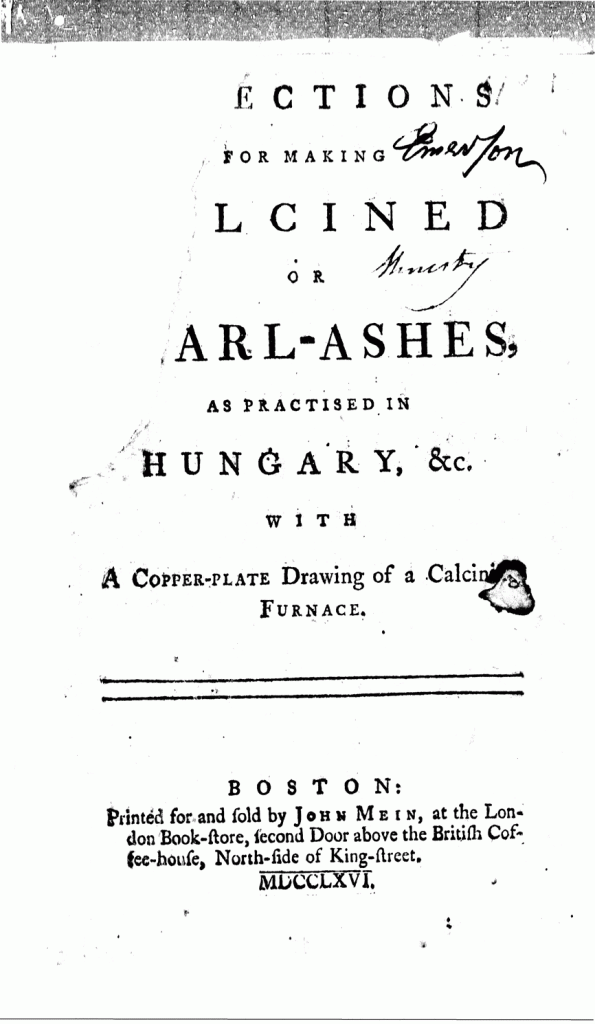
Such was the case with a short pamphlet (less than twenty pages) devoted to “DIRECTIONS for making calcined or PEARL ASHES, As practised in Hungary, &c.” Samuel Hall, the printer of the Newport Mercury, sold the pamphlet at his shop “on the North Side of the Parade,” but the imprint on the pamphlet itself indicated that it was “Printed for and sold by JOHN MEIN, at the London Book-store” in Boston. Both printers (and quite likely others throughout New England that exchanged stock with Mein) looked to make a profit from indirect involvement in the potash trade through the sale of ancillary products.
Directions for Making Calcined or Pearl Ashes, as Practised in Hungary, &c. with a Copper-plate Drawing of a Calcining Furnace (Boston: John Mein, 1766). Boston Public Library.
Both the advertisement and the title page of the pamphlet underscored that it included “a Copper-Plate Drawing of a calcined Furnace.” This would have certainly increased the expense of producing the pamphlet and, ultimately, the cost to the customer, but such an investment could be readily justified. The accompanying image likely offered valuable insight into the text, making it more comprehensible. Art historian Nancy Siegel has argued that engraved images that accompanied eighteenth-century cookbooks were imperative in demonstrating the meaning of the text to readers. The same would have been true for an instruction manual detailing equipment and processes for producing potash, especially for readers not already well versed in the subject. After all, the directions in the pamphlet were “founded on the most extensive Knowledge of Pearl Ashes—a Knowledge acquired by long Practice, Experience and Success. The advertisement warned readers that this was “the only Means to establish Matters of Fact.” It concluded by jeering that “plausible Theories” were “little better than ingenious Amusements.”
In other words, both the text and the engraved copperplate drawing merited attention from anybody serious about potash production. Both were worth the expense.
What was advertised in a colonial newspaper 250 years ago today?
New-Hampshire Gazette (July 4, 1766).
“We beg such Delinquent Customers would reflect upon their extreme Ill usage of us.”
Daniel Fowle and Robert Fowle, “THE Printers of this Paper,” meant business. They were exasperated with subscribers and advertisers who refused to pay their bills. To demonstrate that they were not going to put up with such “Arrearages” any longer, they placed this advertisement in a prominent location in their newspaper. It appeared at the top of the final column on the third page, the very last item readers encountered when scanning the interior of a broadsheet folded in half to create a four-page newspaper. In length, it extended halfway down the page. This was valuable space that the printers could have given over to advertising (assuming said advertisers actually paid their bills), but Fowle and Fowle determined that calling in debts was the better investment.
Fowle and Fowle offered a valuable service at a low price – “the most material Foreign and Domestick Intelligence carried with very trifling Expence” – and they expected to be compensated in a timely manner. Credit was an important part of the colonial economy, but the printers were more than generous in extending credit to their patrons. Some subscribers had fallen behind “three, four, five, six, seven, eight and nine Years.” As a result, the printers threatened to sue “delinquent Customers for News Papers, Advertisement, &c.” if those customers did not settle their accounts. The printers even arranged a series of meetings in the towns where they distributed their newspapers. It was not necessary for subscribers to visit their printing office in Portsmouth. The printers were willing pay the necessary expenses to come to them, if only they would pay their bills.
Benjamin Franklin famously made such a fortune as a printer that he was able to retire at a relatively young age to pursue a variety of other vocations. This advertisement demonstrates that other printers experienced challenges to achieving such success.
What was advertised in a colonial newspaper 250 years ago today?
New-Hampshire Gazette (June 20, 1766).
“To be Sold by the Printers.”
Eighteenth-century printers earned their living by offering a variety of services, as this short advertisement indicates. Publishing the New-Hampshire Gazette was not Daniel Fowle and Robert Fowle’s sole occupation in 1766. If they earned any profit at all from selling subscriptions, it was likely rather small. The important revenues from publishing newspapers came from the advertisements (which helps to explain why printers often gave over so much of the space in colonial newspapers to advertising rather than news or, on occasion, supplied half sheet supplements filled almost exclusively with commercial notices).
In this advertisement, the Fowles announced another branch of printers’ craft: printed blanks. Today such items are better known as blank forms. To record exchanges or legal transactions that took place so regularly that they were standardized, customers could purchase blank forms with boilerplate language. That meant that they did not have to start each new document from scratch with a quill pen. Printed blanks were convenient and saved time, making them a popular product. Often newspaper colophons indicated that the publishers printed the newspaper itself, standalone advertisements, and blanks, suggesting that the printed blanks were a significant part of their operations and revenues.
Some colonial printers also sold books, often imported books or imprints they exchanged with their counterparts in the colonies. Printing a book was a massive undertaking. Considering the time, effort, and capital required for newspapers, advertisements, printed blanks, and other job printing, printers who sold books tended to sell as many or more books printed by others than books that came off their own presses
This advertisement helps to demonstrate the various activities that took place in an eighteenth-century printing shop. Most printers did not specialize in one type of job. Instead, they generated revenues in multiple ways.