
What was advertised in a colonial American newspaper 250 years ago today?
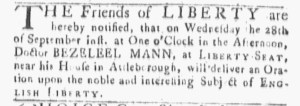
“An Oration upon the noble and interesting Subject of ENGLISH LIBERTY.”
An advertisement in the September 3, 1774, edition of the Providence Gazette advised the “Friends of LIBERTY” of an upcoming “Oration upon the noble and interesting Subject of ENGLISH LIBERTY” to be given by “Doctor BEZELEEL MANN, at LIBERTY SEAT, near his House in Attleborough,” Massachusetts, at the end of the month. Just days before the delegates to the First Continental Congress commenced their meetings in Philadelphia, the doctor announced his intention to expound on some of the ideas that had inspired representatives from throughout the colonies to gather to discuss how to respond to the Coercive Acts.
John Carter, the printer of the Providence Gazette, did his part to promote the lecture. He did not merely generate revenue from publishing the notice but instead gave it a privileged placed in his newspaper. It appeared following local news from the Providence area, including coverage of recent town meetings, and immediately after the shipping news and death notices that regularly marked the end of the news and the beginning of advertising. Carter could have chosen from among nearly twenty advertisements to place there, but he seems to have privileged one that reiterated the political sentiments and sense of alarm expressed in so much of the news he selected to print or reprint from other newspapers on the first several pages of that edition. Even if readers did not closely examine all the advertisements, they were more likely to notice the first one that followed the news. Throughout the colonies, newspaper printers frequently adopted this strategy of treating advertisements like news by placing them immediately after news coverage.
The advertisement for Mann’s lecture also resonated with Carter’s notice that he published an American edition of English Liberties, or the Free-born Subject’s Inheritance. It made its second appearance on the final page of the September 3 edition of the Providence Gazette, having initially run as the first item on the front page a week earlier. In both instances, advertisements as well as news and letters expressed an editorial position, both in terms of their content and their position on the page. In addition, they directed readers to more ways to imbibe the rhetoric of resistance that ultimately became revolution.