February 18

What was advertised in a colonial American newspaper 250 years ago today?

Feb 18 - 2:18:1768 New-York Journal
New-York Journal (February 18, 1768).

“All those that really have the Welfare of their Country at Heart, are desired to consider seriously, the Importance of a Paper Manufactory to this Government.”

The Townshend Act assessed new taxes on all sorts of imported paper. When it went into effect on November 20, 1767, many colonists vowed to encourage and purchase domestic manufactures, especially paper, as a means of resisting Parliament overreaching its authority. Calls for colonists to collect linen rags and turn them over to local papermakers, not uncommon before the Townshend Act, took on a new tone once the legislation went into effect.

The “Manufacturers of PAPER at Milton” in Massachusetts placed an advertisement in the Boston-Gazette in late November 1767. In it, they addressed “All Persons dispos’d in this Wat to encourage so useful a Manufacture.” The “Manufacturers” aimed to collect enough rags quickly enough to replenish the “large Quantities of Paper” that “fortunately arriv’d from Europe before the Duties could be demanded.” Ultimately, the “Manufacturers” wished to produce so much paper that colonists would never have to purchase imported paper again (and thus avoid paying the new taxes), but that required the cooperation of consumers participating in the production process by saving their rags for that purpose.

In January 1768, Christopher Leffingwell placed a similar advertisement in the New-London Gazette. He issued a call for “CLEAN LINEN RAGS” to residents of Connecticut, calling collection of the castoffs “an entire Saving to the COUNTRY.” He encouraged “every Friend and Lover” of America to do their part, no matter how small. Leffingwell suggested that producing paper locally benefited the entire colony; the economy benefited by keeping funds within the colony rather than remitting them across the ocean as new taxes. With the assistance of colonists who collected rags, Leffingwell could “supply them with as good Paper as is imported from Abroad, and as cheap.”

John Keating joined this chorus in February 1768. In an advertisement in the New-York Journal he even more explicitly linked the production and consumption of paper to the current political situation than Leffingwell or the “Manufacturers of PAPER at Milton.” He opened his notice by proclaiming, “All those that really have the Welfare of their Country at Heart, are desired to consider seriously, the Importance of a Paper Manufactory to this Government.” Purchasing paper made in America represented a double savings: first on the cost of imported paper and then by avoiding “a most arbitrary and oppressive Duty” that “further drain’d” the colony of funds that would never return.

Keating acknowledged that collecting rags might seem small and inconsequential, yet he assured colonists that collectively their efforts would yield significant results. He recommended that they cultivate a habit of setting aside their rags by hanging a small scrap in a visible place “in every House” as a reminder. Readers who followed that advice transformed domestic spaces into political venues; otherwise mundane actions took on political meaning as both members of the household and visitors noticed clean linen rags hung as reminders to encourage domestic production and consumption. In the end, Keating predicted that this “would have the desired Effect, and supply us with Paper at home sufficient for our own Use … whereas now we are obliged to send Money abroad, not only to pay for Paper at a high Price, but an oppressive Duty upon it into the Bargain.” Keating not only advanced a “Buy American” campaign but also encouraged colonists to participate in the production of domestic manufacturers for the common good.

January 22

What was advertised in a colonial American newspaper 250 years ago today?

Jan 22 - 1:22:1768 New-London Gazette
New-London Gazette (January 22, 1768).

“CLEAN LINEN RAGS.”

Christopher Leffingwell used his advertisement in the January 22, 1768, edition of the New-London Gazette to promote the “Quantity of coarse and fine Writing, Printing and Wrapping PAPER” he manufactured, but he simultaneously issued a call for readers to supply him with the rags he needed to produce more paper. Purchasing and producing paper amounted to more than mere commerce. These were political acts in the wake of the Townshend Act imposing new duties on imported paper the previous November.

Leffingwell made that apparent. He described handing over rags to local paper manufacturers as “an entire Saving to the COUNTRY.” He opined that “every Friend and Lover” of America should deliberately and vigorously participate in such an endeavor. They should “readily save every Scrap,” including the smallest rags, that came into their possession with the intention of turning them over to him to be made into paper that would reduce the colony’s dependence on imported paper being taxed by Parliament. Leffingwell paid for the rags he received, acknowledging that “the Price given for them, may to some seem very small.” That attitude, he cautioned, did not recognize the greater purpose. By working together to bolster the production of paper in Connecticut, colonists contributed to “the whole Saving” that became “very considerable.” As Lessingwell “paid in Cash” for rags collected by his neighbors and, in turn, they purchased the paper he manufactured from those rags, they collectively advanced the local economy. They made their colony less dependent on goods imported from Britain while also avoiding sending local cash across the Atlantic as payment of the new taxes from the Townshend Act. Lessingwell’s decision to buy up as many rags as possible, laying out “£. 100 lawful Money” so far, had resulted in saving the same amount which “otherwise might have been entirely lost.” In return for his assistance to the economic welfare of the colony, he requested that readers reward him by continuing to supply him with rags as well as purchasing the paper those rags produced. Leffingwell provided a means for colonists of all backgrounds to engage in resistance to Parliament.

“If the People will furnish me with a sufficient Stock of fine white Rags (which they may easily do) it will enable me to supply them with as good Paper as is imported from Abroad, and as cheap,” Leffingwell proclaimed. Everyone benefited from this scenario. Paper and rags, production and consumption, all took on political significance as Leffingwell challenged colonists to consider the meanings attached to some of the most mundane items they encountered in their daily lives.

March 6

What was advertised in a colonial American newspaper 250 years ago today?

mar-6-361767-new-hampshire-gazette
New-Hampshire Gazette (March 6, 1767).

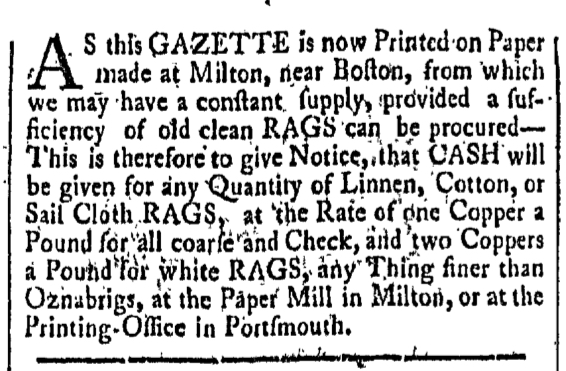
“CASH will be given for any Quantity of Linnen, Cotton, or Sail Cloth RAGS.”

Printers regularly issued calls for rags in their newspapers throughout the eighteenth century. Most were brief, consisting of just a few lines announcing “cash for rags.” Others, like today’s advertisement, were more extensive, specifying which types of rags were desired and the prices awarded for each.

The shorter advertisements often flummox my students. The longer ones, on the other hand, provide sufficient context for figuring out why printers in early America so valued rags, one of the most important raw materials for creating the supplies they needed to pursue their trade. Encountering such notices provides wonderful opportunities for discussing how we are removed from the eighteenth century in a variety of ways.

First, we live in a world in which most paper we use was manufactured from wood pulp. Most students have not even conceived of an alternative prior to reading advertisements in the New-Hampshire Gazette and other newspapers from colonial and Revolutionary America. Here it becomes important to note that even though students are reading these advertisements, they are consulting digital surrogates to do so, keeping them removed from the eighteenth century in important ways even as they seek to better understand the period. Although they have access to the text printed in newspapers – and can even see its format and layout on the page thanks to digital images that provide more than mere transcriptions – they do not actually touch any of the pages from the original publication. In the absence of the material text they miss out on the tactile sensations that would provide clues that paper production has significantly changed in the past quarter millennium.

The more extensive calls for rags also demonstrate how we are removed from the language of consumer culture so fluently spoken in the eighteenth century. Today’s advertisement advised that “CASH will be given for any Quantity of Linnen, Cotton, or Sail Cloth RAGS, at the Rate of one Copper a Pound for all coarse and Check, and two Coppers a Pound for white RAGS, any Thing finer than Oznabrigs.” The printers assumed that readers could identify the many different kinds of fabrics used in early America and advertised for sale elsewhere in their newspapers. They assumed that readers could make distinctions among them, such as determining which were “finer than Oznabrigs.” Although today’s notice did not attempt to sell any goods or services it depended in part on familiarity with consumer culture.

December 28

What was advertised in a colonial American newspaper 250 years ago this week?

dec-28-12271766-new-york-journal-supplement
Supplement to the New-York Journal (December 27, 1766).

“A Variety of Books and Stationary.”

Like many other colonial American printers, John Holt inserted his own advertisements into the newspaper he published. The two-page supplement to the New-York Journal from December 27, 1766, for instance, included three advertisements for “the Printing-Office near the Exchange.” None of them included Holt’s name, but that may have been less important than providing sufficient direction for current and prospective customers to make their way to Holt’s printing shop. Besides, many readers likely would have already known Holt as “the Printer at the Exchange.” For those who did not, the masthead of regular issues of the New-York Journal proclaimed that it was “PRINTED AND PUBLISHED BY JOHN HOLT, NEAR THE EXCHANGE.”

Each of Holt’s advertisements in the December 27 issue addressed a different aspect of his business. One attempted to drum up new business, succinctly announcing “A Variety of Books and Stationary, to be sold at the Printing-Office near the Exchange.” Between subscriptions and advertisements, publishing the New-York Journal generated revenue, but Holt, like many others in his occupation, also acted as bookseller. This yielded an additional flow of income to keep the entire operation running.

dec-28-12271766-ad-2-new-york-journal-supplement
Supplement to the New-York Journal (December 27, 1766).

Another advertisement solicited supplies necessary for the New-York Journal to continue publication. “READY MONEY,” it announced, “given for clean Linen RAGS, of any Kind, at the Printing-Office near the Exchange.” Printers throughout the colonies frequently placed such notices. They printed their newspapers on paper made of linen. Rags were essential to their business; they were recycled and reused as paper. Holt placed this particular advertisement in the upper right corner of the second page. Except for the masthead, it included the largest font in that issue, increasing the likelihood that readers would see and take note of it.

dec-28-12271766-ad-3-new-york-journal-supplement
Supplement to the New-York Journal (December 27, 1766).

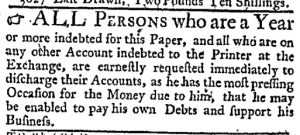
Holt’s third advertisement addressed prior operations of his business as well as its future. In the final issue of the New-York Journal for 1766, he called on former customers to settle accounts: “ALL PERSONS who are a Year or more indebted for this Paper, and all who are on any other Account indebted to the Printer at the Exchange, are earnestly requested immediately to discharge their Accounts.” Once again, similar notices appeared in newspapers printed throughout the colonies. Subscribers notoriously fell behind in paying for their newspapers. Printers extended credit for subscriptions, advertisements, and job printing of various sorts as well as the books and stationery they sold. In designing the layout for this supplemental issue, the crafty Holt placed this advertisement second, immediately after a notice listing the winning numbers for a recent lottery. He may have hoped to capture readers’ attention as they eagerly examined nearly two columns of winning tickets and moved directly to the next item.

The December 27 supplement of the New-York Journal included relatively little news. Of its six columns, only the third and fourth were given over to news items. Holt devoted the remainder of the supplement to advertising, including three advertisements that either promoted his own printing shop or saw to its general maintenance.

August 10

What was advertised in a colonial American newspaper 250 years ago this week?

Aug 10 - 8:9:1766 Providence Gazette
Providence Gazette (August 9, 1766).

“READY MONEY given for Line Rags of any Sort, old Sail Cloth and Junk.”

Printers regularly inserted calls for rags (intended to be used in making paper) in their newspapers, but this appeal was much more extensive than most that appeared during the eighteenth-century.

The proprietors of the Providence Paper Manufactory accepted “Linen Rags of any Sort, old Sail Cloth and Junk.” Furthermore, they listed the prices they would give for each item, even dividing the rags between those “fine than Oznabrigs” and others “coarser than Oznabrigs.” In the process, they also used terminology that would have been familiar to eighteenth-century readers. Colonists would have readily recognized “Oznabrigs” as a type of coarse and plain fabric and “Junk” as old rope that was beyond its usefulness.

The advertisement listed several locations where readers could exchange “Linen Rags of any Sort, old Sail Cloth and Junk” for “READY MONEY.” They could visit the printers or the proprietors of the “Paper Manufactory” in Providence as well as Jonathan Wilson in Newport or another printer, Benjamin Mecom, in New Haven.

Finally, the advertisement concluded with an interesting proposition for subscribers to the Providence Gazette. The rags, sail cloth, and junk could be exchanged for the newspaper itself, as payment “in lieu of Cash.” This established an interesting relationship between the printer of the Providence Gazette and subscribers who traded in their rags. Eventually those subscribers could expect those rags to be returned to them, transformed into linen paper with news and advertisements printed on it.

When it came to paper, the cycle of advertising and consumption in colonial America had a far reach. A colonist could see an advertisement for textiles and make a purchase. After using and wearing out those textiles, he or she could hand them over to the Providence Paper Manufactory or the printers of the Providence Gazette in exchange for more newspapers with additional advertisements for textiles that could be purchased to replace those that had been reduced to rags. At some point in the cycle, colonists could read advertisements for textiles they would purchase printed on linen paper made from textiles that had previously worn or possessed.

February 1

GUEST CURATOR:  Maia Campbell

What was advertised in a colonial newspaper 250 years ago this week?

Feb 1 - 1:31:1766 New-London Gazette
New-London Gazette (January 31, 1766)

CASH is given for clean Linen RAGS, Old Sail-Cloth and Junk, at the Printing-Office in New-London.”

What struck me about this advertisement is the need expressed by the New-London Printing-Office for “Linen RAGS, Old Sail-Cloth and Junk.” At first glance, it might seem perplexing that the New-London Printing-Office would be interested in acquiring such objects. However, during the colonial time period these objects were directly associated with the printing universe. In opposition to paper today that is made from wood, all of these types of items would be used in the composition of the paper used for the newspaper. Junk most likely refers to scrap rope that would be used along with the rags and old sail-cloth.

Also, the New-London Printing-Office could attract a surplus of “Old Sail-Cloth.” New London, Connecticut, was a sea town, making it easy for sailors to give their unneeded materials to the New-London Gazette.

I was intrigued by this clever and efficient way to use old cloth instead of simply disposing of it.

**********

ADDITIONAL COMMENTARY:  Carl Robert Keyes

I have previously passed over similar advertisements dozens of times when I made my selections about which to feature. I didn’t think that there was much especially interesting or noteworthy about printers’ ubiquitous call for rags. Maia helped me to realize why this advertisement merits a second glance and further examination.

I work with eighteenth-century newspapers on a regular basis. I am accustomed to both their appearance and the way they feel in my hands. I also know a little bit more about the histories of printing and papermaking in early America than the average person off the street.

But for Maia and the other students in my Public History class, this is all new! This advertisement presented an opportunity to talk about the origins of the materials that printers used, including paper made from rags rather than wood (a transition that did not take place until well into the nineteenth century). Just as eighteenth-century newspapers look a bit different than their twenty-first-century counterparts, they were created from different materials.

This advertisement also prompted us to talk about eighteenth-century lexicon versus modern meanings of words. I suggested to Maia, based on context in the advertisement, that “Junk” likely referred to other textile scraps. I was close, but further research revealed that “Junk” meant “an old rope” in the eighteenth century, at least according to the Royal Standard English Dictionary published in 1788.[1]

**********

[1] William Perry, Royal Standard English Dictionary (Worcester, MA: Isaiah Thomas, 1788), 313.