September 21

What was advertised in a revolutionary American newspaper 250 years ago today?
New-England Chronicle (September 21, 1775).

“Uneasiness arising in the minds of people from the conduct of myself and family upon the fast day.”

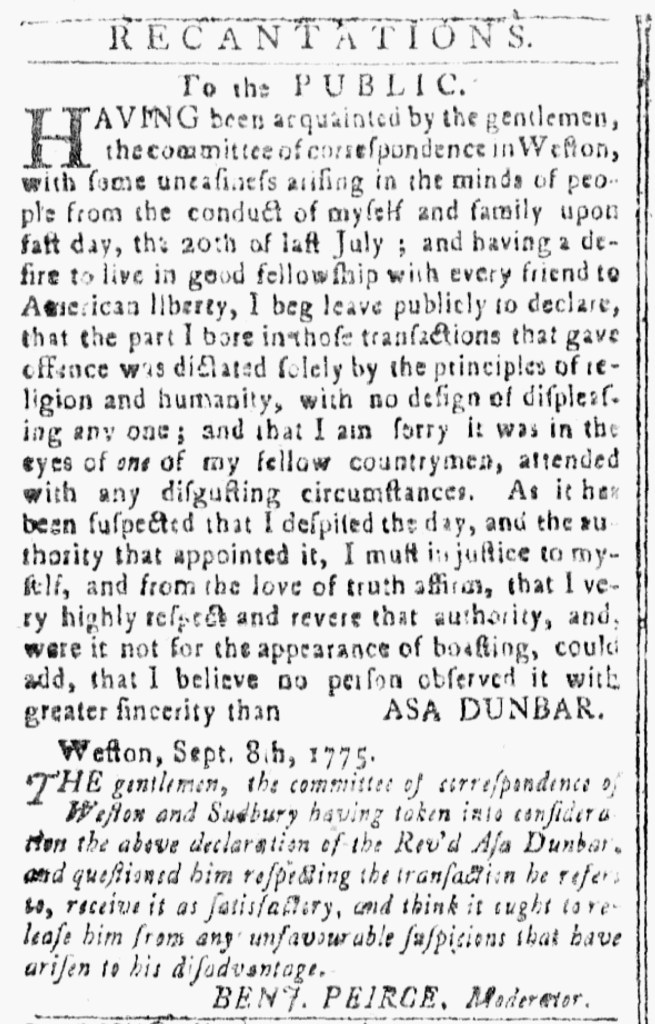
The final page of the September 21, 1775, edition of the New-England Chronicle had an entire column of “RECANTATIONS.”  Five notices appeared under that header, four of them colonizers who expressed regret for signing an address to Thomas Hutchinson, the former governor of the colony, in February 1774.  Such advertisements had become a regular feature in newspapers published in New England over the past year.  In the first of the “RECANTATIONS,” however, Asa Dunbar, a minister in Salem, apologized for something else that had caused concern in his community.

He had been “acquainted by the gentlemen, the committee of correspondence in Weston” about “some uneasiness arising in the minds of people from the conduct of myself and family upon the fast day, the 20th of last July.”  Katherine Carté, author of Religion and the American Revolution: An Imperial History, explains that on June 12 the Second Continental Congress passed a resolution to declare the fast on July 20, allowing for enough time for the news to reach distant colonies from Philadelphia.  The fast day became, Carté asserts, “in effect our first national holiday.”  Furthermore, it “was probably one of the only moments of the Revolutionary War that Americans experienced simultaneously, though not everyone celebrated it.  In a short essay, “Why We Should Remember July 20, 1775,” she chronicles commemorations of the fast day throughout the colonies, noting that many embraced the occasion and a few “marked it in protest.”

Something happened that day that cast suspicion on Dunbar and his support for the American cause: “I beg leave publicly to declare, that the part I bore in those transactions that gave offence was dictated solely by the principles of religion and humanity, with no design of displeasing any one.”  Whatever had occurred, the minister had not intended to make a statement, unlike Samuel Seabury who had “closed the doors of his church in protest” on the day of the fast.  “As it has been suspected that I despised the day, and the authority that appointed it,” Dunbar proclaimed, “I must in justice to myself, and from the love of truth affirm, that I very highly respect and revere that authority.”  Furthermore, “were it not for the appearance of boasting, [I] could add, that I believe no person observed it with greater sincerity.”

A short note from Benjamin Peirce, the moderator of Weston and Sudbury’s Committee of Correspondence, accompanied Dunbar’s recantation.  He reported that the committee took into account Dunbar’s “declaration” and “questioned him respecting the transaction he refers to,” but he did not elaborate on that transgression.  Whatever had occurred, the committee considered Dunbar’s explanation “satisfactory, and think it ought to release him from any unfavourable suspicions that have arisen to his disadvantage.”  That must have been a relief to Dunbar.  Like so many others, he resorted to an advertisement in the public prints to confess, to apologize, and to assure his community that he was not an enemy to American liberties.
August 28

What was advertised in a revolutionary American newspaper 250 years ago today?

Boston-Gazette (August 28, 1775).

“Impress’d with a sense of the prejudice and injury I have done my country, humbly ask their forgiveness.”

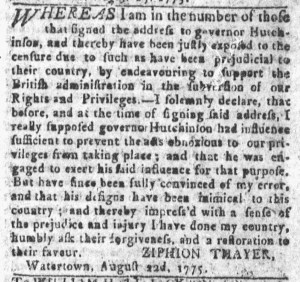
It was yet another apology for signing an address to Thomas Hutchison when General Thomas Gage replaced him as governor of Massachusetts and he departed for England.  This time Ziphion Thayer lamented his error in an advertisement in the August 28, 1775, edition of the Boston-Gazette, published in Watertown as the siege of Boston continued.  Thayer acknowledged that he signed the address and “thereby have been justly exposed to the censure due to such as have been prejudicial to their country, by endeavouring to support the British administration in the subversion of our Rights and Privileges.”  As others indicated in their own apology-advertisements, signing the address came with consequences.  The “censure” that Thayer experienced likely included other colonizers refusing to engage with him socially or in business.

For a time, many signatories who published apology-advertisements claimed that they had affixed their names in haste without reading carefully or fully considering the full implications of the address.  More recently, however, others explained that they signed because they thought at the time that Hutchinson had the power to protect them from the “Vengeance of the British Ministry” and an inclination to advocate for American liberties.  “I solemnly declare, that before, and at the time of signing said address,” Thayer claimed, “I really supposed governor Hutchinson had influence sufficient to prevent the acts obnoxious to our privileges from taking place; and that he was engaged to exert his said influence for that purpose.”

Things certainly did not work out that way, leading Thayer to declare that he had “since been fully convinced of my error” and now realized that Hutchinson’s designs “have been inimical to this country.”  Did Thayer have an authentic conversion?  Or did he merely say what others wanted to hear so he could return to his former standing in his community?  William Huntting Howell contends that the authenticity of such apology-advertisements mattered much less to Patriots than the “rote expression of allegiance” in the public prints.[1]  Thayer asserted that he became “impress’d with a sense of the prejudice and injury I have done my country” and, accordingly, he “humbly ask[ed] their forgiveness, and a restoration to their favour.”  Whether or not Thayer truly believed the former, he wanted the latter and likely believed that his apology-advertisement would help convince others to overlook what he had done.

**********

[1] William Huntting Howell, “Entering the Lists: The Politics of Ephemera in Eastern Massachusetts, 1774,” Early American Studies 9, no. 1 (Winter 2011): 215-6.

August 15

What was advertised in a revolutionary American newspaper 250 years ago today?

Pennsylvania Evening Post (August 15, 1775).

“I will, for the future, conduct myself as a true friend to America.”

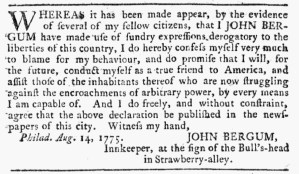
It was another confession accompanied with an apology.  John Bergum, an “Innkeeper, at the sign of the Bull’s-head in Strawberry-alley” in Philadelphia, acknowledged his infraction and promised that he had reformed.  Such items had been appearing among the advertisements in newspapers in Massachusetts for some time.  For the past year, colonizers who signed an address to the former governor, Thomas Hutchinson, when he departed for England had reconsidered their position … or been pressured into recanting by Patriots who did not care for their Tory stance.  More recently, similar advertisements appeared in newspapers outside of New England, especially after hostilities commenced at Lexington and Concord in April 1775.

Bergum inserted his advertisement in the August 15, 1775, edition of the Pennsylvania Evening Post.  “WHEREAS it has been made appear, by the evidence of several of my fellow citizens,” he declared, “that I JOHN BERGUM have made use of sundry expressions derogatory to the liberties of this country, I do hereby confess myself very much to blame for my behaviour.”  Bergum did not reveal any of those “sundry expressions” but instead focused on assuring the public that he would not utter anything like them again.  He promised, “I will, for the future, conduct myself as a true friend to America, and assist those of the inhabitants thereof who are now struggling against the encroachments of arbitrary power, by every means I am capable of.”  Bergum claimed would comport himself as a Patriot in both word and deed as the crisis continued to consume the colonies.

“I do freely, and without constraint,” the innkeeper added, “agree that the above declaration be published in the newspapers of this city.”  That made it sound like someone else had a hand in convincing Bergum of his error and running the advertisement.  William Huntting Howell posits that local Committees of Safety in Massachusetts pressured signatories of the address to Hutchinson into public confessions that concluded with an endorsement of the Patriot position.  The wording in Bergum’s advertisement – “I do freely … agree that the above declaration be published in the newspapers” – suggests that maybe he had an encounter with a local committee that convinced him that it was in his best interests to recant his previous statements and pledge his support in defending “the liberties of this country.”

June 22

What was advertised in a revolutionary American newspaper 250 years ago today?

New-England Chronicle (June 22, 1775).

“I … declare myself a Friend to the Charter Privileges of my Country.”

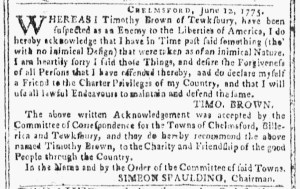
Timothy Brown of Tewksbury, Massachusetts, wanted to return to the good graces of his community in the summer of 1775.  He had fallen out of favor because he had not always supported the American cause with as much fervor as his neighbors wished, so he realized that he needed to apologize and pledge to do better.  To that end, he not only submitted a “written Acknowledgment” to the Committee of Correspondence for the towns of Chelmsford, Billerica, and Tewksbury but also benefitted from the publication of their response in the New-England Chronicle for readers far and wide to see.

“WHEREAS I … have been suspected as an Enemy to the Liberties of America,” Brown confessed, “I do hereby acknowledge that I have in Time past said something (tho’ with no inimical Design) that were taken as of an inimical Nature.”  Like others who had signed an address to Governor Thomas Hutchinson when he departed for England, Brown simultaneously admitted what he had done and attempted to distance himself from it.  He had not intended his words, he claimed, in the way that they had been interpreted, though he understood how whatever he had said had been received.  “I am heartily sorry I said those Things,” Brown lamented, “and desire the Forgiveness of all Persons that I have offended thereby.”  Furthermore, he declared himself “a Friend to the Charter Privileges of my Country” and pledged that he would “use all lawful Endeavours to maintain and defend the same.”

Brown presented that statement in writing to the Committee of Correspondence for Chelmsford, Billerica, and Tewksbury.  In turn, the committee recommended him “to the Charity and Friendship of the good People through the Country.”  Simeon Spaulding, the chairman, published Brown’s acknowledgment of his error and the committee’s response in the New-England Chronicle “In the Name and by the Order of the Committee of said Towns.”  It appeared next to the second insertion of the advertisement that cleared Ebenezer Bradish of attempting “to do any Injury to his Country,” part of a trend of using newspaper advertisements to designate which colonizers once suspected of sympathizing with Tories now expressed support for the Patriot cause.  That the advertisement concerning Brown was inserted in the New-England Chronicle “by the Order of the Committee” suggests that Brown was not the only one to benefit from its publication.  The committee paid for an advertisement to make a public display of Brown falling in line, an example for others who had not yet done so and a testament to the unity they hoped to achieve among colonizers as the imperial crisis became a war of resistance in the spring and summer of 1775.